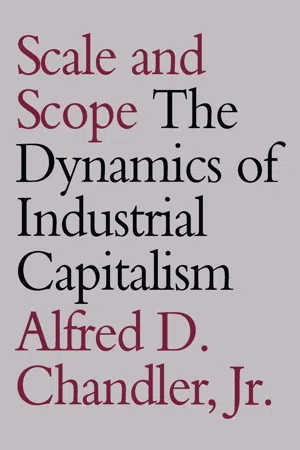
Scale and Scope is Alfred Chandler's first major work since his Pulitzer Prize–winning The Visible Hand. Representing ten years of research into the history of the managerial business system, this book concentrates on patterns of growth and competitiveness in the United States, Germany, and Great Britain, tracing the evolution of large firms into multinational giants and orienting the late twentieth century's most important developments.
This edition includes the entire hardcover edition with the exception of the Appendix Tables.
eBook - ePub
Scale and Scope
The Dynamics of Industrial Capitalism
- 760 pages
- English
- ePUB (mobile friendly)
- Available on iOS & Android
eBook - ePub
Scale and Scope
The Dynamics of Industrial Capitalism
About this book
Information
• I •
Introduction: Scale and Scope
In the last half of the nineteenth century a new form of capitalism appeared in the United States and Europe. Before the coming of modern transportation and communication—that is, before the railroad and the telegraph, the steamship and the cable—the processes of production, distribution, transportation, and communication in capitalistic economies had been carried on by enterprises personally managed by their owners. The number of salaried managers in these enterprises was tiny. And those few managers worked closely with the owners.
The building and operating of the rail and telegraph systems called for the creation of a new type of business enterprise. The massive investment required to construct those systems and the complexities of their operations brought the separation of ownership from management. The enlarged enterprises came to be operated by teams of salaried managers who had little or no equity in the firm. The owners, numerous and scattered, were investors with neither the experience, the information, nor the time to make the myriad decisions needed to maintain a constant flow of goods, passengers, and messages. Thousands of shareholders could not possibly operate a railroad or a telegraph system.
The new forms of transportation and communication, in turn, permitted the rise of modern mass marketing and modern mass production. The unprecedented increase in the volume of production and in the number of transactions led the entrepreneurs who established the new mass-producing and mass-distributing enterprises—like the railroad men before them—to recruit teams of salaried managers. As these enterprises expanded their activities and moved into new markets, the shareholdings of the founding entrepreneurs and their families were dispersed and operating decisions became concentrated in the hands of the managers.
Thus came into being a new economic institution, the managerial business enterprise, and a new subspecies of economic man, the salaried manager. With their coming, the world received a new type of capitalism—one in which the decisions about current operations, employment, output, and the allocation of resources for future operations were made by salaried managers who were not owners of the enterprise. Once modern transportation and communication systems were in place, the new institution and the new type of economic man provided a central dynamic for continuing economic growth and transformation.
• ONE •
The Modern Industrial Enterprise
In an earlier study, The Visible Hand, I investigated the coming of managerial capitalism by examining the evolution of several types of modern business enterprises in a single country, the United States. Here I examine the beginnings and growth of managerial capitalism globally, focusing on the history of its basic institution, the modern industrial enterprise, in the world’s three leading industrial nations.
Of all the new forms of managerial enterprise, the modern industrial enterprise played the most fundamental role in the transformation of Western economies. They had been rural, agrarian, and commercial; they became industrial and urban. That transformation, in turn, brought the most rapid economic growth in the history of mankind. At the center of the transformation were the United States, Great Britain, and Germany, which accounted for just over two-thirds of the world’s industrial output in 1870. Before the coming of the depression of the 1930s they still provided just under two-thirds (Table 1). And the speed with which the output of the United States and Germany surpassed Great Britain, the world’s first industrial nation, was striking.
In each country industrial activities played the central role in transforming an agrarian commercial economy into a modern industrial economy. The significance of industrial output to economic growth has been emphasized by Simon Kuznets, who divides national economies into three basic sectors—agriculture, industry, and services. He subdivides industry, in turn, into mining, manufacturing, construction, utilities (electricity, gas, water), and transportation and communication.1 In all three countries the largest economic growth came in the industrial sector, while agriculture drastically declined in the long run (Table 2). The industrial sector grew significantly in the United States and Germany; in Great Britain the development was slower, but sustained. Just as the industrial sector led the way in economic growth, so industrial growth was concentrated in the manufacturing subdivision (Table 3). And again, growth in manufacturing was more notable in the United States and Germany than in Great Britain. By the twentieth century manufacturing accounted for the largest share of the gross domestic product in the industrial sector in all three economies.
Table 1. Distribution of world’s industrial production, 1870–1938 (in percentages).

The significance of industrial activities can further be illustrated by reference to employment. In the first half of the twentieth century in each of the three countries, industry created more employment opportunities than did either agriculture or service (Table 4). Again, whereas Great Britain experienced only a moderate change of employment structure after the 1880s, the United States, and Germany to a lesser degree, showed a dramatic transformation from an agrarian to a modern economy in which almost half of the employment centered in industry.
Finally, within the manufacturing subdivision the branches that showed the greatest growth in the United States from 1880 to 1948 were those capital-intensive industries in which large manufacturing firms predominated. Data on the growth of these branches, which were compiled by Kuznets for the United States only, are given in Chapter 6.
The manufacturing enterprises whose collective histories are presented in this study—those enterprises that were most responsible for the economic growth of the world’s three largest industrial nations—have provided a fundamental dynamic or force for change in capitalist economies since the 1880s. They remain today at the core of their national economies.2 These enterprises were not just manufacturing firms. They also entered into mining and other activities of the industrial sector, and their hierarchical organizational characteristics resembled those of the other subdivisions of that sector, with the exception of construction, which continued to include more personally managed enterprises. The manufacturers also created both national and international purchasing and distribution networks. Kuznets lists such activities as “trade,” a subdivision of the service sector, and thus his tables somewhat underrepre-sent the significance of industrial enterprises; for the manufacturing firms in the industrial sector were involved in trade far more than the enterprises in the trade subdivision of the service sector were involved in manufacturing. In my view these large manufacturing companies were the prototypes of the modern industrial enterprise.
Table 2. Long-term changes in shares of major sectors in total output, United States, Great Britain, and Germany (in percentages).a

Table 3. Long-term changes in shares of subdivisions of the industrial sector in total output, United States, Great Britain, and Germany (in percentages).

Table 4. Long-term changes in the sectoral distribution of the labor force, United States, Great Britain, and Germany (in percentages).

As a result of the regularity, increased volume, and greater speed of the flows of goods and materials made possible by the new transportation and communication systems, new and improved processes of production developed that for the first time in history enjoyed substantial economies of scale and scope. Large manufacturing works applying the new technologies could produce at lower unit costs than could the smaller works.
In order to benefit from the cost advantages of these new, high-volume technologies of production, entrepreneurs had to make three sets of interrelated investments. The first was an investment in production facilities large enough to exploit a technology’s potential economies of scale or scope. The second was an investment in a national and international marketing and distributing network, so that the volume of sales might keep pace with the new volume of production. Finally, to benefit fully from these two kinds of investment the entrepreneurs also had to invest in management: they had to recruit and train managers not only to administer the enlarged facilities and increased personnel in both production and distribution, but also to monitor and coordinate those two basic functional activities and to plan and allocate resources for future production and distribution. It was this three-pronged investment in production, distribution, and management that brought the modern industrial enterprise into being.
The first entrepreneurs to create such enterprises acquired powerful competitive advantages. Their industries quickly became oligopolistic, that is, dominated by a small number of first movers. These firms, along with the few challengers that subsequently entered the industry, no longer competed primarily on the basis of price. Instead they competed for market share and profits through functional and strategic effectiveness. They did so functionally by improving their product, their processes of production, their marketing, their purchasing, and their labor relations, and strategically by moving into growing markets more rapidly, and out of declining ones more quickly and effectively, than did their competitors.
Such rivalry for market share and profits honed the enterprise’s functional and strategic capabilities. These organizational capabilities, in turn, provided an internal dynamic for the continuing growth of the enterprise. In particular, they stimulated its owners and managers to expand into more distant markets in their own country and then to become multinational by moving abroad. They also encouraged the firm to diversify by developing products competitive in markets other than the original one and so to become a multiproduct enterprise. Industries where the new technologies provided cost advantages of scale and scope came to be operated through the system I have called managerial capitalism. Salaried managers, not owners, came to make the decisions about current operating activities and long-term growth and investment.3 Their decisions determined the ability of their enterprises, and of the industries in which they operated, to compete and grow.
Because this study is the history of a human institution, I focus on the decisions within the institution that led to changes in production and distribution, rather than on changes in the broader economy as indicated by economic statistics—changes that resulted from such decisions. The institutional history told here is the outcome of innumerable decisions made by individual entrepreneurs, owners, and managers. For these decision-makers the choices among alternatives were limited and the outcomes uncertain, but almost always there were choices. Indeed, where they made decisions collectively, the decision-makers disagreed as often as they agreed.
Despite the variability of these individual decisions, taken cumulatively they produced clear patterns of institutional change. In the industries that were being transformed—or in many cases created—by new technologies and expanding markets, individual decisions within an enterprise determined whether it became a major player in the industry, was relegated to a secondary position, or was eliminated altogether. If a firm became a major player, the decisions of its senior managers shaped the ways in which it continued to respond to changing technological innovation, to market demand, to the availability of supplies, and to the more encompassing depressions and global wars. Because in each of the new industries there were only a small number of major players, the responses of their managers often determined the ways in which entire industries and even national economies responded to the changing market, technological, economic, and political environment.
Because the context, that is, the specific situations, in which such decisions were made differed greatly from industry to industry, from country to country, and from one time period to the next, the content of managerial responses differed widely. These responses varied from industry to industry for economic reasons, such as the availability of markets, supplies, capital, and labor—and also because each industry had its own production technologies and distribution requirements. They varied from country to country for cultural reasons. Educational and legal systems affected both the day-to-day operating and long-term strategic decisions: national differences in educational systems influenced the training and recruitment of managers and workers, while national legal systems defined in different ways the basic rules of the game. They varied from one time period to the next for the obvious reason that the technologies, markets, and competition confronting an enterprise and the industries and nations within which it operated differed substantially, often dramatically, in each decade from the 1880s to the 1940s. Obviously, too, the performance of an enterprise and its industry in one decade reflected investments made, personnel hired, technologies adopted, and markets obtained in the previous and earlier decades.
Because there were such major differences among industries, nations, and time periods, historical evidence can easily be found to support almost any set of hypotheses, propositions, or other generalizations concerning the growth and evolution of industries and enterprises. To be valid, historical analyses must be comparative. They must compare the histories of enterprises within the same industry, and then they must compare the collective history of the enterprises within that particular industry with that of other industries in the same nation and also with that of the same industry in other nations. Only such broad-based data can provide the comparisons that indicate common patterns of institutional growth and reveal the impact of cultural, economic, and historical differences on institutional evolution. Such comparisons, in turn, provide the underpinnings for a systematic analysis of the dynamics of modern industrial capitalism.
The first step in writing this institutional history of the modern industrial enterprise was to record the collective histories of individual companies within the same core industries in the world’s three leading industrial nations from their appearance in the last quarter of the nineteenth century until the 1940s. The individual companies studied were the two hundred largest manufacturing firms in each of the three countries at three points in time—during World War I, at the end of the prosperous 1920s, and at the beginning of the post–World War II era. (The specific years chosen differ somewhat among the three countries, for reasons given in the introduction to the appendixes.) These companies are listed in the appendix tables.
The data used are those traditionally used by historians. The information on individual companies has come from a wide variety of sources—company and industry histories; monographs; journal articles and other secondary sources; investment directories such as Moody’s Manual for the United States, the Stock Exchange Year-Book for Great Britain, and the Handbuch der deutschen AktienGesellschaften for Germany; published company and governmental reports; and, for those companies whose histories were most revealing for this study, from archival records. These sources provide information on changing product lines, production processes, shifts in markets, and sources of supply. They also indicate the timing of growth by direct investment, by merger and acquisition, by expansion overseas, and by expansion into new product lines. For nearly all the companies listed they identify the senior decision-makers.
The book is divided into five sections. In Chapter 2 of this first part, I provide a more detailed but still highly generalized description and analysis of the creation and dynamic evolution of the central institution of managerial capitalism—the modern industrial enterprise. I do so by focusing on the similarities in the beginnings and growth of this institution in the three countries over a period of more than six decades. In that chapter are given the definitions, concepts, explanations, and generalizations necessary to make precise comparisons among industries and countries and time periods. These concepts and generalizations are then used to develop an explanatory theory concerning the beginnings and continuing evolution of the modern industrial enterprise. In the concluding section to the volume, I draw together its underlying themes—particularly those that explain the dynamics of industrial capitalism—and then relate these themes to the evolution of the modern industrial enterprise after World War II...
Table of contents
- Cover
- Title
- Copyright
- Acknowledgments
- Contents
- Part I: Introduction: Scale and Scope
- Part II: The United States: Competitive Managerial Capitalism
- Part III: Great Britain: Personal Capitalism
- Part IV: Germany: Cooperative Managerial Capitalism
- Notes
- Credits
- Index
Trusted by 375,005 students
Access to over 1.5 million titles for a fair monthly price.
Study more efficiently using our study tools.
Frequently asked questions
Yes, you can cancel anytime from the Subscription tab in your account settings on the Perlego website. Your subscription will stay active until the end of your current billing period. Learn how to cancel your subscription
No, books cannot be downloaded as external files, such as PDFs, for use outside of Perlego. However, you can download books within the Perlego app for offline reading on mobile or tablet. Learn how to download books offline
Perlego offers two plans: Essential and Complete
- Essential is ideal for learners and professionals who enjoy exploring a wide range of subjects. Access the Essential Library with 800,000+ trusted titles and best-sellers across business, personal growth, and the humanities. Includes unlimited reading time and Standard Read Aloud voice.
- Complete: Perfect for advanced learners and researchers needing full, unrestricted access. Unlock 1.5M+ books across hundreds of subjects, including academic and specialized titles. The Complete Plan also includes advanced features like Premium Read Aloud and Research Assistant.
We are an online textbook subscription service, where you can get access to an entire online library for less than the price of a single book per month. With over 1.5 million books across 990+ topics, we’ve got you covered! Learn about our mission
Look out for the read-aloud symbol on your next book to see if you can listen to it. The read-aloud tool reads text aloud for you, highlighting the text as it is being read. You can pause it, speed it up and slow it down. Learn more about Read Aloud
Yes! You can use the Perlego app on both iOS and Android devices to read anytime, anywhere — even offline. Perfect for commutes or when you’re on the go.
Please note we cannot support devices running on iOS 13 and Android 7 or earlier. Learn more about using the app
Please note we cannot support devices running on iOS 13 and Android 7 or earlier. Learn more about using the app
Yes, you can access Scale and Scope by Alfred D. Chandler Jr.,Alfred DuPont Chandler Jr.,Alfred D. Chandler, Jr. in PDF and/or ePUB format, as well as other popular books in History & Industrial Management. We have over 1.5 million books available in our catalogue for you to explore.