Does exposure to media violence make us more violent? Do stereotypes in the media affect the way we see different social groups? Do media institutions play any role in social change?
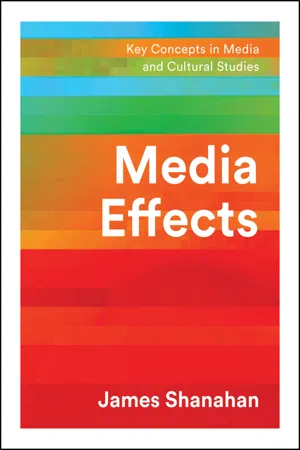
Media Effects is a concise introduction which studies the ways in which media use affects society. James Shanahan explores how researchers and society became interested in media effects, outlines the important developments in the field, and looks at how research on narrative is playing a progressively important role in revealing what we know. The book also provides a timely interweaving of different perspectives, ranging from concerned and critical voices within media studies to quantitative psychological approaches which tend to be more sceptical about powerful media effects.
Concise and authoritative, Media Effects is the go-to text for students and scholars getting to grips with this fascinating and important topic.
- English
- ePUB (mobile friendly)
- Available on iOS & Android
eBook - ePub
About this book
Information
Chapter 1
Introduction
A quick story. In the 1960s, as a child, I was allowed to roam freely around the small city we lived in. My sister and I had bikes, and we could ride them where we chose, with the proviso that we would be back by dinnertime. This was not unusual; all of our friends operated under the same rules. The child-rearing culture of that time allowed parents a great deal of leeway in terms of how much freedom their children should have; children were encouraged to be independent.
In the 1990s, we raised our own daughter differently. If we had let her roam freely around our own small city, at the very same age that I and my sister had done so, our parenting practices would have been seen as irresponsible, and possibly also illegal. Small children were simply not allowed to be left alone; their experiences became much more structured and guided. “Play dates” rather than unsupervised playground interaction became the norm, and an increase in the number of scheduled and programmed activities for children also became more noticeable. The idea of children left to their own devices was no longer acceptable.
In the 30-year interval described above, what happened? One would be tempted to assume that the world had become a more dangerous place in the 1990s, and that parents were reacting protectively to these dangers. However, the facts were that crime rates in the 1960s were not that much different than they were in the 1990s.1 Objectively speaking, children were about as safe from danger in either period.
Many people I have spoken with – who now raise their children in the same protective way we did – express surprise that crime is not worse now than it was 30 years ago. When confronted with the example I describe above, the explanation people usually arrive at, pretty quickly, is that maybe we perceive the world to be more violent than it really is. And once they self-highlight the issue of perception, people then start to think about sources of perceptions. Why do we think this way? In coming around to these thoughts, people often think about the variety of ways in which crime is reported to us, and especially we remember the very awful examples where children have been abducted or killed.
In 1981, 6-year-old Adam Walsh was kidnaped from a store; his body was found several days later. As it took years for his case to be solved, his father John Walsh became an activist for heightening awareness of crimes against children. He started the National Center for Missing and Exploited Children, and also later hosted a television show called America’s Most Wanted. The show was a national sensation, and while it focused not only on child crime, the awareness, and fear, that it created was high. The show came at a time when the power of television to cover crime was increasing, with more cable channels available and the development of a 24-hour news cycle that emphasized sensational and disturbing events as ways to attract ratings attention. In this environment, a national panic over missing children developed (Waxman, 2016).
Of course, any missing or exploited child is a horrible tragedy, but the numbers that were used to generate public fear and concern during this time were far out of line. “The missing children issue subsists on reports repeatedly delivered by both electronic and print media, frequently quoting the figure that 1.5 million children vanish, disappear, or are abducted each year, with implications that stranger or ‘troll-type’ abductions are the greatest concern” (Fritz & Altheide, 1987, p. 477). The scare-numbers were part and parcel of the programs’ ratings success. Scholars have since identified these media misrepresentations as playing an important role in the construction of the social problem and ensuing moral panic, with important effects on how we thought about protecting our own children. The numbers were over-stated. A Pulitzer Prize-winning investigation in the Denver Post2 showed that actual disappearances of the type most feared were quite rare, and that most of the reported numbers were within-family situations or runaways. Without denying the importance of addressing child violence issues as a national problem, the most-dreaded aspect of the issue of disappearing children was over-hyped. It is certainly an instructive example of how media images can affect our most basic perceptions and the cultural practices based on them.
“Media effects”: What are they?
The missing child panic is an illustrative example, but not isolated. In fact, we know in general that media coverage of crime and violence is associated with greater fear among heavy viewers of television, a phenomenon that has been called the “mean world syndrome” (Gerbner & Gross, 1976; Shanahan & Morgan, 1999; Morgan, Shanahan, & Signorielli, 2012). While especially true of television, frequent users of all media are exposed to a relatively heavy diet of violence and mayhem, much more than what they would see in “real life.” Thus, it is not surprising that they also tend to see the world in more violent ways than others:
we have found that one lesson viewers derive from heavy exposure to the violence-saturated world of television is that in such a mean and dangerous world, most people “cannot be trusted” and that most people are “just looking out for themselves” (Gerbner, Gross, Morgan, & Signorielli, 1980). We have also found that the differential ratios of symbolic victimization among women and minorities on television cultivate different levels of insecurity among their real-life counterparts, a “hierarchy of fears” that confirms and tends to perpetuate their dependent status. (Gerbner et al., 1986, p. 28)
While we can postpone the discussion of the causality of these relationships until later in this book, mean-world findings are consistent with the sorts of things that were also going on in the missing child case.
As they develop reasons to account for the differences between reality (the actual statistics) and perception (what they think about reality), people are starting to conceptualize what we call “media effects.” If we begin to see that our perception of reality can be influenced – either positively or negatively – by what we see reported or portrayed in the media, we are then also beginning to explain the importance of the role of media in not just our entertainment but also in our decision-making processes as well. If media can play a shaping role in something as important as how we raise our children, can their power extend to other domains?
*
This book is about a large body of research that deals with this issue. Most of us are likely to agree with the idea that media “matter.” It is not unusual to harbor personal views about media effects, especially in relation to what we see as their damaging consequences. Whether it is in relation to violence in the media, to material we see as dangerous to children (such as content featuring drug use or sexuality), or to media usage practices that are harmful (too much media use, media “addiction”), at most any time there are vigorous debates ongoing about various aspects of the media scene that need reforming.
And it has been ever thus. Society became mass-mediated roughly in the 1830s, which was the time of the introduction of the popular newspapers, then known as the “penny press.” With these and the other new media that were introduced over the years (film, radio, TV, Internet, etc.) came social hand-wringing, moral panic, and more serious research-based concern about the effect of each new medium.
Concerns about media and violence (and other problematic content) have produced many moral debates. Drotner provides an apt summary of how these debates are usually conducted. She, along with many others, has noted that debate about a new medium results in emotional reactions, sometimes verging on panic. In the debate,
the discussion is highly emotionally charged and morally polarized (the medium is either “good” or “bad”) with the negative pole being the most visible in most cases; the discussion is an adult discussion that primarily focuses on children and young people; the proponents often have professional stakes in the subject under discussion as teachers, librarians, cultural critics or academic scholars; the discussion, like a classic narrative, has three phases: a beginning often catapulted by a single case, a peak involving some kind of public or professional intervention, and an end (or fading-out phase) denoting a seeming resolution to the perceived problems in question. (Drotner, 1999, p. 596)
We can see what Drotner is speaking about with a few examples. At the end of the 1800s, attention focused on “dime novels.” Dime novels were cheap serial fiction that were considered to be “low” and of questionable morality by the better segments of society. They were normally sold on newsstands, and were distinguished by their cheap production (hence the term “pulp fiction” sometimes applied to them). The New Medal Library, one such series, described itself as follows:
This is a line of books for boys that is of peculiar excellence. There is not a title in it that would not readily sell big if published in cloth-bound edition at $1.00. One of the best features about these books is that they are all of the highest moral tone, containing nothing that could be objectionable to the most particular parents. Next in importance, comes interest, with which every one of these books fairly teems. No more vigorous or better literature for boys has ever been published. New titles by high-priced authors are constantly being added, making it more and more impossible for any publisher to imitate this line.3
The offerings were action-oriented, highly popular, and often illustrated with garish cover graphics. Moral authority figures questioned whether young people should be exposed to them, and some wondered whether children should be exposed to any fiction at all.
Here is the type of thing – the actual text – that had people worried, from the story Adventures of Buffalo Bill from Boyhood to Manhood:
Instantly Buffalo Bill dashed over the ridge of the hill that concealed him from the view of the Cheyennes, and rode directly toward the band going to attack the two white horsemen.
They halted suddenly at sight of him, but, seeing that he was alone, they started for him with wild yells.
But still he kept on directly toward them, until within range, when he opened upon them with his matchless Evans rifle, a thirty-four-shot repeater, and a hot fight began, for they returned the fire.
This was just what Buffalo Bill wanted, for the firing alarmed the horsemen and placed them on their guard, and he knew that the Indian volleys would be heard at the command and hasten them forward.
Having dropped a couple of red-skins and several ponies, Buffalo Bill wheeled to the rightabout, dashed up to the top of a hill, and, signaling to the two whites to follow him, headed for the command at full speed. (Beadle’s Boys’ Library, 1882)
Conservative elements of society wondered: what would exposure to these types of stories do to impressionable children, and how could society hope to protect against them when they were so popular? Now, of course, these texts that gave so much concern seem hopelessly quaint, having been surpassed by the far more graphic accounts of violence and romance that we see in today’s media. But they were a harbinger of what would come. As media became ever more accessible and vivid, concerns about their effects increased. In the end, there were active efforts to ban certain types of dime novels, but overall not much could be done to stem people’s exposure to them.
The appearance of movies kicked up the level of debate. As films became more popular – dealing with the same themes as dime novels did, but now with moving pictures – research efforts found a considerable number of images of violence in movies, as well as negative effects upon adolescents. The case is instructive, with concern about film rising almost as soon as it started to reach wide audiences in the early 1900s. When it was introduced, film was quite new in terms of the experience that it offered. The riot of image collages and narratives that it made popular could be somewhat un-nerving. Very early films that could be viewed by the public were often just visual records of popular vaudeville-style entertainments, or even things that were naughty or raunchy, such as burlesque dancers. The films appealed to a working-class aesthetic, and brought with them a concern among the well-to-do that films would exert a corrosive social effect. These worries were exacerbated as film develo...
Table of contents
- Cover
- Contents
- Series title
- Title page
- Copyright page
- Figures and Tables
- Preface
- Acknowledgments
- 1 Introduction
- 2 A Narrative Perspective
- 3 Media and Violence
- 4 Media and Social Representation
- 5 Media Use and Social Control
- 6 “New” Media, New Narratives?
- 7 Conclusion
- References
- Index
- End User License Agreement
Trusted by 375,005 students
Access to over 1.5 million titles for a fair monthly price.
Study more efficiently using our study tools.
Frequently asked questions
Yes, you can cancel anytime from the Subscription tab in your account settings on the Perlego website. Your subscription will stay active until the end of your current billing period. Learn how to cancel your subscription
No, books cannot be downloaded as external files, such as PDFs, for use outside of Perlego. However, you can download books within the Perlego app for offline reading on mobile or tablet. Learn how to download books offline
Perlego offers two plans: Essential and Complete
- Essential is ideal for learners and professionals who enjoy exploring a wide range of subjects. Access the Essential Library with 800,000+ trusted titles and best-sellers across business, personal growth, and the humanities. Includes unlimited reading time and Standard Read Aloud voice.
- Complete: Perfect for advanced learners and researchers needing full, unrestricted access. Unlock 1.5M+ books across hundreds of subjects, including academic and specialized titles. The Complete Plan also includes advanced features like Premium Read Aloud and Research Assistant.
We are an online textbook subscription service, where you can get access to an entire online library for less than the price of a single book per month. With over 1.5 million books across 990+ topics, we’ve got you covered! Learn about our mission
Look out for the read-aloud symbol on your next book to see if you can listen to it. The read-aloud tool reads text aloud for you, highlighting the text as it is being read. You can pause it, speed it up and slow it down. Learn more about Read Aloud
Yes! You can use the Perlego app on both iOS and Android devices to read anytime, anywhere — even offline. Perfect for commutes or when you’re on the go.
Please note we cannot support devices running on iOS 13 and Android 7 or earlier. Learn more about using the app
Please note we cannot support devices running on iOS 13 and Android 7 or earlier. Learn more about using the app
Yes, you can access Media Effects by James Shanahan in PDF and/or ePUB format, as well as other popular books in Social Sciences & Media Studies. We have over 1.5 million books available in our catalogue for you to explore.