Paediatric Handbook
  1. English
  2. ePUB (mobile friendly)
  3. Available on iOS & Android
eBook - ePub

About this book

The Royal Children's Hospital Melbourne Paediatric Handbook isa trustedguideto managing common and seriouschildhoodillnessesand disorders.This bestselling resource provides students and practitioners acrossmedical, nursing, and allied healthfields with authoritative and up-to-date information on a comprehensive range ofpaediatrictopics, enabling readers to maketheappropriate decisions at the point of care.

Now in its tenth edition, theHandbookfeaturesclear illustrationsandevidence-baseddiagnostic and management algorithmsthroughout, coveringresuscitation andmedicalemergencies, prescribing andtherapeutics, medicine, surgery, procedures, and much more.

  • Contains accessible summaries of common and seriouspaediatricillnesses and disorders
  • Aligns with latest clinical practice guidelines
  • Features numerous full-colourphotos, illustrations, diagrams, andclinical images
  • Provides practical guidance on professional ethics and communication in paediatric consultations
  • Includes updated information on refugeehealthandtrans and gender diverse health

Paediatric Handbook is an invaluable referenceformedical practitioners, nurses andalliedhealth professionals, as well asstudents and trainees.

Frequently asked questions

Yes, you can cancel anytime from the Subscription tab in your account settings on the Perlego website. Your subscription will stay active until the end of your current billing period. Learn how to cancel your subscription.
At the moment all of our mobile-responsive ePub books are available to download via the app. Most of our PDFs are also available to download and we're working on making the final remaining ones downloadable now. Learn more here.
Perlego offers two plans: Essential and Complete
  • Essential is ideal for learners and professionals who enjoy exploring a wide range of subjects. Access the Essential Library with 800,000+ trusted titles and best-sellers across business, personal growth, and the humanities. Includes unlimited reading time and Standard Read Aloud voice.
  • Complete: Perfect for advanced learners and researchers needing full, unrestricted access. Unlock 1.4M+ books across hundreds of subjects, including academic and specialized titles. The Complete Plan also includes advanced features like Premium Read Aloud and Research Assistant.
Both plans are available with monthly, semester, or annual billing cycles.
We are an online textbook subscription service, where you can get access to an entire online library for less than the price of a single book per month. With over 1 million books across 1000+ topics, we’ve got you covered! Learn more here.
Look out for the read-aloud symbol on your next book to see if you can listen to it. The read-aloud tool reads text aloud for you, highlighting the text as it is being read. You can pause it, speed it up and slow it down. Learn more here.
Yes! You can use the Perlego app on both iOS or Android devices to read anytime, anywhere — even offline. Perfect for commutes or when you’re on the go.
Please note we cannot support devices running on iOS 13 and Android 7 or earlier. Learn more about using the app.
Yes, you can access Paediatric Handbook by Kate Harding, Daniel S. Mason, Daryl Efron, Kate Harding,Daniel S. Mason,Daryl Efron in PDF and/or ePUB format, as well as other popular books in Medicine & Pediatric Medicine. We have over one million books available in our catalogue for you to explore.

Information

Year
2020
Print ISBN
9781119647072
eBook ISBN
9781119647386
Edition
10

CHAPTER 1
Communication in the paediatric consultation

Mike Forrester
Daryl Efron

Key Points

  • Elicit the family’s main concerns, ideas about the problem, and how they think you can help.
  • Involve children in the consultation according to their developmental level and interest.
  • Learn to use a range of structural models and communication ‘microskills’ to enhance consultation efficiency and achieve shared decision making.
  • Be alert to verbal and non‐verbal cues and use a range of techniques to respond to emotion.
  • Conscious communication skill practice will improve the child and family’s experience, increase adherence, decrease errors, health care costs and litigation and also improve clinician well‐being or ‘joy in work.’
Effective communication is fundamental to effective clinical medicine. Flexibly employing a range of communication skills is key to eliciting accurate diagnostic information and understanding the child/family context, which is necessary for shared decision making. Yet clinical communication skills are not innate, nor do they necessarily improve with clinical experience alone. They require learning and conscious practice. Good communication skills improve patient experience, increase adherence, decrease errors, decrease health care costs and litigation and also improve clinician well‐being or ‘joy in work’.
The triadic consultation of paediatrics (doctor–parent–child) poses extra challenges. The child and all carers present need to be encouraged to engage and share their agendas. This requires flexibility in approach, allowing for differing educational, cultural, and religious backgrounds, and levels of social connectedness and advantage. The possibility of trauma or adverse childhood experiences may need to be considered as they will influence the best approach to communication and building trust (See Chapter 14, Behaviour and mental health). Connection with the child and family will be enhanced if the clinician embodies empathy, patience, a non‐judgmental approach and conveys curiosity and enthusiasm.
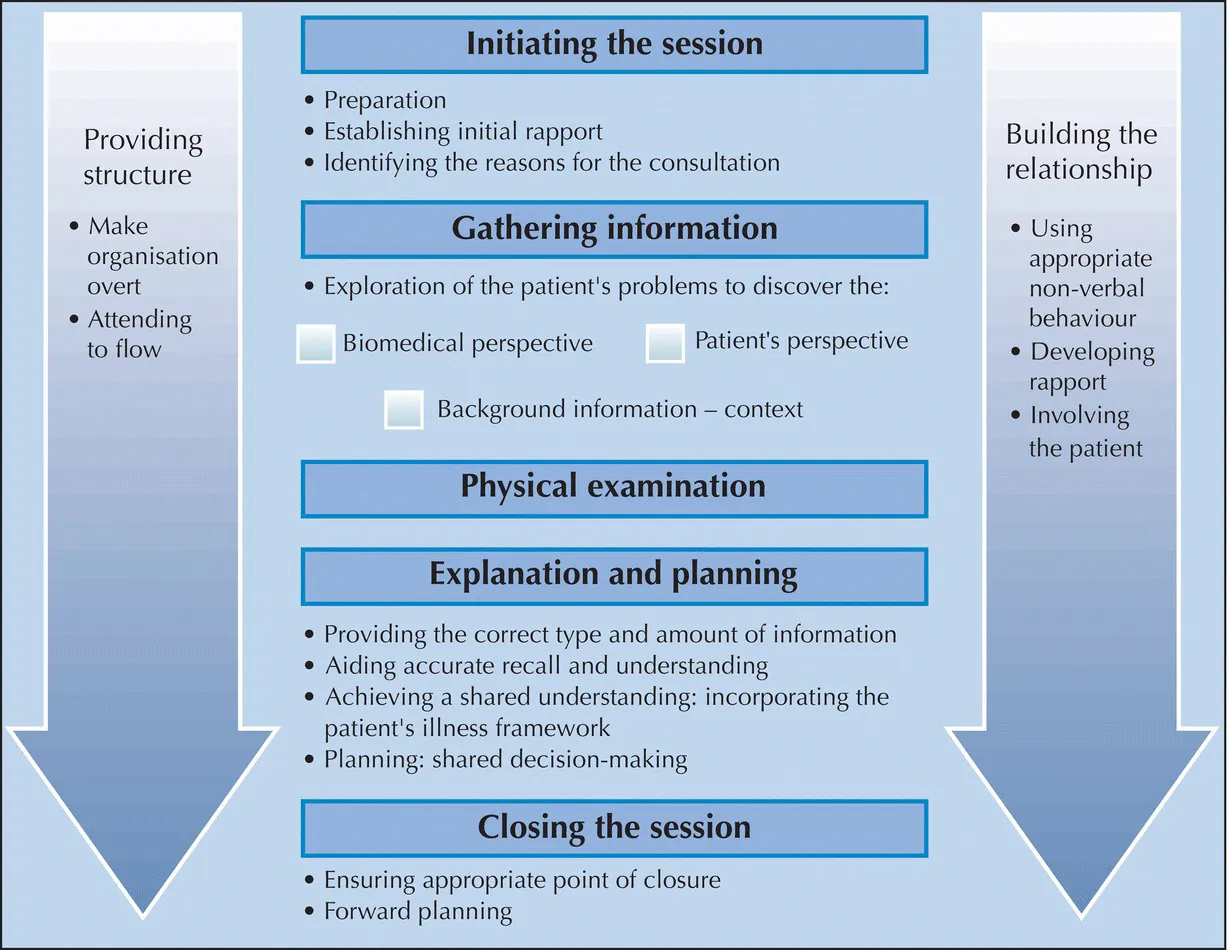
It is professionally satisfying to complete the consultation knowing that clinician and family have both met their agendas in the available time and also enjoyed a human connection. However, all clinicians will have moments when they feel there is a disconnect with the child and the family one is trying to help. Sometimes it can be difficult to pinpoint why the disconnect has occurred. Breaking down the elements of the consultation structure can help (Figure 1.1).
Clinicians employ a range of communication skills to build the relationship, allow a consultation to flow or to recognise the need for repair. These ‘Microskills’ are the elements of effective communication. They include techniques such as asking open questions, use of silence, responding to verbal and non‐verbal cues, responding to emotion, chunking and checking, microsummaries, and signposting (Table 1.1). This chapter introduces the reader to some of these core communication skills.
Schematic illustration of the Calgary Cambridge process.
Figure 1.1 The Calgary Cambridge process.
Sources: Skills for Communicating with Patients. 3rd Ed. Jonathan Silverman, Suzanne Kurtz, Juliet Draper. CRC Press, Published September 2013 and Kurtz S, Silverman J, Benson J, Draper J. Marrying content and process in clinical method teaching: enhancing the Calgary–Cambridge guides. Acad Med. 2003; 78:802–9. Reprinted with permission.
Table 1.1 Micro‐skills to enhance communication effectiveness.
Micro‐skills to enhance communication effectiveness.
Explore shared agenda ‘What do we want to achieve today?’
Open to closed cone questions (start open, then move to more directive questions) and screening questions, ‘is there anything else that’s troubling you’
Listen actively, avoid interrupting
Encourage more information ‘Tell me more’, use of silence
Facilitate by encouragement, paraphrasing, interpretation
Identify and explore cues to underlying concerns, verbal and non‐verbal e.g. eye contact, facial expressions, posture, vocal rate/volume/intonation
Use explicit empathy e.g. ‘I’m sorry to hear that’, ‘That sounds really tough’, 'I can't imagine how this might feel for you, but I wonder…’
Demonstrate confidence with your assessment/differentials/plan (e.g. with regards to what you find reassuring and why)
Explain rationale for suggested investigations and management plan
Avoid jargon: Use concise and easily understood language
Progress using Signposting: explicitly sharing the structure/plan e.g. ‘would it be ok if we first talked about… and then…’ or ‘There are three important things I'd like to discuss, first…’
Use visual methods for conveying information where useful
Chunk and check: Provide information in assimilable chunks, check...

Table of contents

  1. Cover
  2. Table of Contents
  3. Title Page
  4. Copyright Page
  5. List of Contributors
  6. Acknowledgements
  7. Foreword
  8. RCH Handbook List
  9. Preface
  10. CHAPTER 1: Communication in the paediatric consultation
  11. CHAPTER 2: Ethics
  12. CHAPTER 3: Resuscitation and medical emergencies
  13. CHAPTER 4: Poisoning and envenomation
  14. CHAPTER 5: Procedures
  15. CHAPTER 6: Pain management
  16. CHAPTER 7: Fluids and electrolytes
  17. CHAPTER 8: Prescribing and therapeutics
  18. CHAPTER 9: Immunisation
  19. CHAPTER 10: Nutrition
  20. CHAPTER 11: Growth
  21. CHAPTER 12: Adolescent medicine
  22. CHAPTER 13: Allergy
  23. CHAPTER 14: Behaviour and mental health
  24. CHAPTER 15: Cardiology
  25. CHAPTER 16: Clinical genetics
  26. CHAPTER 17: Dentistry
  27. CHAPTER 18: Dermatology
  28. CHAPTER 19: Endocrinology
  29. CHAPTER 20: Forensic medicine
  30. CHAPTER 21: Gastroenterology
  31. CHAPTER 22: Gynaecology
  32. CHAPTER 23: Haematology
  33. CHAPTER 24: Immunology
  34. CHAPTER 25:Infectious diseases
  35. CHAPTER 26: Metabolic medicine
  36. CHAPTER 27: Neonatal medicine
  37. CHAPTER 28: Neurodevelopment and disability
  38. CHAPTER 29: Neurology
  39. CHAPTER 30: Oncology
  40. CHAPTER 31: Ophthalmology
  41. CHAPTER 32: Orthopaedics
  42. CHAPTER 33: Otolaryngology
  43. CHAPTER 34: Palliative care
  44. CHAPTER 35: Refugee health
  45. CHAPTER 36: Rehabilitation medicine
  46. CHAPTER 37: Renal medicine
  47. CHAPTER 38: Respiratory medicine
  48. CHAPTER 39: Rheumatology
  49. CHAPTER 40: Sleep medicine
  50. CHAPTER 41: Surgery
  51. CHAPTER 42: Trans and gender diverse health
  52. APPENDIX: Antimicrobial guidelines
  53. Index
  54. End User License Agreement