Biorefinery Production Technologies for Chemicals and Energy
eBook - ePub

Biorefinery Production Technologies for Chemicals and Energy

  1. English
  2. ePUB (mobile friendly)
  3. Available on iOS & Android
eBook - ePub

Biorefinery Production Technologies for Chemicals and Energy

About this book

This book covers almost all of the diverse aspects of utilizing lignocellulosic biomass for valuable biorefinery product development of chemicals, alternative fuels and energy.

The world has shifted towards sustainable development for the generation of energy and industrially valuable chemicals. Biorefinery plays an important role in the integration of conversion process with high-end equipment facilities for the generation of energy, fuels and chemicals.

The book is divided into four parts. The first part, "Basic Principles of Biorefinery, " covers the concept of biorefinery, its application in industrial bioprocessing, the utilization of biomass for biorefinery application, and its future prospects and economic performance. The second part, "Biorefinery for Production of Chemicals, " covers the production of bioactive compounds, gallic acid, C4, C5, and C6 compounds, etc., from a variety of substrates. The third part, "Biorefinery for Production of Alternative Fuel and Energy, " covers sustainable production of bioethanol, biodiesel, and biogas from different types of substrates. The last part of this book discusses sequential utilization of wheat straw, material balance, and biorefinery approach.

The approaches presented in this book will help readers/users from different areas like process engineering and biochemistry to plan integrated and inventive methods to trim down the expenditure of the industrial manufacture process to accomplish cost-effective feasible products in biorefinery.
Frequently asked questions

Yes, you can cancel anytime from the Subscription tab in your account settings on the Perlego website. Your subscription will stay active until the end of your current billing period. Learn how to cancel your subscription.
No, books cannot be downloaded as external files, such as PDFs, for use outside of Perlego. However, you can download books within the Perlego app for offline reading on mobile or tablet. Learn more here.
Perlego offers two plans: Essential and Complete
  • Essential is ideal for learners and professionals who enjoy exploring a wide range of subjects. Access the Essential Library with 800,000+ trusted titles and best-sellers across business, personal growth, and the humanities. Includes unlimited reading time and Standard Read Aloud voice.
  • Complete: Perfect for advanced learners and researchers needing full, unrestricted access. Unlock 1.4M+ books across hundreds of subjects, including academic and specialized titles. The Complete Plan also includes advanced features like Premium Read Aloud and Research Assistant.
Both plans are available with monthly, semester, or annual billing cycles.
We are an online textbook subscription service, where you can get access to an entire online library for less than the price of a single book per month. With over 1 million books across 1000+ topics, we’ve got you covered! Learn more here.
Look out for the read-aloud symbol on your next book to see if you can listen to it. The read-aloud tool reads text aloud for you, highlighting the text as it is being read. You can pause it, speed it up and slow it down. Learn more here.
Yes! You can use the Perlego app on both iOS or Android devices to read anytime, anywhere — even offline. Perfect for commutes or when you’re on the go.
Please note we cannot support devices running on iOS 13 and Android 7 or earlier. Learn more about using the app.
Yes, you can access Biorefinery Production Technologies for Chemicals and Energy by Arindam Kuila, Mainak Mukhopadhyay, Arindam Kuila,Mainak Mukhopadhyay in PDF and/or ePUB format, as well as other popular books in Technology & Engineering & Fossil Fuels. We have over one million books available in our catalogue for you to explore.

Part 1
BIOREFINERY BASIC PRINCIPLES

1
Principles of Sustainable Biorefinery

Samakshi Verma and Arindam Kuila*
Department of Bioscience and Biotechnology, Banasthali Vidyapith, Vidyapith, Rajasthan, India
Abstract
Sustainable biorefineries have a critical role to play in our common future. The need to provide more goods using renewable resources, combined with advances in science and technology, has provided a receptive environment for biorefinery systems development. Biorefinery offers the promise of using fewer non-renewable resources, reducing CO2 emissions, creating new employment, and spurring innovation using clean and efficient technologies. Lessons are being learned from the establishment of first-generation biofuels operations. The factors that are key to answering the question of biorefinery sustainability include: the type of feedstock, the conversion technologies and their respective conversion and energy efficiencies, the types of products (including co-products) that are manufactured, and what products are substituted by the bioproducts. The BIOPOL review of eight existing biorefineries indicates that new efficient biorefineries can revitalize existing industries and promote regional development, especially in the R&D area. Establishment can be facilitated if existing facilities are used, if there is at leastone product which is immediately marketable, and if supportive policies are in place. Economic, environmental, and social dimensions need to be evaluated in an integrated sustainability assessment. Sustainability principles, criteria, and indicators are emerging for bioenergy, biofuels, and bioproducts. Practical assessment methodologies, including data systems, are critical for both sustainable design and to assure consumers, investors, and governments that they are doing the “right thing” by purchasing a certain bioproducts. If designed using life cycle thinking, biorefineries can be profitable, socially responsible, and produce goods with less environmental impact than conventional products … and potentially even be restorative!
Keywords: Biorefineries, environmental impacts, sustainable development

1.1 Introduction

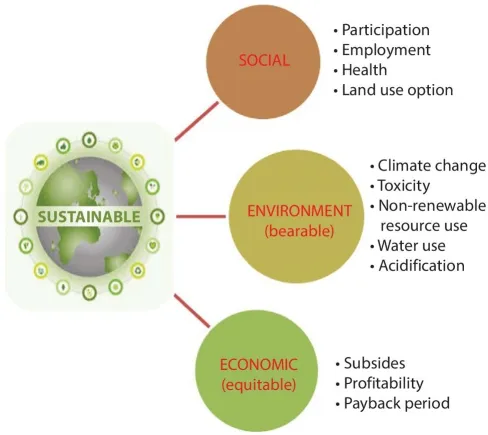
Sustainable development is a positive socio-economic modification which allows ongoing and upcoming generations to encounter their requirements. In order to do this, development has to assist the natural and social systems as it is based on them. All the three dimensions (economic, environmental, and social) of development are interconnected with each other and schematically, the place where they meet is known as sustainability (viable). Sustainability is not static; it is highly vigorous because it varies with geographical surroundings and develops over time [1].
Schematic illustration of the sustainable development.
Figure 1.1 Sustainable development.
Because of increased production and exploitation of fossil fuel energy and use of certain materials and chemicals, it causes huge environmental destruction which takes us to unavoidable termination that there should be the development of new production systems. These new systems of production should work on reducing pollutants or harmful materials and will produce safe and eco-friendly products within the green and sustainable supply chain. A renewable and constant supply having low carbon cost is required to do this process. Biomass is the only source of such renewable feedstock globally [2].
There are several factors that are responsible for determining environmental sustainability which are following: types of products that are manufactured, feedstock types; the technologies with their energy and conversion efficiencies; which type of product is exchanged by bioproducts; how emissions are dispensed to these products; and how these bioproducts are utilized and discarded with the end of life [1].
There is a need of developments in sustainable production for commercialization, co-products, and energy carriers that are being developed from biomass by using biorefinery. There is a rapid development of technology among these areas. It is understood that biomass has all the elements which are present in fossil resources, whereas in different integration due to which we are able to conclude that ongoing and upcoming technologies will head toward the future depending upon low carbon, renewable, and sustainable economies [2]. In our common upcoming time, there will be an important role to play by sustainable biorefinery. As there is no such development within the biorefinery products and technologies, so there will be immense possibilities for great significance. Superior knowledge about upcoming climatic modification footprints, sustainability affairs and inventive technologies will lead us to select more informed methods which will help in developing our renewable resources so that they can fulfill the requirements of society as well as nature on “spaceship Earth” [1].
Necessity to provide more goods and servicesby utilizing renewable sources in combination with advances in science and technology together have provided a providential environment for the development of biorefinery systems. A more bio-based economy has proposed the assurance to manufacture and preserve new employment, minimize CO2 emissions, exploit lesser non-renewable resources, and motivate novelty by utilizing sterilized and more productive technologies. Developed biorefinery should be capable of furnishing future products [1]. A brilliant estimation of such products under various technology frameworks is required within the next decades so that sustainable designs must be consciously formulated and evaluated. Sustainability is not just about renewability or about ecosystem or about GHG emissions because human health effects, economical, environmental, and social work are all need to be directed. If we move rapidly without even knowing the full outcome of any new development, then accidental effects ca...

Table of contents

  1. Cover
  2. Table of Contents
  3. Title Page
  4. Copyright Page
  5. Preface
  6. Part 1: BIOREFINERY BASIC PRINCIPLES
  7. Part 2: BIOREFINERY FOR PRODUCTION OF CHEMICALS
  8. Part 3: BIOREFINERY FOR PRODUCTION OF ALTERNATIVE FUEL AND ENERGY
  9. Part 4: CONCLUSION
  10. Index
  11. End User License Agreement