A life of consciences
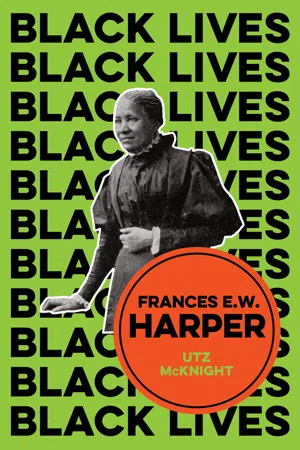
We are always writing for the present, for those who share the concerns and anxieties of our lives. But, of course, we can’t know how what we say and do today is measured by those who come after us, in spite of our desire to inhabit the thoughts and concerns of those who follow. Frances Harper – author, abolitionist, orator, political organizer, temperance activist, suffragist, mother, Black, American, woman – she dedicated her life to the politics of racial and gender justice.
Frances Harper was born in 1825 and lived an incredible life, sharing her ideas and her creativity with an American public until her death in 1911. She grew up a free Black person in a society where the majority of Black people were enslaved. The writer of the first short story published by an African American woman, Frances Harper also produced Iola Leroy, one of the most popular fiction novels in the US of the latter half of the nineteenth century. She was an accomplished and popular poet, and was able to make a living on the sale of her poetry at a time when it was not possible for a Black person to find a position at a university. An important orator and organizer for the Abolitionist Movement, the Temperance Movement, and the Suffragist Movement, Frances Harper was an activist – what we today call a public intellectual – with the tenacity and skill to remain at the center of the sweeping political changes that occurred in her lifetime. She was frequently published in the leading African American newspapers and magazines, contributing her ideas to a wide public in the society (Peterson, 1997).
What Harper couldn’t know is that, by the latter part of the twentieth century, her own contributions would be largely obscured by the very forces of racism and sexism that she fought against all her life (Foster, 1990). Each discovery today of the wealth of contributions made historically by Black women in the society is a mandate to again center these voices integral to the American democratic project, who, because of the politics of their time, were obscured or have subsequently had their contributions largely erased. We can only wonder how much of what was achieved by those living before us is unrecoverable; how much of what was accomplished has been erased by disfavor, disinterest, simple neglect, and the prejudices of popular opinion. Our history is derived from the imagination of those who would silence and vilify certain persons, groups, and causes. What ideas and work remain available from our past? What should we think today in a time when racial and gender inequality still remain definitive of American society?
What we do know is that, until the work of Black feminist researchers in the last four decades, much of the writing of Frances Harper was unavailable and thought lost. It is only through the work of these scholars, the diligent work of recovery and preservation, that we now have access, as well as to her popular novel Iola Leroy, to Harper’s three serialized novels, the work Fancy Sketches, many of her speeches, and the majority of her poetry. We owe a great debt to this research movement, by Black women working as established scholars, independent researchers, librarians, and activists. This dedication to recovering a Black past before the nadir in the late 1880s, and the decades of terror that described the time of lynching and Jim Crow, asks us as readers of Frances Harper’s work to question how we consider race and the contribution of Black people today in this society.
Even if the proximate causes have changed, the general social concerns that occupied Frances Harper are shared by us today. She can serve as an inspiration for both creative writing and political engagement. She demonstrates what was possible to do as an individual in a society where Black community members were enslaved and where women were not able to vote. What would it mean for us to live alongside those who remind us of the terrible oppression possible for us as well, to interact with those who share the burden of social descriptions of racial inferiority, even as our political status differentiates us? We know.
Today more Black people are in prison than were enslaved in 1825, and one out of three Black male adults will be incarcerated at some point in their lives. With large numbers of African Americans living in poverty, and a perception of racial inferiority that persists, with significant pay differentials between men and women, and #MeToo a necessity, the words of and life led by Harper provide encouragement and an example of how we might also thrive. The timeline for Harper’s life covers not only the last half of the nineteenth century, when the new nation sought to define its major institutions, but also the last decades of the centuries-long enslavement of Black people, the Civil War, and Reconstruction. She was present as the Western US opened up to settlement, and in the period of national development that saw rapid industrial growth, and then the portion of the late nineteenth century that, because of the establishment of Jim Crow laws and lynching, many consider the nadir of the free African American experience in the US.
Frances Harper in the 1820s and 1830s
Born in 1825, in Baltimore, Maryland, Frances Harper was orphaned at 3 years of age and went to live with her uncle and aunt, William and Henrietta Watkins. The family had a library, and as a child Frances was, at a young age, given access to books and taught to read and write. This encouragement was to be her fortune, and words and their value would become her lifelong passion. In Baltimore, where the family was living, the social relationships of the family gave Frances conversational exposure to people with an interest in the major political causes of the day. Her uncle William Watkins was an abolitionist and public speaker, someone with social standing in the community of people, made up of free Blacks and Whites, advocating for social causes and racial equality. William Lloyd Garrison and many other activists were regular guests at the Watkins household.
Harper’s upbringing among those who were were active in organizing against slavery and other social problems not only taught her the value of political activism but also provided her with an understanding of the importance of education and writing as tools to address social ills. The public critic – the person who would address an audience in speaking halls, living rooms, and in formal gatherings to advocate for changes in the society – was a fixture in the everyday lives of the inhabitants of the young nation. The first decade after Frances Harper’s birth saw the publication of David Walker’s Appeal, the public work of Maria Stewart in Boston, and Nat Turner’s Rebellion.
In Harper’s day, there were established organizations that sought various types of reforms and social change in the society at large. And in Baltimore, where she grew up, free Blacks and Whites had long been able to establish a public audience ready to discuss a wide range of social causes and issues, through printing newspapers, adverts, and lectures (Foster, 1990). This public forum, a social space within which to publicly make statements and admonish fellow inhabitants and the government, was active throughout the mid-Atlantic seaboard and the East Coast in the 1820s. While, just as today, it was not clear how discussions in this public arena determined the definition of government interests, there is no question that the public intellectual in the nineteenth century had an importance beyond the imperatives of electoral politics. Much of this has to do with the place of this sort of public discourse in local politics – how independent town, city, county, and state politics are from the supervision of the federal government in the US. Electoral parties in the US are not an end in themselves, for a public is always engaged in discussion about the merits of a law, a policy, or the conditions in which local people live.
Unlike other Black women who became well-known public figures during her lifetime, Frances Harper did not have the financial means to remain at home throughout her childhood (Foster, 1990). Having established a school in 1820 – the Watkins Academy – her uncle William Watkins was able to provide the young Frances Harper with the vocational training necessary to succeed at those occupations conventionally available to her as a free Black woman. It was this training that allowed her to work, as a teenager, as a young servant in the household of a White family, and, eventually, to be the first woman hired as a faculty member to teach sewing at Union Seminary in 1850. When she later moved to Ohio with her husband to run a dairy farm and help raise their children, this practical experience as a servant was important, and necessary when she was shortly thereafter widowed and working to keep the farm. Frances Harper was raised with the best training available for someone Black who had no access to independent sources of income. This is a condition that most African Americans are too familiar with today, with a negative savings rate and few assets being the norm for too many families. She had to survive by the education that she received, opportunity, hard work, and the trust and assistance of those around her. This was a free Black person’s life in the 1820s and 1830s, and is true today for us as well.
Harper’s work as a servant paralleled the types of work done by those who were enslaved, but with the glaring distinction of being free – free to make use of her own life and time as she would, each day. As a servant, however, she came face to face with the consequences of a politics of race in the society whereby some Black people who worked were free, and some slaves. This experience undoubtedly transformed her thinking about how race defined the lives of Black people in America.
In the 1820s and 1830s, when Frances Harper was a child, the state of Maryland reflected many of the major forces for change in the new nation. Baltimore and surrounding areas were places where free Blacks could live alongside slaves in large numbers – enough to make the differences in status between Black people an explicit public issue that Whites sought to address. Whites did not generally suggest enslaving those who were free, but instead sought to reduce the number of free Blacks who lived in the state (Fields, 1985). The uneven economic development between the state’s northern counties and southern counties was a source of great tension among politicians. The importance of slaveholding for agriculture and economic development that prevailed elsewhere in the South was not evident in Baltimore, even if true in the southern parts of the state. The importance of Baltimore as a growing industrial center on the mid-Atlantic seaboard meant it was a center for the political currents that were sweeping the young nation. For Frances Harper, growing up in Baltimore meant that she was regularly exposed to the social conditions of slavery, as well as given an insight into the value of schooling and literacy for effecting social change (Parker, 2010, p. 102).
Think for a moment of what Frances Harper’s attendance at the Academy run by her uncle must have signaled for the slaves working around her, slaves who often were prohibited by their Masters from learning to read and unable to write. It is important not to make a false equivalence between what slavery and being free meant for Black people at the time. Slavery remains a terrible wound in our history today, but we don’t need to think of Black people as always available to its constraints as a condition of living in the society, or as the limit to our political ambition. The necessary national conversation that we have today about reparations and reconciling the effects of slavery generations later should not prevent a discussion of how free and slave Black people lived alongside one another. What it meant to be Black at the time, and after the Civil War, should include such an understanding of the complexity of Black life.
Frances Harper’s was a singular political awareness, if we consider the situation for a moment: to be free and yet to be exposed as a young child to those who were not; to be socially conscious of the aspiration toward racial equality derived from the attitudes and behaviors of those Whites who frequented the Watkins’ home; to know that many Black people discussed the plight of those enslaved even as they wrote, spoke publicly, and organized for the welfare of those who had run away. She also came into constant contact with White slave owners, and those who perceived her free status as an impediment to her exploitation, even as they dismissed her capacity for constraining their desires with regard to their own slaves.
What would a White stranger have represented socially, politically, for Frances Harper? What would a slave have been for a young Frances Harper, if not a person to be pitied, and also an immediate existential threat, a literal symbol of the precarious nature of her own status in Baltimore (Fields, 1985, pp. 39, 79)? In the 1820s and 1830s, when the kidnapping of free Blacks to be sold as slaves further south was common, how did Frances Harper determine the motives and interests of the adults, White and Black, around her? I write this to have us consider how race was a factor in the young Frances’ life, in contrast to how it is in our own lives. How would others have perceived this young woman, who was not only courageous and literate, but also independent? And though her situation with regard to opportunities for an education was unique, she herself, as a young free Black girl child, was not unique in Baltimore, or in the society as a whole.
How has our awareness of race changed, and what remains accessible to us of what she must have known? Answering this question requires a degree of reflective sophistication about the influence of race on our lives – an awareness that Frances Harper demonstrates throughout her work. It would be a rare person today who would have her degree of insight and courage. Thus, it is important to remember, when we read her poetry and books, how few of us have the same perspicuity, the determination that was required – when there were slaves present, and when women were unable to vote and were expected to be silent in most public fora – to confront the description of her own racial subordination in her public writing (Stancliff, 2011).
Today, when so many people write and publish works on race and society, it is simply too easy to remain within a narrative that sees progress in the fact that Black people can publish and find an audience for their work. Reducing the achievements of those like Frances Harper to a simple content analysis, or a discussion of literary form, reduces the achievements of those, like her, who succeeded at a time when there were substantial barriers to publishing and making a career as a public speaker and poet. Leveling the field of production in this way reduces the importance of the work that others have done to change how the society addresses race as a problem, and we tend to ignore the organizational and professional effort that this success took – how it was also a tremendous step in our progress toward the ideal of racial equality. To what extent is it possible to make sense of the types of commitments that are evident in the life of Frances Harper such that she would become the most successful Black poet of the mid nineteenth century, a writer of four novels – one of which was a bestseller – a public speaker, an essayist, and a leading organizer of social movements in the United States for almost 50 years?
In her letters, it is clear that Frances Harper led a life whose main ambition was to correct the racial and gender injustices that she perceived in the world around her. The activist and literary world in which she lived, as well as how she was raised when young, fostered an awareness of a politics of representation in her own person as a Black woman writer and social critic. This commitment to what we today call civil rights is ever present in her writing, her speeches, and her advocacy. I want to suggest that it is only now, with our complex theories that address the conjoining of the critical politics of race, gender, and sexuality, that there exists a public readership that can respect and understand how a Black woman could be one of the most important writers, poets, and activists of the last 50 years of the nineteenth century. Her story now can be brought to our attention as a difference of perspective that matters, her work given a place as an important component in a developing narrative of a diverse American democratic polity.
It is not a coincidence that, though Frances Harpe...