eBook - ePub
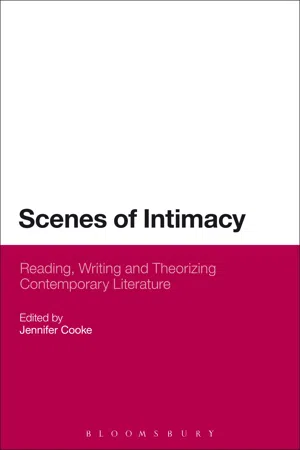
Scenes of Intimacy
Reading, Writing and Theorizing Contemporary Literature
- 224 pages
- English
- ePUB (mobile friendly)
- Available on iOS & Android
eBook - ePub
About this book
Scenes of Intimacy analyzes the representation of acts and relationships of intimacy in contemporary literature, the effect this has upon readers, and the ways these representations resonate with, complement, and challenge the concerns of contemporary theory. Opening with an in-depth interview with literary critic, Derridean, and novelist Professor Nicholas Royle, the volume contains eleven further essays that move from intimate scenes of familial and pedagogic legacy, on to representations of love, of sex, and finally to scenes of death and dying. The essays are textually attentive to how literary techniques create intimacy, and draw upon new and notable theoretical positions and critics from queer theory, affect studies, psychoanalysis, poststructualism and deconstruction to ask difficult and uncomfortable questions about intimacy and its representation. Across the genres of poetry, autobiography, journals, love letters, short stories and novels, Scenes of Intimacy shows that contemporary literature poses new possibilities and questions about our intimate relationalities, their failures and their futures.
Information
Part One
Intimate Scene-Setting
1
Making a Scene: Towards an Anatomy of Contemporary Literary Intimacies
Jennifer Cooke
Loughborough University
This book discusses literary representations of intimate acts and intimate relationalities, placing them in productive communication with contemporary theory and demonstrating how these two ways of writing about intimacy can challenge, illuminate and enrich one another. ‘Literary intimacy’ sounds as though it might be a delicately veiled euphemism for sex scenes, yet, while some of the following essays are concerned with sexual encounters, others turn to the representation of non-sexual intimacies such as familial relationships or particular states, like death, illness or grief, which bring us into intimate contact with strangers or alter the shape and experience of our existing intimacies. Analysing acts, states and relationships is one route for understanding the nature of contemporary literary intimacies; with this comes attention to the social and historical significance of which acts and relationalities are represented and why, especially those which are newer to literature or the public sphere more generally. Another route taken by the essays that follow is to examine the techniques by which authors write intimacy: this includes considerations of personal genres, such as letters, emails, love poetry or journals, as well as analyses of specific literary techniques that create textual intimacy, including fragmentation, citation, apostrophe, voice and style. In other words, the essays here attend not just to what is said about intimacy and its acts in literature, but also to how it is said. In turn, representations of intimacy and the literary techniques of intimate writing can produce intimate reading encounters. Thus literary texts can portray intimacy by describing it; employ techniques that create or enhance the intimacy represented; or they can engage their readers intimately by deliberately prompting emotional responses. Sometimes such inter-textual and extra-textual intimacies occur simultaneously. The textual affects invited by intimate structures and representations have recently been the focus of contemporary theorizing, and all of the essays here draw upon, extend or question thinking in this domain. Broadly speaking, these are the grounds that Scenes of Intimacy occupies and the spaces for theorization which it opens up.
Speech and silence surrounding intimacy
Contemporary literature of the late twentieth and early twenty-first centuries is consanguineous with a larger Western cultural tendency to loosen the implicit rules that have policed a firm separation between the public and the private domains. It sometimes seems, in fact, that nowadays everything is seen and everything discussed: the face of a newly executed dictator circulates around social media sites before government officials are even aware of his death; reality TV shows document the medical treatment of teenage STDs in oozing close-ups; the non-famous as well as celebrities discuss their drug addictions or sex lives on TV chat shows or recount the horrors of their abuse as children in magazine columns. Public discourses generally remain recognizably conventional and conservative: when discussion is ‘open’, it tends to be within the confessional mode (Foucault 1990; Foucault 2003: 167–263), which is governed by a morality seeking to reward and (re)establish normative behaviour. This is complemented by more privately practised strategies of what Eva Illouz has called a contemporary Western ‘therapeutic ethos’ (Illouz 2007: 71), which encourages emotional self- (and couple)-management, segues neatly into market relations, and is most readily exhibited in the burgeoning self-help book market and the discourses they shape and inform in popular culture. Generally speaking, popular public discourses seek to rationalize, simplify, categorize and ‘manage’ complex emotions and intimacies, often within a moral paradigm which stresses responsibility to oneself and communication with others. While this may initially sound a boon, critics have stressed how such an approach can lead to relational calcification, where intimacy adheres to set but stultifying patterns (Vogler 2000: 85), or how the logic of cost-benefit analysis and hyperrationality which saturates the market can also saturate our private lives and the choices made within it, restricting the potential for intimacy (Illouz 2007: 114), especially configurations of intimacy which do not fit within the pre-classified and prescribed models, such as the heteronormative couple.
Unsurprisingly, despite the appearance of public volubility on matters of intimacy and the advocacy of emotional management, and in contrast to the speed of information travelling across the web and airwaves, certain examples of contemporary literature are engaging with what still often remains unspoken in many arenas: the intimacies we find deeply uncomfortable, sometimes chaotic, and that we prefer not to articulate or perhaps even to think about too closely or too frequently. Intimacies about which it is difficult or unusual to talk can be the result of a variety of factors: the lack of an existing embedded language to articulate certain non-normative intimate configurations; the reminder we do not wish to have that some of us will suffer painful and protracted deaths; the fact that for most individuals, topics like abuse or impotence are hard to broach privately and perhaps even harder to name publicly, as is paradoxically testified to by the ‘exceptions’ who ensure that televisual revelations of intimate details remain compelling voyeurism. Literature has brought certain silenced and liminal practices, experiences and relationships into greater visibility, as indeed have some strains of theory, particularly postcolonial, feminist and queer approaches. Some of the difficult questions confronted by the literature written about in the essays collected here include: What happens if a highly anticipated sexual encounter engenders shame, disgust and recrimination, rather than the expected happiness and fulfilment? What if an African-born mother wishes to regularly insert her fingers into her daughter’s vagina to see if she is still a virgin, even though her daughter, raised in America, finds this unacceptable? How to describe the harm of lesbian violence and abuse when the paradigms for understanding those acts are primarily masculine? How does a diagnosis of schizophrenia alter one’s sense of self and one’s perception by others, and what happens when it is retracted years later? Or, how do you react if your wife is slowly dying of cancer and as she does so, her personality changes, moving further and further from the person you recognize? These examples also show how contemporary literature is questioning and challenging a variety of cultural and social assumptions, i.e. that sex between consensual lovers happily increases the intimacy between them; that specific cultural practices should necessarily be respected; that women are not physically violent towards one another; that it is the illness which alters us, not the diagnosis; and that we can unchangingly love our partners right through their painful illnesses and up to the end. These territories are fraught and often involve readers revisiting some of their most intimate presumptions. The contemporary literature discussed in these essays presents scenes of intimacy which can be distinctly distressing, raising wider questions about identity, sexuality, cultural practices, love, illness and death, and the texts discussed challenge the constructions of normality which underpin our characterizations of acceptable relationships and behaviours.
Silences surrounding certain intimacies are driven partly by our legacies of politesse, many with a lingering moral and class flavour, and partly by whom we define as familiar and whom a stranger: talk of intimacy, it is often assumed, is best conducted with those who are our intimates. Such social conventions and proscriptions mask a deep-seated aversion for admitting our embodiment and a reluctance to acknowledge how our emotional states are often chaotic, confused and ambivalent: it is not just sex that is hemmed in with unspoken rules about when and where it is an appropriate topic of discussion. The same mores pertain to other acts which attest to our bodily nature, such as descriptions of illness, bodily functions, or passionate physical reactions to emotions. While they might appear on our television screens in colourful high-definition intensity, they are reassuringly distant; contrastingly, in our everyday lives and interactions with others we are carefully aware with whom talk of intimacies can be broached and shared. Intimacy is relational and thus traverses the whole spectrum of our experiences with others, from the mundane to the ecstatic, the painful to the frustrating, from the humorous to the baffling; the following chapters demonstrate such a range.1
The scenes of representation
The title of this volume, Scenes of Intimacy: Reading, Writing and Theorizing Contemporary Literature, stresses the ‘represented’ nature of the intimacies discussed. Borrowing the language of the theatrical play, the title expresses the importance of the spatial and the temporal, as much to our lived experience of intimacy as to how it plays out upon the page. Our intimacies are so often facilitated – negatively and positively – by the spaces we inhabit and frequent, the home and the workplace being the most universal, with leisure and public spaces also being formative. Intimacies are contextual so they fall under the mark of generic nomenclature – one is a lover, a mother, an abuser or a son – yet simultaneously they are textured by the singular experience that one person has of another. They do not happen in blank space. Thus ‘scenes’, with its multiplicity and reference to the theatrical, encourages us not to ignore the physical spaces that are the dramatic settings for our intimacies, settings which are liable to change and to replace one another as much as to become routine backdrops or secretive screens. Alongside considering the spatial dynamics of intimacy, the intimacies between people – as well as between texts and people – have a temporal dimension captured by ‘scenes’ since they are usually of episodic intensity. There are sex scenes or scenes of dying, scenes of violence, abuse or confrontation, and scenes of love, joy or reconciliation, but it is unusual for these to be the sole scene in a literary work, although they are often pivotally important. Some of these scenes, such as those of love and reconciliation, have familiar ‘scripts’ – phrases and behaviours which are expected or, conversely, ruled out in certain situations – and yet, more often than not, literature reflects the fact that our intimate relationships with others are more messy and incoherent, more unanticipated and unscripted, than the ways we are expected to react to them. Using ‘scenes’ to conceptualize the reading encounte...
Table of contents
- Also Available from Bloomsbury
- Title
- Copyright
- Contents
- Acknowledgments
- Notes on Contributors
- List of Figures
- Part 1: Intimate Scene-Setting
- 1 Making a Scene: Towards an Anatomy of Contemporary Literary Intimacies Jennifer Cooke
- 2 A New Literary Intimacy: An interview with Nicholas Royle Nicholas Royle and Jennifer Cooke
- Part 2: Legacies, Love, Sex and Death: Scenes of Intimate Reading and Writing
- 3 Reading the Intimacies of Shame in Edwidge Danticat's Breath, Eyes, Memory Elina Valovirta
- 4 Citation and Intimacy in Janet Frame's Autobiography Sylvie Gambaudo
- 5 Textual Intimacies: Letters, Journals, Poetry - Ghost Writing Telegraph Cottage Felicity Allen and Simon Smith
- 6 Poetry and Intimacy: The Engagements of Keston Sutherland Aaron Deveson
- 7 Talking About Love in Raymond Carver Catherine Humble
- 8 Rebecca Brown, Intimate: A Literary Response to Stereotypes about Gender and Lesbian Sexuality Lies Xhonneux
- 9 Impersonal Intimacies: Echoes of Bataille in Ian McEwan's On Chesil Beach Jill Marsden
- 10 ‘Dear Osama’: Impersonal Intimacy and the Problem of Mothering in Chris Cleave's Incendiary Reina van der Wiel
- 11 Breast Cancer Autopathography: The Laws of the Body and the Body of the Law Helen Thomas
- Index
Trusted by 375,005 students
Access to over 1.5 million titles for a fair monthly price.
Study more efficiently using our study tools.
Frequently asked questions
Yes, you can cancel anytime from the Subscription tab in your account settings on the Perlego website. Your subscription will stay active until the end of your current billing period. Learn how to cancel your subscription
No, books cannot be downloaded as external files, such as PDFs, for use outside of Perlego. However, you can download books within the Perlego app for offline reading on mobile or tablet. Learn how to download books offline
Perlego offers two plans: Essential and Complete
- Essential is ideal for learners and professionals who enjoy exploring a wide range of subjects. Access the Essential Library with 800,000+ trusted titles and best-sellers across business, personal growth, and the humanities. Includes unlimited reading time and Standard Read Aloud voice.
- Complete: Perfect for advanced learners and researchers needing full, unrestricted access. Unlock 1.5M+ books across hundreds of subjects, including academic and specialized titles. The Complete Plan also includes advanced features like Premium Read Aloud and Research Assistant.
We are an online textbook subscription service, where you can get access to an entire online library for less than the price of a single book per month. With over 1.5 million books across 990+ topics, we’ve got you covered! Learn about our mission
Look out for the read-aloud symbol on your next book to see if you can listen to it. The read-aloud tool reads text aloud for you, highlighting the text as it is being read. You can pause it, speed it up and slow it down. Learn more about Read Aloud
Yes! You can use the Perlego app on both iOS and Android devices to read anytime, anywhere — even offline. Perfect for commutes or when you’re on the go.
Please note we cannot support devices running on iOS 13 and Android 7 or earlier. Learn more about using the app
Please note we cannot support devices running on iOS 13 and Android 7 or earlier. Learn more about using the app
Yes, you can access Scenes of Intimacy by Jennifer Cooke in PDF and/or ePUB format, as well as other popular books in Literature & Literary Criticism. We have over 1.5 million books available in our catalogue for you to explore.