eBook - ePub
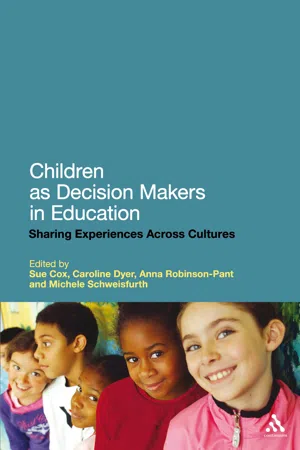
Children as Decision Makers in Education
Sharing Experiences Across Cultures
- 192 pages
- English
- ePUB (mobile friendly)
- Available on iOS & Android
eBook - ePub
Children as Decision Makers in Education
Sharing Experiences Across Cultures
About this book
Since the UN Convention on the Rights of the Child, there has been an increasing recognition globally that children need to have more say in their education. Children as Decision Makers in Education looks at how children can actively participate in decision-making. It builds upon previous research into student voice and decision-making, citizenship education in the school curriculum and work with children as researchers. This insightful collection is forward-looking, bringing together cross-cultural experiences and supporting individuals or groups to work collaboratively in the future.
Information
Part 1
Can we make space for children’s decision-making? Perspectives on educational policy
Globally, attitudes to children have changed over time, towards acknowledging the importance of their decision-making. This is reflected, for example, in the almost universal ratification of the United Nations Convention on the Rights of the Child. Among the decision-making rights upheld by the Convention are children’s right to stay with their parents if they choose (Article 9.1); to express their views freely (Article 13.1); and to assemble peacefully (Article 15.1). We would hope to see such shifts in attitude, and such international agreements, reflected in national policy and, in turn, in how these policies are enacted in schools, classrooms and other educational sites. The chapters in this part of the book explore how far, in different contexts, these aspirations are manifested; they also introduce concepts which facilitate analysis of children’s involvement at different levels. Among the themes are the extent to which policy rhetoric is matched by reality, and the roles of organizations such as non-governmental organizations (NGOs) in bridging gaps and supporting children and adults in making children’s decisions heard and realized. Policy can be an enabler, but it certainly does not guarantee that children are empowered, and, as some of these chapters point out, evidence of resistance can be found at many levels.
An historical overview of the situation in the England since 1965 provides an interesting case study of some of these themes. The intersection of politics and education creates a fluctuating trajectory. Rather than being taken seriously, Colin Richards argues that children’s decision-making is restricted by such factors as high-stakes examinations and school league tables, driven by a performativity agenda. Increasingly, there are moves to include children’s perspectives, for example in how their views of their schools and teachers are now part of the Office for Standards in Education (Ofsted) process of inspection, but ‘myths’ live on. Along with ‘myths’, Richards uses ‘ages’ and ‘autonomy’ as organizing ideas in his analysis, which is based on many years of experience with Ofsted and as an academic educationist observing policy and practice in England. We invite readers to compare his observations with the situation in other contexts.
Given the limitations of policy, organizations promoting children’s right to decide have used interventionist tactics to facilitate the prerequisite skills, structures and attitudes. The following two chapters document case studies of such strategies, in different national contexts. In Chapter 2, Tristan McCowan considers the ‘prefigurative’ potential of schools in the Brazilian context, in relation to pupil participation in schools and ultimately in society. In particular, he analyses a municipal government’s ‘Plural School’ initiative, based on the principle of inclusion through democratization. Once again, we find the challenges of facilitating the participation of all children, of democratizing the relationships between teachers and pupils, and of taking young people’s decision-making powers beyond the more trivial elements of uniforms and food. However, there is evidence that the prefigurative strategies employed can lead to wider exercising of the right to participate.
The work of the international NGO Oxfam in conflict zones is the basis for the next chapter. Drawing on experience from conflict zones internationally, the region of Central Mindanao in the Philippines becomes the focus of an exploration of how conflict and poverty affect schooling and create particular conditions for the participation of children. Sheila Aikman considers how school as a place and as a social space can create opportunities, and how the dynamics of power affect processes. Among the achievements of the programme in Mindanao are higher levels of attendance, interest and participation from children, and fewer interruptions to schooling as a result of the conflict.
Finally, Clive Harber draws on evidence from a wide range of contexts to argue that, on the whole, school children are not decision makers, and that policy and teacher education are parts of the problem. He brings together studies of pupils’ views of schooling to illustrate the ‘unfreedoms’ inherent in the purposes and structures of schooling. Crucially, the chapter also synthesizes evidence of how very important listening to pupils and giving them power and responsibility are. We might expect this in terms of developing the capacity for democratic citizenship, but it proves to be excellent practice even using more conventional indicators of effectiveness such as examination outcomes and pupil discipline.
Chapter 1
The changing context of decision-making
in English primary education: ages,
myths and autonomy
in English primary education: ages,
myths and autonomy
Colin Richards
Introduction
This chapter discusses children as decision makers in the context of developments in English primary education. It cannot do justice to developments elsewhere, whether in other parts of the United Kingdom or overseas. It uses three organizing ideas – ‘ages’, ‘myths’ and ‘autonomy’ – as a way of outlining the changing context in which English primary schools have operated, primary teachers have taught and primary pupils have experienced their schooling over the forty years since the publication of the Plowden Report (Central Advisory Council for Education 1967). Very largely the story is one of adult decision-making, albeit in a changing context, with different sets of adults making different kinds of decisions at different times. It is a story in which children’s perspectives are not so much consciously ignored as not really considered – either in policy, research or school decision-making. There are some signs that at long last those perspectives are being seen as important – at least at the level of rhetoric but only very patchily as yet at the level of practice. The lessons of English history (if it has lessons) are not all that hopeful. There is a need now to make that rhetoric a reality – forty years after the Plowden Report was published with the title Children and Their Primary Schools, with its assertion that ‘At the heart of the educational process lies the child’, with its slogan ‘The child as agent of his own learning’, but with its 500-page report providing no evidence that children had ever been consulted in its deliberations!
An age of excitement, 1965–74
The first period, 1965–74 is termed ‘an age of excitement’ – but this, of course, is an adult viewpoint – that of a teacher. Would children, had they been asked (which they were not), have seen it in similar terms?
Despite very real problems (very large class sizes by current standards, high staff turnover and the vestiges of the eleven-plus1) there was a sense of optimism in the system – captured in the upbeat style, messages and rhetoric of the Plowden Report itself. Primary education was expanding in terms of numbers of pupils, increases in resources and rising public and professional expectations. There was a sense of freedom (coupled with anxiety) over the removal of the restrictions on teacher initiative following the demise (in many areas) of selection. There was a rhetoric, too, of increased freedom for children to pursue their own needs and interests, though what research there was into primary classrooms (Boydell 1974) and my experience as a primary school teacher revealed in most cases either the continuance of overt teacher direction or an illusory freedom offered children to do what teachers thought was in the children’s best interests – a kind of pseudo-progressivism where children were given neither the tools nor the opportunities for genuine decision-making over their own learning.
There arose the myth of a primary school revolution – founded to some degree on highly innovative practice in a small minority of schools but essentially the result of wishful thinking on the part of some child-centred educationalists who occupied prominent positions in local education authorities (LEAs) and initial teacher education (Richards 1980). Though mythical, these ideas added to the sense of interest and anticipation in working in a system where the children, the teachers and the system itself were perceived to be full of unrealized possibilities. Teachers enjoyed (albeit rather anxiously) licensed autonomy; they were trusted by politicians and parents alike to take professional decisions about both the content of the curriculum and the way it should be taught and assessed. A parallel licensed autonomy was not offered to children – this was not the golden age of children’s decision-making that some nostalgic liberals fondly imagine!
An age of disillusionment, 1974–88
The period 1974–88 was very different – seen from an educationist’s perspective. There was virtually no research into how children perceived or influenced their educational experience during this period, despite a number of major classroom observational research projects. This was an age of disillusionment – with the post-war democratic consensus, with the state of the British economy, with the condition of the public services, with the quality of primary education and with the standards achieved by primary school pupils. National surveys of primary and middle schools (Department of Education and Science 1978, 1983), classroom observational research (Galton et al. 1980) and my own personal experience visiting schools as a university lecturer and latterly as a government inspector revealed a substantial gap (inevitable to some degree) between professional rhetoric and practice, not least in relation to the degree of freedom accorded primary pupils – revealed as illusory despite the wild claims of populist rhetoric over teachers abdicating responsibility over teaching and learning to their pupils – as illustrated by publications such as the Black Papers (e.g. Cox and Boyson 1975, 1977) written by conservative academics, many with little direct experience of English state schools or pupils.
These factors, within and external to the educational system, helped establish a myth of decline, especially of declining standards in literacy and numeracy. Though decision-making over curriculum, teaching and assessment remained largely in the hands of schools (and, more particularly, of individual teachers), there was a loss of professional self-confidence and direction in the face of continuing criticism, despite the fact there was no substantial evidence either from research or school inspection of a decline in educational standards or of pupils being accorded excessive degrees of freedom. Teachers exercised a kind of monitored autonomy, as during the 1980s both central and local government began to develop policies for the curriculum and LEAs tried to monitor and influence practice in individual schools. However, the notion of pupil perspective, let alone pupil consultation or decision-making, featured in neither national nor LEA thinking.
An age of regulation, 1988–97
The next nine-year period can be characterized as an age of regulation. It would be interesting to know in what terms primary pupils experienced it, but the research was never undertaken. The stirrings of government involvement, begun in the previous period, were replaced by strong intervention especially in the areas of curriculum and assessment. For the first time since 1897 English primary schools were required to follow a detailed, codified, state-imposed curriculum and were provided with a national system of assessment successively modified over the years – there was little scope for decision-making by schools and teachers attempting to grapple with an overloaded, over-assessed curriculum. An attempt to introduce citizenship as a cross-curricular theme offered the possibility of pupil participation beyond the national curriculum, but like the other cross-curricular themes citizenship never got off the ground. There was one interesting counter-movement to note – the introduction of ‘circle time’ in a small number of schools – at last giving children something of a ‘voice’ but not usually involving decision-making of any substantial kind. For teachers, regulated autonomy replaced monitored autonomy. The instigation of a national cycle of inspection was a very powerful, though indirect, way of regulating the system – policing schools’ compliance with national directives and severely limiting or even precluding high-risk experimentation with content, process or decision-making. The myth of low standards especially in the so-called ‘basics’ promulgated particularly by Ofsted’s second chief inspector (see Richards 1997) was used to justify tighter regulation and control, though the evidence was, at worst, very suspect and, at best, far from conclusive.
An age of domination, 1997–2003
The first six years of the New Labour government can best be described as an age of domination; children may have experienced it in terms of tests, targets, plenaries and carpet-sitting! Far from restoring (albeit in a more accountable form) initiative and freedom to experiment in the primary sector, central government intervened ever more directly and sharply. It introduced a national literacy strategy which was far more detailed and prescriptive than the national curriculum orders ever were (see Wyse et al. 2008). The accompanying numeracy strategy provided rather more ‘degrees of freedom’ but only relative to its literacy equivalent. The government set early learning goals for the under-sixes. It prescribed teaching methods which were dangerously close to breaking the law as laid down in the 1988 Education Reform Act. It made a fetish of national testing – treating it as the measure for judging the performance of primary schools. It signally failed to curb the excesses of Ofsted and used that organization to reinforce the domination of the measurable and gradable as the expression of standards and quality. It was symptomatic of this period that pupils’ views and perspectives never featured in any governmental consultation or inspection framework.
The government pursued the myth of moderniz...
Table of contents
- Cover
- Also available from Continuum
- Title Page
- Copyright
- Contents
- Notes on Contributors
- Introduction
- Part 1: Can we make space for children’s decision-making? Perspectives on educational policy
- Part 2: Children’s decision-making: its impact on life in schools and the community
- Part 3: Children as decision makers: what are we trying to achieve? The ethical and political dimensions
- Part 4: Facilitating children’s participation in research and decision-making
- Endpiece: What can we learn about children as decision makers by bringing together perspectives and experiences from different cultures?
- Index
Trusted by 375,005 students
Access to over 1.5 million titles for a fair monthly price.
Study more efficiently using our study tools.
Frequently asked questions
Yes, you can cancel anytime from the Subscription tab in your account settings on the Perlego website. Your subscription will stay active until the end of your current billing period. Learn how to cancel your subscription
No, books cannot be downloaded as external files, such as PDFs, for use outside of Perlego. However, you can download books within the Perlego app for offline reading on mobile or tablet. Learn how to download books offline
Perlego offers two plans: Essential and Complete
- Essential is ideal for learners and professionals who enjoy exploring a wide range of subjects. Access the Essential Library with 800,000+ trusted titles and best-sellers across business, personal growth, and the humanities. Includes unlimited reading time and Standard Read Aloud voice.
- Complete: Perfect for advanced learners and researchers needing full, unrestricted access. Unlock 1.5M+ books across hundreds of subjects, including academic and specialized titles. The Complete Plan also includes advanced features like Premium Read Aloud and Research Assistant.
We are an online textbook subscription service, where you can get access to an entire online library for less than the price of a single book per month. With over 1.5 million books across 990+ topics, we’ve got you covered! Learn about our mission
Look out for the read-aloud symbol on your next book to see if you can listen to it. The read-aloud tool reads text aloud for you, highlighting the text as it is being read. You can pause it, speed it up and slow it down. Learn more about Read Aloud
Yes! You can use the Perlego app on both iOS and Android devices to read anytime, anywhere — even offline. Perfect for commutes or when you’re on the go.
Please note we cannot support devices running on iOS 13 and Android 7 or earlier. Learn more about using the app
Please note we cannot support devices running on iOS 13 and Android 7 or earlier. Learn more about using the app
Yes, you can access Children as Decision Makers in Education by Sue Cox, Caroline Dyer, Anna Robinson-Pant, Michele Schweisfurth, Sue Cox,Caroline Dyer,Anna Robinson-Pant,Michele Schweisfurth in PDF and/or ePUB format, as well as other popular books in Education & Education General. We have over 1.5 million books available in our catalogue for you to explore.