eBook - ePub
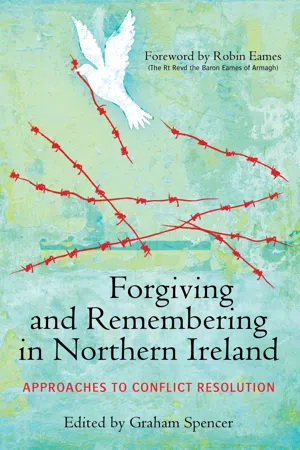
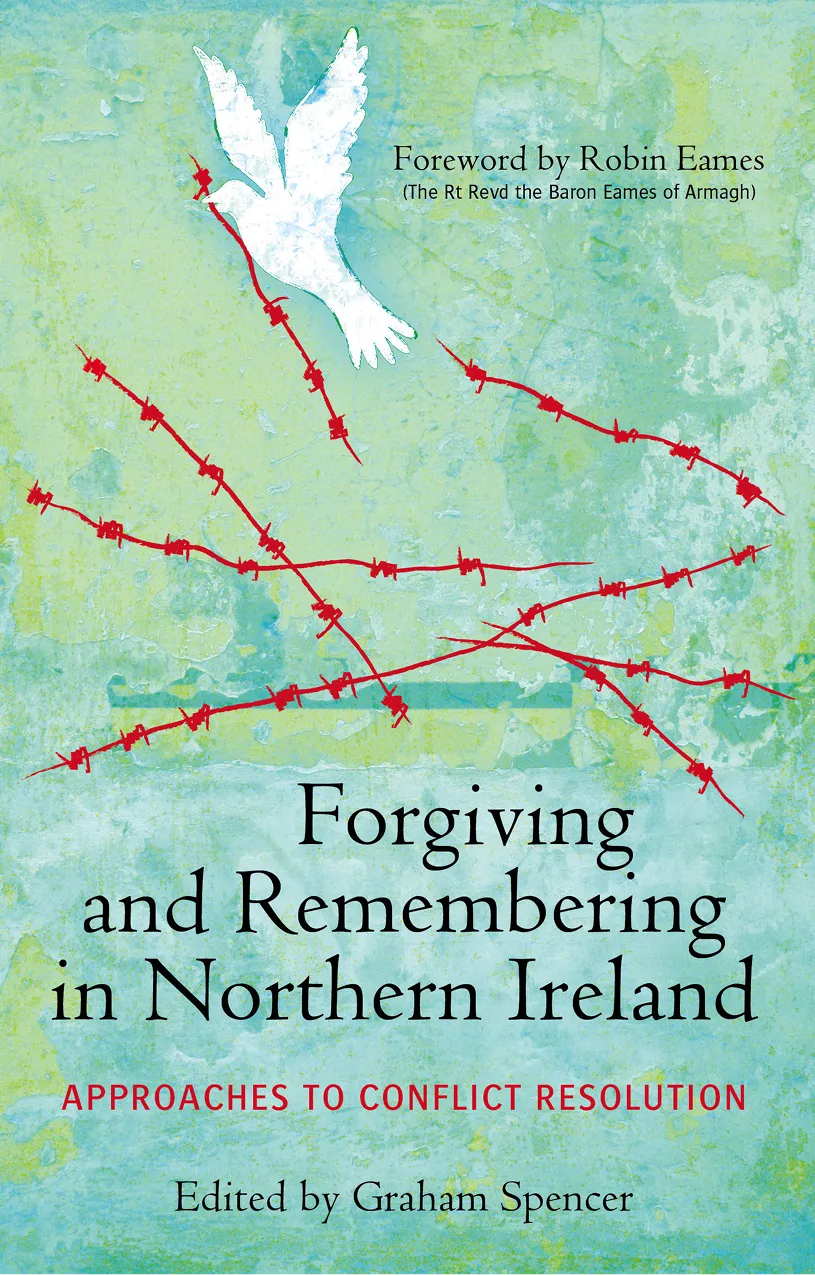
Forgiving and Remembering in Northern Ireland
Approaches to Conflict Resolution
- 320 pages
- English
- ePUB (mobile friendly)
- Available on iOS & Android
eBook - ePub
About this book
As Northern Ireland moves from conflict to tentative peace, ongoing violence and unrest underline that the province remains a turbulent and troubled society. This book brings together contributions from those directly affected by the Troubles who work for peace and reconciliation in their communities. The issues they raise are given poignancy and power by being grounded in human experience, and provide a necessary starting point for exploring the tensions which arise in the struggle to reconcile forgiveness and remembrance in order to create a more purposeful and meaningful future. They have important implications not only for Northern Ireland but also for other societies emerging from conflict.
Information
In memory of David Stevens
Forgiving and Remembering in Northern Ireland
Approaches to Conflict Resolution
Edited by Graham Spencer

Published by the Continuum International Publishing Group
| The Tower Building 11 York Road London SE1 7NX | 80 Maiden Lane Suite 704 New York NY 10038 |
www.continuumbooks.com
This collection copyright © Graham Spencer, 2011
All rights reserved. No part of this publication may be reproduced or transmitted in any form or by any means, electronic or mechanical, including photocopying, recording or any information storage or retrieval system, without prior permission from the publishers.
First published 2011
British Library Cataloguing-in-Publication Data
A catalogue record for this book is available from the British Library.
ISBN 978-1-4411-9392-6
Typeset by Fakenham Prepress Solutions, Fakenham, Norfolk NR21 8NN
Contents
Acknowledgements
Foreword by the Rt Revd the Lord Eames of Armagh, OM
Introduction: Forgiving and Remembering in Northern Ireland – Graham Spencer
1 Forgiving: A Doubting Thomas – Brian Lennon SJ
2 Reconnecting the Rhetoric and Reality of Forgiving and Remembering – Michael Jackson
3 Home Before Dark – Ruth Patterson
4 Forgiving as Command and Process: The Problem of Destination over Journey – Timothy Kinahan
5 Memory and Forgetting in a Contested Space – David Stevens 89
6 Forgiving and Church Responsibility – Aidan Troy
7 On Fire with the Justice of God: Re-Reading Romans as a Political Proclamation Towards a Desired Future – Johnston McMaster
8 Building Space: Regeneration and Reconciliation – Glenn Jordan
9 Rewriting Our Stories: Narrative, Identity and Forgiveness – David McMillan
10 Forgiveness Through Post-Traumatic Growth – Michael C. Paterson
11 The Transformational Possibilities of Forgiveness – David Bolton
12 Understanding Through Collaboration and Friendship: An Interview with Jo Berry and Patrick Magee
13 Developing a Forgiving Spirit: A Personal Story – David Clements
14 The Possibility of Forgiveness: An Interview with Duncan Morrow
15 The Struggle to Forgive – Chris Hudson
16 The Release and Gift of Forgiving: An Interview with Richard Moore
Conclusion
List of Contributors
Acknowledgements
This is an opportunity to thank the many people in Northern Ireland who over the years have shared their stories with me about what conflict has meant to them. I cannot thank those people enough for their time, honesty and courtesy. Without the help of people who have lived in and worked with conflict, my understanding of Northern Ireland would be shallow. On a personal note deep thanks go to Keith Tester and I am indebted to Karen Cray in more ways than I can say. The book though is dedicated to David Stevens, former leader of Corrymeela, who tragically died before this book went to press.
Foreword
Reconciliation has become the most used yet most misunderstood word in the vocabulary of architects of peace-building of our generation. The cry for reconciliation is heard on all sides as though it represented a New Jerusalem which, when reached by whatever means, is the ultimate solution to all human problems. It is viewed as a simple entity, symbolizing some historic landmark in a post-conflict era that, once achieved, allows a myriad of other dimensions of behaviour or attitude to complete a jigsaw of human need. This is often the cry of those who have failed to analyze the ingredients of conflict – give us this reconciliation, but don’t expect too much from us …
In this significant book Graham Spencer has given us the opportunity to consider an aspect of the process of reconciliation which seems to have fallen behind in current discussion of peace-building – forgiveness.
There are many reasons for this apparent lack of attention. As one who has been involved in Christian Ministry in Northern Ireland for over four decades, I approach the subject of reconciliation as a practitioner who has seen much of the tapestry of the human side of conflict and post-conflict situations at first hand. I have witnessed the success yet failure of attempts within the political field to produce peace – success in achieving working arrangements between conflicting political ideals, yet failure to produce complete reconciliation where it matters most – on the ground level of actual human experience of everyday living. I am in no doubt that from a Christian standpoint, what constitutes forgiveness remains a priority not just as a point of achievement in definition of reconciliation, but as a progressive contribution to the achievement of lasting community peace.
And there lies the problem.
Reconciliation can never be imposed by legislation or by political working arrangements. Politics can provide frameworks which encourage understanding and co-operation. But something more is needed if a post-conflict situation is ever to be translated into human stability and community peace. Something is needed which translates a desire to end conflict into a condition of common understanding among divergent and traditionally opposed communities.
Among such needs an understanding of what can succeed, when more traditional bridge-building methodology seems impossible, is essential.
How does society deal with its past? How do we approach past failure? How do we regard that most sensitive yet significant human ingredient – memory?
Without an attempt not only on the personal level but as a community to work out the role of the past in our attitude to the present and aspirations for the future, we are bound to repeat the failures of the past. We are bound to make the same mistakes. We are bound to restrict the possibilities of a more stable or peaceful future.
That attempt constitutes the most complex and undoubtedly the most divisive problem in peace-making. It is within that area that forgiveness provides the most dramatic yet most noble of means to progress. There will always be deep differences on how to deal with the past. For some, nothing will satisfy except detention and conviction, nothing less than ‘justice’ in terms of knowing who did what and who was responsible. For many the past can never be left behind unless they have full knowledge of how or why atrocities occurred. For even more, a full account of responsibility on both a personal and a group level is essential before they can move on. For still others, the recognition that endless questions will never be answered leads to a weariness and a desire simply to forget.
Forgiveness in whatever form is becoming one of the few ways of unlocking the mystery and opening a window on the future.
In this valuable book Graham Spencer and his contributors grapple with that question. In these pages there is a refreshing attempt to define forgiveness as well as a real effort to compare the personal act of forgiveness with the communal. Coming from a wide spectrum of experience and expertise, those who have contributed provide us with a genuine attempt to understand the widely divergent definitions of forgiveness. They also give us much food for thought on how forgiveness, like reconciliation itself, is a fragile process which requires constant review.
Graham Spencer has provided a fascinating chart for all who struggle with the demands of a post-conflict situation. But more importantly he has produced an analysis of one of the great human yet spiritual graces – the ability to respond to a past which can never be re-written or the wrong which can never be undone – forgiveness. As these pages disclose, forgiveness is itself costly, but the consequences of such an act are endless. In fact, forgiveness is emerging as the most hopeful approach to reconciliation when all others fail.
The question remains after reading this book: how does a society become convinced of the value of forgiveness when it has yet to understand the meaning of reconciliation? This is where that other dimension to the process of reconciliation assists in ...
Table of contents
- Cover
- Title Page
Trusted by 375,005 students
Access to over 1.5 million titles for a fair monthly price.
Study more efficiently using our study tools.
Frequently asked questions
Yes, you can cancel anytime from the Subscription tab in your account settings on the Perlego website. Your subscription will stay active until the end of your current billing period. Learn how to cancel your subscription
No, books cannot be downloaded as external files, such as PDFs, for use outside of Perlego. However, you can download books within the Perlego app for offline reading on mobile or tablet. Learn how to download books offline
Perlego offers two plans: Essential and Complete
- Essential is ideal for learners and professionals who enjoy exploring a wide range of subjects. Access the Essential Library with 800,000+ trusted titles and best-sellers across business, personal growth, and the humanities. Includes unlimited reading time and Standard Read Aloud voice.
- Complete: Perfect for advanced learners and researchers needing full, unrestricted access. Unlock 1.5M+ books across hundreds of subjects, including academic and specialized titles. The Complete Plan also includes advanced features like Premium Read Aloud and Research Assistant.
We are an online textbook subscription service, where you can get access to an entire online library for less than the price of a single book per month. With over 1.5 million books across 990+ topics, we’ve got you covered! Learn about our mission
Look out for the read-aloud symbol on your next book to see if you can listen to it. The read-aloud tool reads text aloud for you, highlighting the text as it is being read. You can pause it, speed it up and slow it down. Learn more about Read Aloud
Yes! You can use the Perlego app on both iOS and Android devices to read anytime, anywhere — even offline. Perfect for commutes or when you’re on the go.
Please note we cannot support devices running on iOS 13 and Android 7 or earlier. Learn more about using the app
Please note we cannot support devices running on iOS 13 and Android 7 or earlier. Learn more about using the app
Yes, you can access Forgiving and Remembering in Northern Ireland by Graham Spencer in PDF and/or ePUB format, as well as other popular books in Theology & Religion & Religion. We have over 1.5 million books available in our catalogue for you to explore.