eBook - ePub
Fear and Friendship
Anglicans Engaging with Islam
- 224 pages
- English
- ePUB (mobile friendly)
- Available on iOS & Android
eBook - ePub
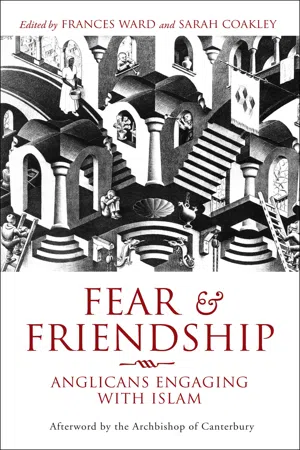
Fear and Friendship
Anglicans Engaging with Islam
About this book
Many encounters between people of different religions are marked by an initial sense of incompetence, ignorance and fear-- of getting it wrong, of causing offence, of ulterior motives. Such fears are here explored honestly, in stories of actual situations and relationships - often unexpected, sometimes funny, invariably profound.Friendship is presented as a public rather than merely a private phenomenon, enabling relations of trust and depth to develop and leading to the possibility of authentic talk and reciprocity of respect and courtesy. It emerges as a risky venture in learning how to be human, involving honest negotiation, self-sacrifice and a seeking after the truth. It can enable people to address the fears that so often prohibit inter-religious encounters from deepening beyond the superficial. A strong underlying theme is how the Church of England can contribute to social cohesion in a religiously pluralistic society, even if local clergy and congregations at first feel untrained or wary.
Information
1
Fear and Friendship: Conversation or Conversion?
Alex Hughes writes here of his encounter with Mohammed, one which begins in theological stalemate and grows into friendship. It is written against a background in which the confidence and certainty of Mohammed’s stance on Islam seems reflected in its local prominence, while the threadbare nature of the local Anglican presence finds its echo in Alex’s cautious and slightly indirect equivocations and qualifiers on faith. But, as the relationship with Mohammed develops, the richness of Alex’s deliberate poverty, his empty hands, becomes plain, transforming into a sense of gift and possibility: for (as he reminds us) friendship, like worship, is not for use but for joy.
The parishes of St Peter’s and St Luke’s, Southsea, where I have been priest-in-charge since October 2008, are in the heart of Portsmouth. Although they take in the university, law courts, guildhall and civic offices, as well as pockets of high-value housing, they cover one of the most densely populated and poorest parts of Hampshire, scoring highly on most indices of deprivation. The churches themselves have been declining for decades: I once presided at a ‘Family Communion’ to which only three people came, two of them late (tardy, not dead). One parish has a seriously dilapidated building, no lay officers and only one parishioner regularly attending worship;1 the other is cash-strapped but sustained by a small group of devoted lay folk who work incredibly hard to ‘keep the show on the road’, though barely any of them are parishioners. From the outside both churches look as if they might have gone out of business, and the local community pays them scant regard.
On the eastern edge of the parishes, in a very prominent position – far more prominent than either of my churches or any other religious site in the area – is the newly face-lifted and refurbished Jami mosque. The mosque is a recent acquisition, following a split within the city’s Sunni community. In addition to two prayer halls, one each for men and women, the mosque comprises a suite of offices and school rooms. It comes across as a bustling religious community, given its prominent location and the conspicuous flux of prayer-capped men and women in various forms of distinctively Islamic clothing. Even though the Jami mosque has a reputation for being closed to outsiders, and only 8 per cent of the parishes’ population are Muslim, I would guess that many local people could more easily identify the whereabouts of the mosque than either parish church.
Perhaps because of my preoccupation with the fate of my churches, and the demand of this exercise to focus on the Muslim presence in my area, I may have under- and overstated respectively the fortunes of church and mosque. For the purposes of my reflection, however, this may not be a bad thing: perception is often more significant than reality, especially when comparative self-perception is involved. The plain truth is that, as I have pondered how the Church of England might better engage with Islam, I have come to recognize how little this is a matter of concern to me at the level of my day-to-day ministry. Although one of the things that attracted me back into the Anglican fold in my late teens was its vaunted spirit of hospitality, I question now how that is, or might be, put into practice in my situation.
If the demands of parish ministry mean that I am not greatly intent on pursuing relations with my Muslim neighbours, one such has been eager to pursue me. He introduced himself – minus his give-away name – via an answerphone request for answers to some questions he had about Christianity. Unabashed evangelist that I am, I called him at once and we arranged to meet for coffee.
Mohammed opened, in typical Arab style, with sincere enquiries about my family’s well-being. He then moved on swiftly to ask what I thought about Sikh cow-worship. I replied that I did not think that, strictly speaking, Sikhs do worship cows; but I was glad when he decided not to continue with this topic, as I felt a little out of my depth. Perhaps he was, too. In any case, it quickly transpired that the point of his gambit was to assess my capacity to distinguish between truth and falsehood in religious matters, as a preamble to testing the relative merits of Christianity and Islam. I have yet to satisfy him on this score.
One of the reasons why I like Mohammed is that, as a passionate advocate of his religion – he is a postgraduate student from Saudi Arabia – he reminds me of myself, as I was in my early teens. Back then I was utterly convinced of the cogency and objectivity of my arguments for the truth of Christianity, which were largely predicated on the truth of the Bible. For certain, I thought, any intellectually honest enquirer after religious truth should come round to my position. Alas, many did not; and in time, neither did I. There then followed a period in my late teens when I debated vigorously with some of my co-religionists precisely in order to refute my former stance. After a few years I gave this up as a bad job: the argument never seemed to go anywhere. And I find the same with Mohammed. He is adamant that if I treat his claims for the finality of the Qur’an without prejudice I will submit to its authority. I, however, am deeply prejudiced, by which I mean that I don’t accept the terms of his approach. Despite his assertions to the contrary, I believe that there is a ‘hidden move’ in Mohammed’s apology for (Sunni) Islam, which is his prior commitment to its truth. As our conversations have continued I have tried to talk this through with him, as I will explain later.
I have to confess that I found our first couple of meetings rather stultifying, as Mohammed continued to try to engage me on his own terms. I began to wonder whether I might politely ‘drop’ him, until things shifted slightly at our third meeting. He began as usual by asking me a question designed to elicit an answer which he could criticize within his preferred framework. Fortunately a waitress arrived at that moment, and we were distracted. I took advantage of the hiatus to ask a question of my own. How did Mohammed become a Muslim? It was my first real opportunity to introduce a story-telling element into our conversations. I can’t say it was very successful, for we soon reverted to our old dialectical exchange. But by the time we paid our bill I felt that something had changed: our discussion was perhaps a bit less abstract; we had touched tentatively on the part played by will, desire and aesthetic sensibility in religious faith; we even talked around the formative significance of history, culture and upbringing. Maybe what happened was that for the first time we talked together about what it is like to be a religious person, rather than about religion in some abstract sense. I think this was the start of our journey towards a friendship of sorts.
At our most recent meeting, for example, after our usual pleasantries, Mohammed started telling me about the trouble he was having with his academic studies, and we went on to talk about how the sense of purpose he derives from his faith helps him to persevere. This led further as we shared our common experience as people of faith of the challenge posed by widespread indifference to ‘meaning’ and ‘purpose’. For a moment we found that faith drew us together, even though the substance of our faith is very different. Perhaps it is because of moments like this that, although the awkward question of conversion, or ‘reversion’, remains steadfastly ‘on the table’ between us as we sip our coffee, that question is not something we feel obliged either to ignore or to fear, since we can in some ways identify with one another, despite the gulf that separates us. If anything, the challenge posed by the possibility of conversion/reversion means that our friendship is not evasive, but frank and honest, especially when it comes to matters of faith.
In fact, as I think about it now, it is probably fair to say that I speak more freely about my personal faith with Mohammed than with any of ‘the faithful’ who belong to my churches (among whom the conversation turns more often than not to matters of institutional survival). This is an unexpected gift. I would also add that Mohammed’s frankness about his intentions towards me has meant that our discussions have not been hampered by a felt need to tiptoe around each other’s religious sensibilities. This has been quite liberating for me, since I am far from being anything like an ‘interfaith guru’, and generally fear to tread on such politically-sensitive ground. Furthermore, I actually think that my only other sustained engagement with a Muslim neighbour – a fairly liberal Shia – suffered from a lack of forthrightness about our differences: it put friendship before faithfulness in a way that actually militated against building the kind of quality relationship I enjoy with Mohammed. I wonder whether it is sometimes tempting, or politically expedient, to acquiesce in a superficial friendship which prevents the development of a hard-won companionship.
Another way in which my time with Mohammed has become more fruitful is through the attention we give to our scriptures. Though I had no direct experience of ‘scriptural reasoning’, I wondered whether our dialogue might be helped if we actually spent time together looking at our sacred texts. Mohammed was delighted when I suggested this, and since then our meetings have always included study of the Bible and the Qur’an. (Mohammed’s Arabic Bible now has more marginal notes and highlighted passages than the battered RSV study edition I have been using for the last 18 years.)
Because Mohammed is keen to show me the error of my Christian ways, he has unashamedly chosen Qur’anic texts that criticize elements of Christian belief (he went straight for the theological jugular by giving me Surah 19 ‘Maryam/Mary’ and Surah 5 ‘Al-Maeda/The Feast’, which accuse Christianity of polytheism with respect to the doctrine of the Trinity and devotion to Mary). I in turn have selected passages from the Bible which I think help to show why Christians believe what they do (I countered with John’s prologue and chapter 14). There is insufficient space here to elaborate on all of the scriptures we have discussed, but two have proved particularly fruitful.
I wrote earlier about the kind of religious apologetic that rests almost exclusively on demonstrating the ‘truth’ of scripture. In the course of our conversations it has become apparent that I am not the first Christian with whom Mohammed has engaged in this way, and that some of his previous interlocutors have been happy to play tit for tat with him, by pitting the veracity of the Bible against the Qur’an. My challenge, therefore, has been to try to tease out why I think the church’s relationship to the Bible is different from Islam’s relationship to the Qur’an.
Mohammed has been rather taken aback by my willingness to concede that the Bible is full of errors and contradictions, and has found it hard to understand why this does not lead me to abandon my faith. It has also been a challenge to me to articulate a coherent account of my position. To be honest, I have not satisfied either of us on this front, though it has spurred me on to read and reflect more deeply on the subject – which is really to say that, in trying to explain myself to Mohammed, I have discovered my own theological ignorance and ineptitude. There is a real danger here that I might try to withdraw from or evade certain avenues in our conversation from fear of exposure; and I do realize that my position must seem weak to Mohammed. I’m not really sure how to handle this, except to speak as truthfully and with as much integrity as I can (which is harder than one might imagine given what is at stake in our robust conversations).
Although I’m sure Mohammed thinks my view of scripture leaves me vulnerable to conversion/reversion, I can tell that he is also intrigued by a faith that does not work in the same way as his own. Probably the best conversation we have had on this topic arose from our reading of John 14–16, especially the texts relating to the ‘Spirit of truth’, which led us on to what I described as ‘the birthday of the church’ at Pentecost (Acts 2). Through this shared reading I was able to talk about the strange dynamic in which the Spirit-inspired church is historically prior to the inspiration of the Christian scriptures, yet accepts their priority. Trying to explain this to Mohammed felt a bit like juggling blancmange, and made me very conscious of the way in which I am ‘on show’, and in some sense performing on behalf of the whole church when I talk to him. It was not at all comfortable to become so acutely aware of my stammering witness, and I can well imagine that I might have ducked the challenge had I been less sure of our friendship. I console myself with the rather commonplace thought that it is only through allowing oneself to be vulnerable that new dimensions of relationship are opened up. Perhaps there are aspects of Islam that Mohammed finds difficult to make sense of, too. Maybe one day he will talk to me about them. Not altogether unrelated to this is that, at my suggestion, we have made a shared mental note to talk about the question of violence in the name of religion. Given the sensitivity of the subject I would never dare to broach it normally, but I feel confident that my relationship with Mohammed is secure enough for us to be able to discuss it in a fairly forthright manner.
I have already indicated that underlying the discussions Mohammed and I have about our respective scriptures is a fundamental question about the pursuit of truth – or Truth, as I am sure he would write it. The most promising conversation we have had about this emerged from our reading of Surah 5, which tells the story of how Allah certified the prophetic message of Jesus by sending down a feast from heaven to dispel any lingering doubts among his followers. I asked Mohammed whether Allah still provides such miraculous reassurances for hesitating faith. He thought not, because they are only necessary to establish the credentials of Allah’s chosen prophets, of whom Mohammad was the last. I then recounted the story of ‘doubting Thomas’, ending with Jesus’ words, ‘Have you believed because you have seen me? Blessed are those who have not seen and yet believe’ (John 20.29). We did not hesitate to agree that in this respect we are both more blessed than the first disciples. But then I wondered what it was that led us to our faith? How do we know our faith is true? And, more pertinently, how might we be persuaded of its falsehood?
As I anticipated, Mohammed launched into an account of the logical and evidential process by which the truth-claims of the Qur’an may be established beyond reasonable doubt. When it was my turn to speak, I told Mohammed that I often feel in our discussions on this subject that ‘I am playing football while you are playing rugby’. When he asked me to explain what I meant by this I realized I was about to get out of my intellectual depth (and that a considerable strain was going to be put on the discussion by Mohammed’s limited English). To the best of my ability I tried to relate the history of Western philosophy, leading to modern and post-modern scepticism. I was very impressed by Mohammed’s ability to follow what I was saying, and surprised by the humility with which he acknowledged the possible weakness of his approach. He said he would go away and do some reading on this before we next met, though as I write, our conversation has been deferred because of his need to concentrate on his studies. But it clearly raises some big questions for anyone engaged in conversation with, or attempting the conversion of, someone whose faith is different from one’s own. What is truth? How do we recognize it? How should we pursue it? Or is ‘truth’ an unhelpful or erroneous category from which we need to be delivered? And the simple truth is that, although I have some idea about how one might think about these questions, I don’t know the answers. Without fully understanding the sophisticated work that has been written on these matters, I sense that my faith is in some sense ‘groundless’ – or at least grounded in the grace of a God who cannot conveniently be placed on the table between Mohammed and me for inspection. So how can we talk about the rightness or truth of our respective faiths? Where do we begin? As yet we have not really grappled with this problem at an intellectual level, except insofar as I think we are both able to see that it is a problem. What I will say, though, is that despite the difficulty of knowing how to pursue truth, our growing friendship means that Mohammed and I try not to flinch from speaking truthfully. Perhaps this is a start.
A few months ago Mohammed returned to Saudi Arabia, having finished his course of study. Although he told me of his plans to return for further study I have not seen him since. If he comes back, I will be pleased to resume our meetings, but the current (temporary, I hope) end of our active engagement gives me the chance to reflect more generally on how it has affected me.
As I explained at the beginning, I am very conscious of the relative public profiles of church and mosque in my parishes, and Mohammed’s confident approach to me, with its explicit agenda and robust challenge, has only served to reinforce my perception. This has had some small practical consequences, as well as providing material for further reflection.
Probably the most obvious response to the feeling that my churches are largely invisible and ignored, and overshadowed by the life of the mosque, has been that, for the last 18 months, my colleague and I have prayed the daily offices outside the church building. It would be our normal practice to pray bodily – standing and sitting, making the sign of the cross, bowing for the ‘Glory be’, and perhaps even nodding at the name of ‘Jesus’ – and we have made this a feature of our praying outside, too. Our aim has been to bear witness to a living spiritual tradition, with a discipline of regular and ordered prayer (drawing an obvious parallel with Islam). For similar reasons I have encouraged the congregation to decorate the outside of the chur...
Table of contents
- Cover
- Title
- Copyrights
- Contents
- Foreword
- Preface
- 1 Fear and Friendship: Conversation or Conversion? – Alex Hughes
- 2 ‘Strangers and Neighbours’: The Springfield Project and Barelwi Mosque Next Door – Edmund Newey in conversation with Richard Sudworth
- 3 From Identity Politics to Engagement: Making Sense of Muslim Communities in Britain – Philip Lewis
- 4 Islamophobia – Nuzhat Ali
- 5 Much Ado About Nothing at Bradford Cathedral – Frances Ward
- 6 Via Media – Miriam Mushayi, Imran Manzoor and Javaad Alipoor
- 7 The Importance of Offence: Satire, the Church of England and Islam – Rachel Mann
- 8 Giving Place: Exploring Christian Hospitality – Ian Wallis
- 9 Scriptural Reasoning – Catriona Laing
- 10 Hospitality in Prayer – Judith, SLG
- Afterword – Rowan Williams, The Archbishop of Canterbury
- A Note on the 2009 Littlemore Conference at St Andrew’s, Handsworth – Edmund Newey
Trusted by 375,005 students
Access to over 1.5 million titles for a fair monthly price.
Study more efficiently using our study tools.
Frequently asked questions
Yes, you can cancel anytime from the Subscription tab in your account settings on the Perlego website. Your subscription will stay active until the end of your current billing period. Learn how to cancel your subscription
No, books cannot be downloaded as external files, such as PDFs, for use outside of Perlego. However, you can download books within the Perlego app for offline reading on mobile or tablet. Learn how to download books offline
Perlego offers two plans: Essential and Complete
- Essential is ideal for learners and professionals who enjoy exploring a wide range of subjects. Access the Essential Library with 800,000+ trusted titles and best-sellers across business, personal growth, and the humanities. Includes unlimited reading time and Standard Read Aloud voice.
- Complete: Perfect for advanced learners and researchers needing full, unrestricted access. Unlock 1.5M+ books across hundreds of subjects, including academic and specialized titles. The Complete Plan also includes advanced features like Premium Read Aloud and Research Assistant.
We are an online textbook subscription service, where you can get access to an entire online library for less than the price of a single book per month. With over 1.5 million books across 990+ topics, we’ve got you covered! Learn about our mission
Look out for the read-aloud symbol on your next book to see if you can listen to it. The read-aloud tool reads text aloud for you, highlighting the text as it is being read. You can pause it, speed it up and slow it down. Learn more about Read Aloud
Yes! You can use the Perlego app on both iOS and Android devices to read anytime, anywhere — even offline. Perfect for commutes or when you’re on the go.
Please note we cannot support devices running on iOS 13 and Android 7 or earlier. Learn more about using the app
Please note we cannot support devices running on iOS 13 and Android 7 or earlier. Learn more about using the app
Yes, you can access Fear and Friendship by Sarah Coakley, Frances Ward, Sarah Coakley,Frances Ward in PDF and/or ePUB format, as well as other popular books in Teología y religión & Religión. We have over 1.5 million books available in our catalogue for you to explore.