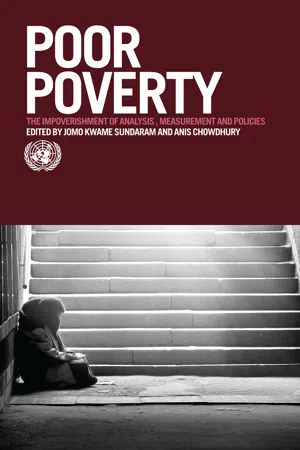
This book, co-published with the UN's Dept of Economic and Social Affairs, offers a critical appraisal of the conventional measures and analysis of poverty as well as of poverty reduction policies. It is available as open access through the Bloomsbury Open Access programme and is available on bloomsburycollections.com.
Despite greater efforts in reducing poverty since the early 1980s, poverty remains stubbornly high in many parts of the world. This collection argues that the mainstream perspectives on poverty and deprivation have contributed to considerable distortion and misunderstanding and that is not unrelated to ineffectual policy perscriptions. In particular it highlights the World Bank's dollar-a-day measure of poverty and exposes the inadequacies of Bretton Woods-inspired poverty reduction programmes.
eBook - ePub
Poor Poverty: The Impoverishment of Analysis, Measurement and Policies
- 240 pages
- English
- ePUB (mobile friendly)
- Available on iOS & Android
eBook - ePub
Poor Poverty: The Impoverishment of Analysis, Measurement and Policies
About this book
Trusted by 375,005 students
Access to over 1.5 million titles for a fair monthly price.
Study more efficiently using our study tools.
Information
Chapter 1
The Terrible Simplifiers: Common Origins of Financial Crises and Persistent Poverty in Economic Theory and the New ‘1848 Moment’
… soon or late, it is ideas, not vested interests,
which are dangerous for good or evil.
which are dangerous for good or evil.
John Maynard Keynes, closing words of
The General Theory (1936)
The General Theory (1936)
The United Nations recently announced that the number of chronically hungry people on the planet has exceeded the billion mark for the first time. It is extremely unlikely that any of them will ever hold a Swiss 1,000 franc banknote (worth more than 900 dollars), but if they did, they would see the portrait of a man who perceived the essence of the explanation as to why extreme poverty and extreme plenty coexist so naturally on this planet, and of the grim fate of the permanently starving—Swiss historian Jacob Burckhardt (1818–1897). Burckhardt coined the term ‘the terrible simplifiers’ to describe the demagogues who—in his dark vision of what the 20th century would bring—would play central roles in the future (Dru 2001: 230). Events amply fulfilled Burckhardt’s predictions of a cataclysmic 20th century, of the rule of terrible simplifiers, men who were Burckhardt’s colleagues at the University of Basel, Friedrich Nietzsche, called power-maniacs (Gewaltmenschen), and John Maynard Keynes referred to in 1936 as ‘madmen in authority’.
A key common element in persistent world poverty and in the financial and (real) economic crisis is the ‘terrible simplification’—a theoretical overshooting into irrelevant abstractions—that has taken place in economic theory after World War II. As unlikely as it may initially sound, I shall endeavour to explain in this paper how—in spite of its apparent sophistication—equilibrium economics became ‘mathematized demagoguery’ based on an extremely simplistic world view. Joseph Schumpeter’s solution to the late 19th century Methodenstreit (‘battle of methods’) of economics had pointed in a very different direction, arguing that the profession needed to have theories at different levels of abstraction. According to the problem posed and the question asked, one should be able to enter the edifice of economic theory at a level of abstraction where one was likely to find an answer (Schumpeter 1908). After World War II, economics experienced the opposite development: only very abstract theory survived. In this process, the main causes of uneven development as well as the cause of financial crises were assumed away from the theoretical edifice. The financial crisis appears to have created a turning point. The July 18, 2009 edition of The Economist—normally a weekly that strongly supports mainstream economic theory—portrays the crisis in economic theory on its front cover with a book entitled ‘Modern Economic Theory’ experiencing a meltdown like an ice-cream abandoned on the beach on a hot summer’s day, with the subtitle: ‘Where it went wrong—and how the crisis is changing it’.
WHERE ECONOMICS WENT WRONG: ON ABSTRACTION VS. SIMPLIFICATION
All theories depend on abstractions. When we use the word ‘leaf’—like leaves on a tree—we are making a sweeping generalization by implicitly overlooking the enormous differences that exist among various types of leaves. However, opening the theoretical box labelled ‘leaf’, we find that botanical science has produced a very detailed classification system for leaves: sword-shaped (ensiformis), lance-shaped (lanceolata), ovate (ovata), elliptic (elliptica), cordate (cordata), oblanceolate (oblanceolata), etc. Most people eating black-berries would be satisfied with recognizing just one species (Rubus fruticosus), but in my country (Norway) alone, botanists distinguish among a large number of species, for which the main distinguishing factor is the shape of the leaves (Rubus plicatus, fissus, sulcatus, radula, etc.). The apparent simplification of using the word ‘leaf’ is a justified abstraction, not a terrible simplification, because—in the spirit of Schumpeter (1908)—it is possible to arrive at a qualitative understanding of leaves through a taxonomy (a classification system) for leaves that exists on a multiplicity of levels, down to a level of detail that far exceeds most people’s needs.
In botany, opening the very abstract box called ‘leaf’, we find a very complete taxonomy at different levels of abstraction. If we pry open most of the theoretical abstractions in economics, we shall find that even these static boxes are empty. Economics hardly contains any taxonomies; in fact, the most salient feature of economics as a science is the ‘equality assumption’; the economic mainstream effectively assumes away all differences among human beings, among economic activities and among nations. One classic example of this is the concept of the ‘representative firm’, which equates the giant firm Microsoft with a twelve-year-old self-employed shoeshine boy in a Lima slum (Reinert 2007).
Assuming that qualitative differences do not exist—as does mainstream economics in key areas—is a terrible simplification that has extremely serious consequences in terms of lost human welfare. We can only understand why medical doctors make more money than truck drivers if we are willing to observe the differences between the two professions. In parallel fashion, we can only understand the difference in wealth between the United States and Africa by qualitatively understanding the huge differences in the productive structures of the two areas.
The roots of this problem are already found in Adam Smith’s Wealth of Nations (1776), where the author bundled all manufacturing, all agriculture and all trade—all human economic activity—into one single category: labour hours. I have previously explained how Adam Smith is at his least convincing when he tries to prove to his readers that all economic activities are alike (Reinert 1999). Building on ‘labour hours’ as the only unit of accounting, David Ricardo (1817) constructed the labour theory of value that provided the origins of international trade theory that essentially conceived of world trade as the bartering of labour hours, void of any quality, among nations. Not even the fact that some economic activities obviously are able to absorb more capital or become more mechanized than others is accounted for.1
Economic theory is cyclical, and this paper argues that crises create turning points when theory is forced to move from a very high level of abstraction—from practical irrelevance—to something more closely resembling reality, and therefore becomes more able to solve the problems facing us.
International trade theory’s prediction of equalization of wages across countries is, in my view, the key terrible simplification that causes world hunger. Not only are all qualitative differences assumed away, the production process itself is also abstracted away. Assuming away unemployment, as the World Bank traditionally does in its models, only adds another dimension to the terrible simplification on which our world economic order is based. In many countries, 80 per cent of the potentially active population are unemployed or underemployed. Assuming that fact away is a terrible simplification.
Even very simple taxonomies may have strong explanatory power. If we divide human beings into just two different categories, men and women, we can explain procreation. Similarly, as Friedrich List (1841) observed, successful economic strategies have historically been based on the classifications found in King (1721), which have been the basis for all successful strategies of catching up. The core theoretical argument explaining this lies in an equally simple binary taxonomy found in a 1923 paper by US economist Frank Graham (see Appendix 1), arguing that a key point in the career of Nobel Laureate Paul Krugman was precisely the elimination of Graham’s taxonomy.2
US historian Richard Goldthwaite shows the historical importance of the dichotomy between raw materials and manufacturing in a recent book: what is generally seen as Europe’s ‘commercial revolution’, Goldthwaite argues, was in fact a process of import substitution—manufactured goods, that had previously been imported in the Levant, started to be produced in Europe from the 12th century onwards (Goldthwaite 2009, 6–8). I shall argue that this extremely important distinction—between raw materials subject to diminishing returns, monoculture and perfect competition on the one hand, and manufactured goods subject to increasing returns and a large division of labour on the other—was lost in the post-WW II period. Only nations that continued their industrialization strategies—like India and China, starting from the late 1940s—have been successful during the latest process of globalization. If India and China are removed from the sample, globalization is a shambles, even more so in terms of real wages than in terms of GDP per capita (because wages as a percentage of GDP have been reduced across the board).
Today’s mainstream economics, I would argue, has lost not only a key feature of the Enlightenment—making order by producing classification systems (taxonomies)—but also the key feature of the Renaissance that preceded the Enlightenment: the immense creativity and innovations, in all aspects of human life, unleashed during that period. Economics lost what Nietzsche refers to as ‘capital of will and spirit’ (Geist- und Willens-Kapital). Our qualitative understanding (‘verstehen’ in German philosophy) was crowded out by a more mechanical form of understanding (see Drechsler 2004 for a discussion). ...
Table of contents
- Poor Poverty
- Copyright
- Contents
- List of Tables
- List of Figures
- Acknowledgements
- Contributors
- Introduction
- Chapter 1: The Terrible Simplifiers: Common Origins of Financial Crises and Persistent Poverty in Economic Theory and the New ‘1848 Moment’
- Chapter 2: Growth, Development Policy, Job Creation and Poverty Reduction
- Chapter 3: Governance, Growth and Poverty Reduction
- Chapter 4: The Emperor’s New Suit: Global Poverty Estimates Reappraised
- Chapter 5: Poverty Reduction in China and India: Policy Implications of Recent Trends
- Chapter 6: The Bottom of the Pyramid Strategy for Reducing Poverty: A Failed Promise
- Chapter 7: How Effective is Microfinance as a Poverty Reduction Tool?
- Chapter 8: Property Rights for Poverty Reduction?
- Chapter 9: How Cash Transfers Promote Work and Economic Security
- Index
Frequently asked questions
Yes, you can cancel anytime from the Subscription tab in your account settings on the Perlego website. Your subscription will stay active until the end of your current billing period. Learn how to cancel your subscription
No, books cannot be downloaded as external files, such as PDFs, for use outside of Perlego. However, you can download books within the Perlego app for offline reading on mobile or tablet. Learn how to download books offline
Perlego offers two plans: Essential and Complete
- Essential is ideal for learners and professionals who enjoy exploring a wide range of subjects. Access the Essential Library with 800,000+ trusted titles and best-sellers across business, personal growth, and the humanities. Includes unlimited reading time and Standard Read Aloud voice.
- Complete: Perfect for advanced learners and researchers needing full, unrestricted access. Unlock 1.5M+ books across hundreds of subjects, including academic and specialized titles. The Complete Plan also includes advanced features like Premium Read Aloud and Research Assistant.
We are an online textbook subscription service, where you can get access to an entire online library for less than the price of a single book per month. With over 1.5 million books across 990+ topics, we’ve got you covered! Learn about our mission
Look out for the read-aloud symbol on your next book to see if you can listen to it. The read-aloud tool reads text aloud for you, highlighting the text as it is being read. You can pause it, speed it up and slow it down. Learn more about Read Aloud
Yes! You can use the Perlego app on both iOS and Android devices to read anytime, anywhere — even offline. Perfect for commutes or when you’re on the go.
Please note we cannot support devices running on iOS 13 and Android 7 or earlier. Learn more about using the app
Please note we cannot support devices running on iOS 13 and Android 7 or earlier. Learn more about using the app
Yes, you can access Poor Poverty: The Impoverishment of Analysis, Measurement and Policies by United Nations, Anisuzzaman (Anis) Chowdhury,Jomo Kwame Sundaram, Anisuzzaman (Anis) Chowdhury, Jomo Kwame Sundaram in PDF and/or ePUB format, as well as other popular books in Economics & Development Economics. We have over 1.5 million books available in our catalogue for you to explore.