What this book most definitely is not is yet another academic discussion of Lope de Vega, Calderon and their contemporaries, divorced from any understanding of what makes these plays work so brilliantly on our stages. Instead it is a leading contemporary translator's account of why these plays deserve to assume their rightful place in our performance repertoire, firmly set within the demands and opportunities of how our theatre works.
In a way it is the story of a love affair between a translator and a dramatic tradition whose riches are only now becoming apparent to theatre audiences; but it is also an exploration of the ways in which translation itself takes plays that are distant from us in time and space and makes them real and visible in terms of our own experience and our contemporary sensibilities.
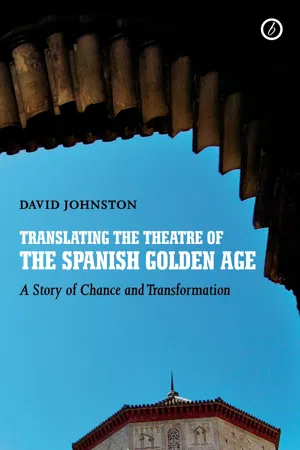
eBook - ePub
Translating the Theatre of the Spanish Golden Age
A Story of Chance and Transformation
- 104 pages
- English
- ePUB (mobile friendly)
- Available on iOS & Android
eBook - ePub
Translating the Theatre of the Spanish Golden Age
A Story of Chance and Transformation
About this book
Information
A Popular Theatre
IT IS SURELY a truism of theatre history that what was once popular theatre becomes increasingly rarefied with the passage of time. The idea of a sonnet being spoken on stage sounds undeniably arcane, a show-stopper in the most literal sense. It is into this potential rupture that the translator steps in order to keep the conversation between play and its new audience going. The theatre of the Spanish Golden Age was, of course, genuinely popular in that it provided the only space in which the community was able to think about itself in front of itself; it did one of the things that theatre perhaps does best, that is to encourage the collaborative performance of collective meaning. And it did that through its writers’ interpretative creativity, giving their audiences fast-moving pieces located within the heart of their own national narrative and common fund of stories, addressing through them the foibles, fears and fantasies of the moment. All of which remain – or can be encouraged to remain – resonant today.
A great example of that is Lope’s Fuenteovejuna, written sometime between 1612 and 1614, and still one of the most frequently performed and translated of Golden Age plays. The name of a small town in the south of Spain, not far from Córdoba, Fuenteovejuna deals with an event that still loomed large in the popular imagination. In 1476 the lord of Fuenteovejuna was murdered by the villagers acting in unison in reprisal for the reign of terror that he had inflicted on the local population. When interrogated under torture, the only response that nail-pulling and rack-stretching were able to elicit from the villagers was that ‘Fuenteovejuna did it’, a phrase now common currency in Spanish to refer to any event for which only collective responsibility can be apportioned. Like The Great Pretenders, written five or six years earlier, Fuenteovejuna moves extraordinarily across a whole tapestry of vivid theatrical actions, from sexual terrorism to pun-laden comedy and that most powerful scene in which Laurencia baits the men, calling their manliness into question for their cowardly acceptance of a political hierarchy that turns their women into playthings:
You cluck around like frightened hens
while your women are beaten and raped!
What sort of men are you? Go home,
take off your swords, they’re just for show!
Go and get on with your spinning!
For the love of God, stand aside
and let the women of this town
show you what real honour means,
because we will not bow to tyrants
and we will meet their violence with ours.
Go home, before we turn on you!
Before we turn our stones on you!
You call yourselves men? Go and fuck
each other, then finish your sewing!
Cowards! Sheep! Hide behind your women
and tomorrow, when Frondoso’s dead,
executed by that murderer
without trial and without jury,
we’ll dress you in your scarves and skirts,
and powder your white cheeks with rouge.
Once again the translation here features a ‘vulgar ethnicity’. But the sense of shock that this speech must have prompted in the theatre would have been palpable. This is anything but a comfortable drawing-room piece. Indeed, little wonder then that Fuenteovejuna has been produced time and time again as a rallying call to action. In its own day, of course, it had to be seen to offer an image of final reconciliation. At the end of the play, the King and Queen pardon the villagers in the name of natural justice, effectively restoring God-given authority as the climax to the surface narrative. But it is hard to escape the feeling that what is both theatrically compelling about this play, and what undoubtedly lingers longest in the memory of spectators, is that the men, goaded by their women’s sense of outrage at the wrongs that have been perpetrated upon them, commit an act of revolutionary violence. In the emotional experience of the audience, the cruel overlord effectively carries the rap for the tyranny of feudalism and for machista violence over the centuries. The electric tension that this must have created in the audience of the time becomes the objective that the contemporary translator – and, of course, director – have to aim for, perhaps above all else.
The Elizabethan stage might have found Laurencia’s speech harder to handle, not least because it would have been delivered by a man. Lope, however, would have had little trouble in casting his Laurencia. Golden Age plays are notably full of strong women, and acting companies were assembled so as to be able to offer the full gamut of stock characters, from worldly-wise servant right up to monarch. In the professional theatre actresses were as well represented on stage as men, in exactly the same way as the audience was divided equally between the sexes. Many of these actresses were considered, to use today’s term, to be stars. The names Micaela de Luján (one of Lope’s great muses), María Calderón (who bore a son to one of her most devoted admirers, King Philip IV), María de Riquelme (who countered the commonly held view that all actresses were deeply immoral by enjoying a long and happy marriage to minor dramatist Manuel Alvarez de Vallejo), and Baltasara de los Reyes, among others, are all still remembered today. Surviving documents belonging to La Baltasara (as de los Reyes was popularly known) provide evidence of the economic as well as artistic power of these women, who...
Table of contents
- Cover
- Title Page
- Copyright
- Dedication
- Contents
- Preface
- The Artful Voyeur
- A Continuum of Transformation
- Outside the Circle of Shakespeare’s Art
- Universal? Or Perhaps Unique?
- The New Art of Writing Plays
- Theatre’s Riotous Assembly
- A Popular Theatre
- Through the Looking Glass, Darkly
- Forgive its Many Flaws
- The Theatre of Words
- Out of the Wings
- Further Reading
- Index
Trusted by 375,005 students
Access to over 1.5 million titles for a fair monthly price.
Study more efficiently using our study tools.
Frequently asked questions
Yes, you can cancel anytime from the Subscription tab in your account settings on the Perlego website. Your subscription will stay active until the end of your current billing period. Learn how to cancel your subscription
No, books cannot be downloaded as external files, such as PDFs, for use outside of Perlego. However, you can download books within the Perlego app for offline reading on mobile or tablet. Learn how to download books offline
Perlego offers two plans: Essential and Complete
- Essential is ideal for learners and professionals who enjoy exploring a wide range of subjects. Access the Essential Library with 800,000+ trusted titles and best-sellers across business, personal growth, and the humanities. Includes unlimited reading time and Standard Read Aloud voice.
- Complete: Perfect for advanced learners and researchers needing full, unrestricted access. Unlock 1.5M+ books across hundreds of subjects, including academic and specialized titles. The Complete Plan also includes advanced features like Premium Read Aloud and Research Assistant.
We are an online textbook subscription service, where you can get access to an entire online library for less than the price of a single book per month. With over 1.5 million books across 990+ topics, we’ve got you covered! Learn about our mission
Look out for the read-aloud symbol on your next book to see if you can listen to it. The read-aloud tool reads text aloud for you, highlighting the text as it is being read. You can pause it, speed it up and slow it down. Learn more about Read Aloud
Yes! You can use the Perlego app on both iOS and Android devices to read anytime, anywhere — even offline. Perfect for commutes or when you’re on the go.
Please note we cannot support devices running on iOS 13 and Android 7 or earlier. Learn more about using the app
Please note we cannot support devices running on iOS 13 and Android 7 or earlier. Learn more about using the app
Yes, you can access Translating the Theatre of the Spanish Golden Age by David Johnston in PDF and/or ePUB format, as well as other popular books in Literature & European Drama. We have over 1.5 million books available in our catalogue for you to explore.