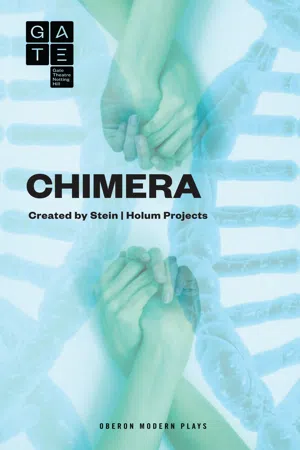
Progressive modern theatre does not shrink from taking its scripts from real science. Chimera is the story of Jennifer Saunders who learns of her rare medical condition, and the struggles to maintain a sense of self. Deborah Stein's critically acclaimed play is an ambitious, frightening and compelling take on timeless, pivotal issues of the human experience. Her inventive and funny solo performer reflects the biological, psychological and emotional ordeals in the face of the inescapability of genetic disease.
- 64 pages
- English
- ePUB (mobile friendly)
- Available on iOS & Android
eBook - ePub
About this book
Information
PART I
1. THE COFFEE LADY’S INTRODUCTION
We sit longer than comfortable. When is the show going to start? Finally, a woman enters from where we entered. She carries a white ceramic coffee mug.
Half in, half out, she starts to talk to us. Her voice envelops the space.
COFFEE LADY: There’s – did you see? There’s coffee out there, did you get some? You want to? It’s okay, we have time…anyone? No? All right, suit yourselves.
She goes to the back of the house and takes a seat in the audience.
So. It’s just us? Is this – everyone? Oh. I thought – there’d be – more – but. This is fine. No, no, it’s fine. Really. Well don’t look at me. Go on. Look over there. Don’t want you to miss anything. There you go.
She directs the audience to look at the stage.
This is a kitchen. This is a theatre. This is a kitchen. There’s new tile there, replaced the old linoleum. This tile is clay, beige, it’s cool if you put your cheek to it. Not that you’re going to do that, put your cheek on the floor. But if you were to lie down on the floor like a dog and put your face on the tile, it feels cold.
This is the kitchen of Jennifer Samuels. It has her personal stamp. There is nothing personal about this kitchen.
As she describes the kitchen, her physical description does not match up with what we’re actually looking at.
On the right she has one of those, what’s-it-called, those bar-things that were so popular in the 90s, a bar where you can cook and entertain at the same time. That’s on your right, there. Stainless steel. There are three wooden stools with short backs, and cream-colored cushions. About eighteen inches off the ground, on the far side, where the stools are, the bar is scuffed and dented. Feet. In sneakers. Kicking. Jennifer Samuels has a son. Brian. When she put in this bar, he was eight. And prone to kicking with dirty, dirty little boy feet.
In the center of this kitchen is an island that doubles as a table. Behind that is a sink and if you stand at the sink running the garbage disposal, you’re going to look out that window. On the shelf by the window is a bowl of fruit, a lemon and some limes and a heavy peach, and also a row of bottles. Medicines? Vitamins. But if you stand at the window, you won’t look at the shelf, you’ll look out the window and into the garden. There are lilacs there, and lettuce, and a pear tree. Jennifer Samuels has a beautiful garden.
The window doesn’t actually open. This is a kitchen. This is a theatre. The faucet doesn’t work. This isn’t that kind of theatre.
On the table, on the island, on the table, there is a knife. To the left of the sink, against the wall, there is a refrigerator. Sleek, brushed steel, the kind with the two long doors and a freezer that is the same size as the fridge part. Inside the fridge, on the top shelf, on the left side of the fridge, there is a bag of rotting apples.
Jennifer Samuels stands in the kitchen between the island table and the sink by its window and she is breathing heavily, and she sees her heart beating in her chest. Sees it – well, the only word is “throbbing,” – she sees her own heart throbbing against the skin, making her flesh vibrate – she’s fascinated, fascinated by the perceptible tactility of her own body. Guh-thump, guh-thump, guh-thump…
There’s all kinds of similes I could use here, to describe what it looks like and feels like, but I won’t, because this is not a poem.
COFFEE LADY gets up, comes down from the back of the house and stands at the side of the stage, sipping her coffee.
We’re not living inside a poem, are we now? No. Life is not like that. Life is not like that at all. At all. Maybe you were expecting a poem.
COFFEE LADY hands her cup to an audience member in the front row, insists that they take it from her.
Can you hold that for me? Thank you.
She steps onstage.
There’s a fleshy rotting smell coming from somewhere in the kitchen. It’s not the apples.
Jennifer Samuels takes the lemon from the bowl on the window ledge and cuts it into wedges and throws it down the garbage disposal.
COFFEE LADY stands at the sink, her back to the audience.
She turns around. She is now JENNIFER SAMUELS. Her voice continues as a voiceover.
COFFEE LADY: (Voiceover.) Inside the head of Jennifer Samuels, inside her insides, we are crawling through her bloodstream like a disease, she is becoming aware of the world and herself and her cells in a way she never ever dreamed about, she feels herself splitting into two, the cells congealing into baby and then person, her own blood betraying itself and later when she lies down on this floor and feels herself split from herself, she thinks,
JENNIFER: (Live.) “This isn’t me. What am I doing?”
While COFFEE LADY speaks, the movement described in the next paragraph is mimed. (There are no props in this kitchen, and it turns out that the fridge and the cabinet don’t open. They are what she said they were: a stage set. But we do hear the sounds of the described actions on a hyper-real soundtrack that corresponds exactly to her actions.)
Movement sequence: JENNIFER SAMUELS breathes heavily. Watches her own heart beat in her chest. Smells a fleshy rotting smell. Crosses to the fridge. Opens, sniffs, closes. Turns. Goes to window, picks a lemon out of a bowl, crosses to the table centerstage. Cuts the lemon in half, then in quarters. Crosses to the sink, drops the lemons down the drain. Turns on the water, then the disposal, turns off the disposal, then the water. Turns.
COFFEE LADY: (Voiceover.) Ah. Lemon.
JENNIFER: (Live.) That’s better.
Sniffs her arm.
JENNIFER SAMUELS almost falls down but is caught mid-fall, as if paused mid-air.
COFFEE LADY speaks.
COFFEE LADY: (Voiceover.) Jennifer Samuels falls down.
JENNIFER falls completely.
Jennifer Samuels can’t stand up. Jennifer Samuels places her cheeks and hands to the floor.
She does.
The tiles are cool. She’s burning up. The tiles are clay, they keep the cold.
JENNIFER: (Live.) Something’s not right.* Something’s going on…
COFFEE LADY: (Voiceover start at *.) Something’s going on inside *of Jennifer Samuels.
JENNIFER: (At *.) …inside…
She stands up.
COFFEE LADY: (Voiceover.) Brian is eight years old.
Brian is not yet born.
Brian is eight years old and she can’t stand the smell of him.
JENNIFER vomits in the sink.
Lemons.
COFFEE LADY turns around from the sink.
COFFEE LADY: (Live.)
Let me dispel something right off. This is not a tragedy. Nobody is going to die in this story. You got that? You clear about that? Because some people will hear things, or see things, that will make them worry, “oh no, this person or that person whom I’ve never met but because their story is being told on a stage via certain ancient narrative structures designed to make me care, to make me invest in him or her, this character or that character in whom I have, in spite of myself, invested, this person, this little boy, is going to die.”
So, get this straight, this is not that kind of story. Nobody’s going to die.
I speak of Jennifer in the past tense, standing here in her abandoned kitchen, because there came a time when Jennifer Samuels disappeared. She – v...
Table of contents
- Cover
- Half-title Page
- Title Page
- Copyright
- Contents
- Characters
- A Note About the Costumes
- Pre-show
- Part I
- Part II
- Part III
Trusted by 375,005 students
Access to over 1.5 million titles for a fair monthly price.
Study more efficiently using our study tools.
Frequently asked questions
Yes, you can cancel anytime from the Subscription tab in your account settings on the Perlego website. Your subscription will stay active until the end of your current billing period. Learn how to cancel your subscription
No, books cannot be downloaded as external files, such as PDFs, for use outside of Perlego. However, you can download books within the Perlego app for offline reading on mobile or tablet. Learn how to download books offline
Perlego offers two plans: Essential and Complete
- Essential is ideal for learners and professionals who enjoy exploring a wide range of subjects. Access the Essential Library with 800,000+ trusted titles and best-sellers across business, personal growth, and the humanities. Includes unlimited reading time and Standard Read Aloud voice.
- Complete: Perfect for advanced learners and researchers needing full, unrestricted access. Unlock 1.5M+ books across hundreds of subjects, including academic and specialized titles. The Complete Plan also includes advanced features like Premium Read Aloud and Research Assistant.
We are an online textbook subscription service, where you can get access to an entire online library for less than the price of a single book per month. With over 1.5 million books across 990+ topics, we’ve got you covered! Learn about our mission
Look out for the read-aloud symbol on your next book to see if you can listen to it. The read-aloud tool reads text aloud for you, highlighting the text as it is being read. You can pause it, speed it up and slow it down. Learn more about Read Aloud
Yes! You can use the Perlego app on both iOS and Android devices to read anytime, anywhere — even offline. Perfect for commutes or when you’re on the go.
Please note we cannot support devices running on iOS 13 and Android 7 or earlier. Learn more about using the app
Please note we cannot support devices running on iOS 13 and Android 7 or earlier. Learn more about using the app
Yes, you can access Chimera by Deborah Stein,Suli Holum,Stein/Holum Projects in PDF and/or ePUB format, as well as other popular books in Literature & British Drama. We have over 1.5 million books available in our catalogue for you to explore.