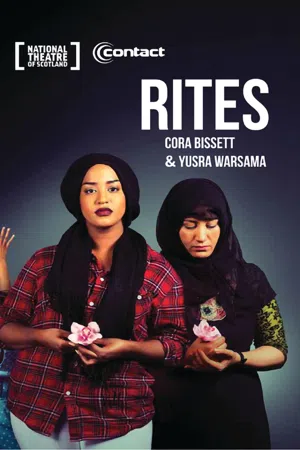
Rites is a powerful and provocative new play exploring the deep-rooted cultural practice of Female Genital Mutilation (FGM). This ritual of enforced cutting has been performed for centuries and millions of girls worldwide, often as young as five years old, are still subjected to it. The reasons are complicated and myriad. It depends who you are what you've been taught. Some things are simple though: FGM is still happening across the world. FGM is happening in the UK, here and now.
Rites is based on interviews and true stories from girls affected in Scotland and the rest of the UK, mothers who feel under pressure to continue the practice, and the experiences of midwives, lawyers, police officers, teachers and health workers trying to effect change in communities. Weaving together different perspectives into a multi-voiced production, the play explores the complexities, misconceptions and challenges involved in trying to change what is to many, a fundamental rite of passage.
- 80 pages
- English
- ePUB (mobile friendly)
- Available on iOS & Android
eBook - ePub
Rites
About this book
Information
PANEL 1
The following scene is delivered as part of the soundscape that starts the play and should not be delivered by actors on stage.
| INTERVIEWER: | So, let’s go back to the first question… What is FGM? |
| FATIMAH: | So FGM, is, err, or female genital mutilation, sometimes known as female genital cutting or circumcision. It’s basically a practice that involves changing or altering, or removing part of a girl or a woman’s external genitals. And the most important part of the definition is for no medical reason. It’s also – it’s a practice that’s really harmful to girls… And there’s lots of, like local terms for it. So you hear – Sunnah or you hear Bundo or, erm/ |
| ABHAYA: | Khatana, Halalis, Tahoor… I come at FGM from the perspective that it is one of the worst human rights violations on the planet about which very little was being done, and about which very little was known. |
| INTERVIEWER: | Why’s it being done? |
| FATIMAH: | It’s complicated. (Laughter.) It’s cultural, it’s deep rooted, it’s about a rites of passage. |
| ABHAYA: | But we should be clear, it’s child abuse at the end of the day. |
| FATIMAH: | I think we have to be careful with words like “child abuse”… We forget that the women who we are calling the abusers almost certainly had FGM themselves, so at what point do they shed the victim persona and take on a persona of an abuser? |
Before ABHAYA can retort the interviewer jumps in. | |
| INTERVIEWER: | Is there a connection between religion and FGM? Is there a connection there? |
| ABHAYA: | It’s done whether or not they’re Muslim…so it’s Christian, Muslim and Animist. It exists around the world. |
| FATIMAH: | It pre-dates religion. |
| ABHAYA: | There is nothing in the Quran that states that FGM is lawful. God wouldn’t have created it if it wasn’t meant to be used…that’s what I’m saying. As simple as that. |
| FATIMAH: | It’s on a continuum of gender-based violence/ |
| ABHAYA: | Yeah. It’s all about men controlling a woman’s sexuality and controlling a woman’s…space. |
| KHALED: | No, I think, I think it's completely the opposite, men have never really interfered… |
| Men are not present while the cutting is happening, they don’t know in detail what really goes on. You know, at the end of the day I know this is being done to please men but on the other hand if you speak to men from these communities they will tell you that, “This is not my issue. It’s a woman thing.” | |
| Right from the start it was the women who controlled it. | |
| INTERVIEWER: | So why’s it driven by the women? Why do the women drive it then? |
| KHALED: | We don’t know/ |
| FATIMAH: | It’s very complex. |
| ABHYA: | It’s not complex when it comes down to a child. |
| INTERVIEWER: | (Not giving up on the point.) What makes a woman do these things to her daughter? |
FARA 1
FARA enters.
| FARA: | I am real. I am a West African woman living in Scotland. I am being played by an actress for you. I gave them my words and they gave theirs. Every character you meet today is a real person. I am one of many stories, many different stories, which you may be surprised by. You may think you know a little of what this is about. You may know a lot. It’s more complicated than it seems. We do not all agree. Let us start by listening. |
She listens and hears the sound of a party from the distance. She becomes a young girl. She looks excited. The women come out from behind the screen as her aunties. They are readying her for the FGM ceremony. It is joyous, celebratory. Drums, chanting, clapping. They put a very special dress upon her, much fuss being made. We go up to the point where she enters the hut. The drums are escalating, the other women have disappeared now. The singing is still heard on track but is becoming a little disjointed. We cannot see FARA. The spotlight is now on her mother standing to the side of the screen, watching. She is emotional but steadfast. There is a pain in her, but she looks on. The drums get louder and louder, building to a crescendo, then cut dead. | |
PANEL 2
| SARAH: | It’s happening here. In my school. I think it was in 2008, I was going to take a group of girls on a horse riding trip and I was taken aside by one of the team leaders and I was told that 11 of the girls I was planning to take on this trip had disclosed that they had FGM…and couldn’t, you know, go horse riding. I thought: she probably doesn’t mean what I think she means. I thought, it must be another school acronym, like FSM (Free School Meals) etc…etc… But it wasn’t – it was FGM. And I think the thing that horrified me the most – of course everybody thought that it was a terrible thing, that it was a tragedy, but it was the acceptance that you can’t do anything, that you can’t change, you can’t go there, can’t have conversations about it, and it just seemed, I remember thinking at the time, it’s almost as if you have two sets of rules – one for white British and one for other… |
| NAILAH: | I remember I was in primary school at the time, around ten years old, someone from my family came to give me measurement, clothes or new skirt, and my mum allowed it because it happened to most girls in the town, at that time, like 90% in the Egyptian village, so it was like normal to them…you know? |
| I was really innocent, I didn’t know what was going on. I feel like I was in a dream, like a bad dream. My elder sister was trying to stop it, trying to tell me, “Don’t Go. Don’t go.” And I said, “Why is she telling me not to go? They are going to give me a new skirt.” But she is older than me, she knew. She was trying to tell my mum, “don’t do it for her.” But I didn’t understand what she mean by that you know? | |
| AWAT: | Actually my first experience with er… FGM was going back to probably 1988 during the war between Iraq and Iran. It was a very, very tough war. Five thousand villages destroyed by Saddam and we were forced to refugee camps. |
| So we are educated family because we lived in a different area of Kurdistan, we came the camps and they, the people from the rural areas, they affect my mum, and my mum, I believe that she did not want to do but somebody persuaded, convinced her to do… the pressure you know. | |
| One day I was – I came back from school and I heard, “Someone comes, a woman comes to do”, we say, “Khatana”…cutting for woman and unfortunately it was to my little sister. And for me that was kind of shocking. I was very curious – “what do you want to do, why do you need to taking…?” It was happening in my house. | |
| And we try to, you know, go and to know what’s happening, what’s happening inside so they shout at us to leave the room. And I was very curious because, kind of, for me there was, my dad wasn’t there and want to be like Father, you know, you feel you are responsible. The woman they shout at me and they will say, “Oh don’t, don’t, don’t be upset. Just wait outside.” | |
| And all the kids from the neighbour are all together and just talking and some kind of laughing – “Oh what are they going to do?” And, for me, it was kind of something very… very heavy in mind. And we are waiting, we was waiting to see the pieces of cutting, the flesh they might throw out. All the kids, they are looking for our piece of flesh from my family, you know. |
FARA 2
| FARA: | I came to Scotland when I was twenty five. I was the first person in my family to go to University. Before I was in Uni, if you asked me about FGM I would just say it’s just something we do, a part of my culture, and I really…because that’s what I was made to believe. And then one day I was in class, at University um, I was taking a module on gender based violence and one of the topics we were covering that day was FGM and I remember I was sat in the class and the lecturer was talking about FGM. Half of the lecture I didn’t have a clue what he was talking about. |
A uni table is rolled on. The characters from the panel become the other students listening to the lecture out front. We hear the voice of the lecturer. We see the graphics of what he is describing. He explains the different types of FGM. | |
| LECTURER: | Good morning everyone. Today, we will be talking about the deeply ingrained cultural tradition of FGM. |
| Female genital mutilation, also known as female genital cutting and female circumcision, is the ritual removal of some or all of the external female genitalia. Typically carried out by a traditional circumciser using a blade or razor, mostly without anaesthesia. The age at which it is conducted varies: from days after birth to puberty, and often involves a larger celebratory ceremony. | |
| The World Health Organisation have classified Female Genital Mutilation into four types: | |
| Type 1– excision of the prepuce, with or without excision of part or all of the clitoris; | |
| Type 2 – excision of the clitoris with partial or total excision of the labia minora. After the healing process has taken place, scar tissue forms to cover the upper part of the vulva region; | |
| Type 3 – infibulation – this is the most severe form of female genital mutilation. Infibulation often (but not always) involves the complete removal of the clitoris, together with the labia minora and often the whole of the medial part of the labia majora. The two sides of the vulva are then sewn together with silk, catgut sutures, or thorns leaving only a very small opening to allow for the passage of urine and menstrual flow. This opening can be preserved during healing by insertion of a foreign body; | |
| Type 4 – all other forms which do not involve types 1, 2, or 3. Which can include: pricking, piercing or incising of the clitoris and... | |
Table of contents
- Cover
- Title Page
- Copyright
- Contents
- Original production
- Panel 1
- Help and Advice
Trusted by 375,005 students
Access to over 1.5 million titles for a fair monthly price.
Study more efficiently using our study tools.
Frequently asked questions
Yes, you can cancel anytime from the Subscription tab in your account settings on the Perlego website. Your subscription will stay active until the end of your current billing period. Learn how to cancel your subscription
No, books cannot be downloaded as external files, such as PDFs, for use outside of Perlego. However, you can download books within the Perlego app for offline reading on mobile or tablet. Learn how to download books offline
Perlego offers two plans: Essential and Complete
- Essential is ideal for learners and professionals who enjoy exploring a wide range of subjects. Access the Essential Library with 800,000+ trusted titles and best-sellers across business, personal growth, and the humanities. Includes unlimited reading time and Standard Read Aloud voice.
- Complete: Perfect for advanced learners and researchers needing full, unrestricted access. Unlock 1.5M+ books across hundreds of subjects, including academic and specialized titles. The Complete Plan also includes advanced features like Premium Read Aloud and Research Assistant.
We are an online textbook subscription service, where you can get access to an entire online library for less than the price of a single book per month. With over 1.5 million books across 990+ topics, we’ve got you covered! Learn about our mission
Look out for the read-aloud symbol on your next book to see if you can listen to it. The read-aloud tool reads text aloud for you, highlighting the text as it is being read. You can pause it, speed it up and slow it down. Learn more about Read Aloud
Yes! You can use the Perlego app on both iOS and Android devices to read anytime, anywhere — even offline. Perfect for commutes or when you’re on the go.
Please note we cannot support devices running on iOS 13 and Android 7 or earlier. Learn more about using the app
Please note we cannot support devices running on iOS 13 and Android 7 or earlier. Learn more about using the app
Yes, you can access Rites by Cora Bissett,Yusra Warsama in PDF and/or ePUB format, as well as other popular books in Literature & British Drama. We have over 1.5 million books available in our catalogue for you to explore.