This book has been nominated for both the Sheridan Morley Prize for biography, and the Theatre Book Prize.
A story of a man whose star rose very quickly and very early, and fell slowly and inexorably. A story of a man who knew himself perhaps too well, but not particularly wisely. It is exhilarating, perplexing and tragic.
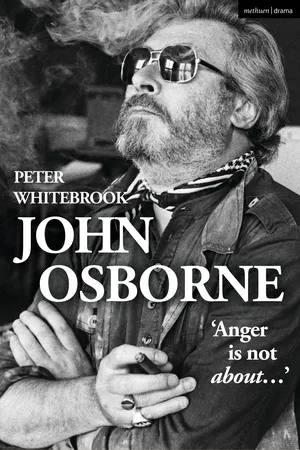
This new biography offers the most rounded portrait of Osborne yet seen. By embedding him in a social and cultural as well as a biographical context, Whitebrook presents Osborne in a way that has not been attempted before.
It is the first book to properly explore the importance of his early collaborative work with Anthony Creighton, his lasting friendship with Pamela Lane, and his deep spiritual beliefs. It reveals the autobiographical background to Look Back in Anger and Watch It Come Down and places his literary achievement within a quintessentially English tradition.
Seldom has a dramatist so compulsively revealed so much of himself – his flaws, his anxieties, his passion and his hatred – as John Osborne. His was a dazzlingly high-octane performance and in a succession of increasingly ambitious plays written during the 50s and 60s, he was able to unite a profound, intuitive intelligence with a caustically honest depth of feeling. By refusing to submit to caution, he laid bare in some of the most poetic and incendiary language heard in the 20th-century theatre, not only his own struggles and contradictions but those of the era. Almost single-handedly, he made the theatre important again.
Catapulted from obscurity to being the icon of his age when he was only twenty-five, Osborne was at the height of his fame equally celebrated and derided as 'the Angry Young Man'. John Osborne: 'Anger is not about' examines his fractious, often chaotic personal life against the social and political background of his times. It provides an invigorating insight into his complex, often anguished personality and a fresh critical assessment of his writing. A vivid account not only of what it was like to be John Osborne, loyal and generous, scathing and brutal, but what it was like to be so restlessly a creative artist in the latter 20th century.
Click here to read an exclusive extract in The Independent
- 432 pages
- English
- ePUB (mobile friendly)
- Available on iOS & Android
eBook - ePub
About this book
Information
PART 1

Beginnings
CHAPTER 1
A New Start
LATE AT NIGHT ON 22 September 1961, a three-vehicle convoy consisting of two cars and a furniture removal van turned off the main London to Eastbourne road and drove quietly into the Sussex village of Hellingly. It was a leafy, peaceful place, comprising a manor house, a few houses and cottages, a fourteenth-century church incorporating stained glass by William Morris and, on the outskirts of the village, an extensive mental hospital. But the occupants of the vehicles were less interested in village history than its potential as a refuge from the scandal whirling about them in London. Theirs was a clandestine flight, elaborate precautions having been taken to elude newspaper reporters and photographers galvanised by the white heat of pursuit. And as they nosed into the lane leading to their destination, it appeared that the operation had successfully gone unnoticed. Before them, standing silhouetted in the moonlight and surrounded by an overgrown and densely entangled garden, stood The Old Water Mill, a deserted seventeenth-century house and couple of outbuildings including the disused eleventh-century mill that gave the property its name.
But as the vehicles advanced, sudden movement disturbed the hedgerows and bushes. Dark figures sprang forward, bringing the procession to a jolting halt. Voices, urgent and demanding, pierced the silence and flashlights punctured the still night air as jostling journalists and cameramen identified the second car as that carrying their quarry. John Osborne, a thirty-one-year-old Londoner celebrated on both sides of the Atlantic as ‘Britain’s most provocative playwright’, and one of the most photographed and written-about figures of the day, had been ambushed and his cover comprehensively blown.1
The popular press both loved and loathed Osborne in equal measure. This was a time in England, as Philip Larkin observed, midway ‘between the end of the Chatterley ban and the Beatles’ first LP’, and the air was full of unsettling social change, like the tangy scent of a new season.2 It had brought with it a growing moral liberalism and a new spirit of pruriently inquisitive journalism, spearheaded by the ruthlessly competitive gossip columnists of the popular daily newspapers and the editorial demand for progressively intrusive photographs to accompany their stories. John Osborne was discovering that in contrast to previous years, it was no longer possible for a public figure to expect to lead a private life.
Although the memory of world war was still so vivid that the majority of people just wanted a quiet, ordered existence, Britain was beginning to change and, depending upon who you were, you either welcomed it or not. And symbolic of that change was John Osborne, the young man now peering into reporters’ cameras from a car window in a secluded Sussex lane. He presented a curious face to the nation. Although immensely articulate, courteous and well spoken, his ‘belligerent asides’ on the governing Conservative Party, the H-Bomb, journalists, the theatre, critics, the monarchy, women, athletes, gardeners and anyone and anything else that took his fancy had made him notorious.3 Again, depending upon your point of view, he was either exhilaratingly outspoken and was saying what desperately needed to be said, or intensely irritating. John Osborne, it appeared, was making a career of being confrontational and it had already made him enviably wealthy. His current earnings were estimated at a stupendous £20,000 a year (about £394,000 at 2015 values) or, it was reproachfully pointed out, ‘twice the nation’s rate for the prime minister.’4
His journey from anonymity and penury to professional success, prominence and wealth, had been dazzlingly rapid; one month, he was unknown, but by the next you couldn’t get away from him. The turning point had come five years earlier in 1956 with his writing Look Back in Anger, an unheralded play produced at a small London theatre. Until then, Osborne had been an obscure and unreliable regional repertory actor, but the play changed everything. Co-starring Mary Ure, his second wife, it was a portrait of a venomous marital struggle that had astonished, invigorated and appalled critics and audiences. Both the play and its author immediately attracted the attention of journalists who, on the lookout for something to brighten up the grey tedium of the mid-1950s, identified Jimmy Porter, the play’s raging, vividly expressive hero, and John Osborne, his equally combative, eloquent creator, as representative of a new and shocking social type. The ‘Angry Young Man’, well mannered but appallingly uncouth, had arrived. In the whistling slipstream of Look Back in Anger had come a flurry of plays, novels and films brimming with social ‘fury and disgust’.5 While cultural commentators debated quite what the Angry Young Man was angry about, if anything, the popular press gleefully recorded the outrageous and frequently ludicrous examples of ‘anger’ and ‘angry’ activities and opinions that John Osborne, conveniently neither a reticent nor a discreet man, both wittingly and unwittingly provided.
Already, Osborne’s exploits that summer of 1961 had included his joining the widespread protests against the H-Bomb by publishing an open ‘letter to my fellow countrymen’ in a left-wing weekly paper. This recklessly inflammatory tirade, composed ‘in sincere and utter hatred’ of the government, culminated in the intimidating cry of ‘Damn you, England.’6 For several weeks afterwards, newspaper columns had been clogged with the clamour of approval and rebuke, with politicians, clergymen, trade unionists, writers and the general public all pitching in to have their say. That the ‘letter of hate’ had been written and dispatched when its author was lounging on a sun bed at a luxury villa on the French Riviera had naturally fanned the flames of controversy still higher. The unrepentant playwright had returned to England only to be arrested at a Ban the Bomb demonstration in Trafalgar Square. These adventures, though, merely added piquancy to the main Osborne story running that summer, that of his very public liaison with a married woman prominent in London’s cultural circles and with vague connections to the Royal Family, while his wife, Mary Ure, was giving birth to a baby whom the press assumed to be his at an expensive London nursing home.
The ‘other woman’ in the case was sitting beside Osborne in the car that night in Sussex. Penelope Gilliatt was a vivacious, twenty-nine-year-old Vogue journalist and film critic for the Observer. She was also the wife of Dr Roger Gilliatt, an eminent and socially well-connected neurologist who had been best man at Anthony Armstrong-Jones’s wedding to Princess Margaret the previous year. Both she and Osborne looked equally startled to find themselves the targets of a shouted volley of reporters’ questions. What exactly were Osborne and Penelope up to, they wanted to know. Did he not have a wife in London who had just given birth to a baby? Whose was the furniture in the removal van? Why had they left London? Osborne’s recent purchase of The Old Water Mill, a rural piece of the England he claimed to loathe, had been widely reported in the press. Were he and Penelope proposing to live together? What did they have to hide? What did they have to say? By now, Osborne was wise enough to the ways of daily newspaper journalism to say nothing. Instead, jumping out of the car and with Penelope at his side, he darted across the garden, closely followed by their accomplices, his friend Anthony Creighton, his secretary, Sonia McGuinness and her husband, Frank. Once inside the house, he slammed and bolted the door behind them.
Osborne’s dash to Sussex turned out to be one of the most extravagantly publicised of all his escapades that year. To an eager press, the story promised a wealth of such entertaining gossip that journalists immediately set up camp outside The Old Water Mill. Over the next few days both the Daily Express and the Daily Mail reported more details of the errant dramatist’s moonlit manoeuvres. The Sunday Pictorial splashed the ‘John Osborne and Friend in Midnight Mystery Move’ story on its front page, flanked on one side by a picture of Osborne and Mary Ure, and on the other by a snap of Penelope and Roger Gilliatt.7 At first, Osborne retaliated to the barrage of questions at the kitchen window with a salvo of ‘No comment’s. But a day later, having cornered ‘the Angry Young Man in one of his better moods’, the Daily Telegraph enlivened its centre page with an extensive interview, even though the Angry Young Man himself was being uncharacteristically and disappointingly evasive.8 All he wanted, Osborne repeated, was a bit of peace and quiet.
Although this was highly unlikely in the short term at least, the need for a new beginning was something preoccupying not only Osborne himself but, had he thought about it, was something that had run like a thread through several generations of his family.
* * *
His fourth wife, the actress Jill Bennett, once described him as a Welsh Fulham Upstart – in other words, a lower-middle-class provincial who had got above himself. A description calculated to taunt, it was one he accepted without rancour and even sported with some truculent affection. Fulham he certainly was, having been born there, the son of a lower-middle-class father with artistic inclinations and a working-class mother whose grievances seemed to encompass the world. And if a mark of being an upstart is to be possessed of a fierce drive to achieve despite the social odds, then he was that as well. Yet his Osborne forebears were only glancingly connected with Wales. During the 1970s, when he was in his forties and writing the first volume of his autobiography, the professional genealogists he asked to delve into his family history confirmed that in the male line only his father, grandfather and great-grandfather had Welsh blood. His mother, her forebears and his remaining Osborne ancestors, for many generations at least, were thoroughly English. This news gratified him immensely, since over the years he had gone to considerable lengths to rise above what he considered lowly beginnings, and was then well on his way to becoming an English gentleman, complete with a rambling country estate, dogs lolloping at his heels, and a distant view of hills. As he wryly confided to a notebook, forgetting for the moment that he was half-Welsh: ‘Whatever else, I have been blessed with God’s two greatest gifts: to be born English and heterosexual.’9
The name Osborne derives from the Old English Osbern, which in turn derives from Old Norse or Old Danish. The family may therefore have been Nordic in origin, although by the seventeenth century they had become established in and around the village of North Tawton in Devon, making their living as carpenters and bakers. During the early years of the nineteenth century, as the Napoleonic Wars rumbled and thundered overseas, Philip Osborne, John Osborne’s great-great grandfather and a carpenter in the family tradition, crossed the Bristol Channel with Martha, his wife, and settled in Newport, a thriving town on the Monmouthshire coast. There, they joined swarms of English incomers seeking work in the mines, the ironworks and new industries transforming the southern Welsh valleys into a mighty, coke-consuming furnace, a place the dour Scottish sage Thomas Carlyle would liken to a ‘vision of hell’.10 It was here that Lord Nelson, his redheaded mistress Emma Hamilton, and her husband, Sir William, a former ambassador to Naples and authority on volcanoes, had arrived in the summer of 1802 to inspect the cannons being forged for the Navy and that would eventually outgun the French at Trafalgar.
If Philip and Martha Osborne had indeed arrived in Newport in search of a new start, they would have taken particular pride in the progress of Henry, their first son, born in 1839. Henry became a domestic servant at the King’s Arms, a public house on a corner of Commercial Road near the docks, busy with stevedores and a first and last port of call for sailors. When he was thirty, Henry made a judicious marriage to Louisa Thomas, a determined, practical girl whose father, Griffith Thomas, like Philip Osborne, was a carpenter. By now, Henry was the landlord of the King’s Arms and was able to make a home for his family in rooms above the bar. He and Louisa had three children, the eldest, Henry junior, being born a year after the marriage in 1870 and Thomas following two years later. James, the youngest, who would become John Osborne’s grandfather, arrived on 10 April 1873. Determined to insulate the boys as much as possible from the working-class spoor of the pub and thrust them up the social ladder, Henry and Louisa dispatched the children as boarders to a school in Cambridge. Unfortunately, all three proved academically negligible. Reluctantly, Henry and Louisa conceded that their plans for their sons’ social advancement would have to be modified in favour of the more mundane paths of Newport trade. Consequently, Henry junior found work in an ironmonger’s shop and Thomas in a draper’s. James became an apprentice to a jeweller.
By 1890, Henry senior had died and Louisa was left to preside over her sons’ futures alone. But both husband and wife had saved assiduously, and Louisa was not the kind of woman to allow widowhood to disrupt her ambition for her boys. Nobody, she thought, ever got anywhere by working for someone else. She had only to emerge from her sitting-room, descend the stairs and peer into the public bar of the King’s Arms to recognise that, in good times or bad and whatever its virtues and evils, drink was in constant demand and that pushing pints across a bar put money in your pocket and food on the family table. Therefore, she saw to it that Henry abandoned the ironmonger’s and become the landlord of a local free house, while Thomas was lifted out of the draper’s to take over the King’s Arms. James was provided not with a pub, but the lease of a small jewellery shop nearby.
But on 16 September 1897, when he was twenty-four, James (known as Jim) set out not for the shop but for St Mark’s Church. There he married Anne (known as Annie) Prosser, a girl two years his younger whom he had been courting for several months. Doubtless Louisa Osborne approved the match, for Jim was following the example of his brothers before him and making a ‘good’ marriage. Like Louisa, Annie’s mother was a widow. However, her husband had been a successful ironmaster who owned a ‘rather grand’ house and on his death had left his wife and four children well provided for.11 Like Louisa, Annie, a conventional, rather reproving woman, had high hopes for her family.
But while beer was a bestseller and Henry and Thomas and their families cruised along contentedly on the profits, the same, alas, could not be said for either jewellery or Jim. His business presented an imposing enough face to the world. His shop window displayed trays of rings, necklaces and brooches, while his advertisements in the local press promised prospective customers a ‘Grand Selection of Gold and Diamond Goods from the finest Manufacturers in the trade’, and assured the owners of failed watches and broken pendants that repairs would be ‘executed by experienced London Wor...
Table of contents
- Cover
- Half-title Page
- Title Page
- Copyright
- Contents
- List of Illustrations
- Dedication
- Part 1: Beginnings
- Part 2: Extravagance
- Part 3: Resilience
- Bibliography
- Notes
- Acknowledgements
- Index
Trusted by 375,005 students
Access to over 1.5 million titles for a fair monthly price.
Study more efficiently using our study tools.
Frequently asked questions
Yes, you can cancel anytime from the Subscription tab in your account settings on the Perlego website. Your subscription will stay active until the end of your current billing period. Learn how to cancel your subscription
No, books cannot be downloaded as external files, such as PDFs, for use outside of Perlego. However, you can download books within the Perlego app for offline reading on mobile or tablet. Learn how to download books offline
Perlego offers two plans: Essential and Complete
- Essential is ideal for learners and professionals who enjoy exploring a wide range of subjects. Access the Essential Library with 800,000+ trusted titles and best-sellers across business, personal growth, and the humanities. Includes unlimited reading time and Standard Read Aloud voice.
- Complete: Perfect for advanced learners and researchers needing full, unrestricted access. Unlock 1.5M+ books across hundreds of subjects, including academic and specialized titles. The Complete Plan also includes advanced features like Premium Read Aloud and Research Assistant.
We are an online textbook subscription service, where you can get access to an entire online library for less than the price of a single book per month. With over 1.5 million books across 990+ topics, we’ve got you covered! Learn about our mission
Look out for the read-aloud symbol on your next book to see if you can listen to it. The read-aloud tool reads text aloud for you, highlighting the text as it is being read. You can pause it, speed it up and slow it down. Learn more about Read Aloud
Yes! You can use the Perlego app on both iOS and Android devices to read anytime, anywhere — even offline. Perfect for commutes or when you’re on the go.
Please note we cannot support devices running on iOS 13 and Android 7 or earlier. Learn more about using the app
Please note we cannot support devices running on iOS 13 and Android 7 or earlier. Learn more about using the app
Yes, you can access John Osborne by Peter Whitebrook in PDF and/or ePUB format, as well as other popular books in Literature & Gothic, Romance, & Horror Literary Criticism. We have over 1.5 million books available in our catalogue for you to explore.