B is for Black by Courttia Newland
Moj of the Antarcticby Mojisola Adebayo
The Sons of Charlie Paora by Lennie James
Brown Girl in the Ringby Valerie Mason-John
Something Dark by Lemn Sissay
35 Centsby Paul Anthony Morris
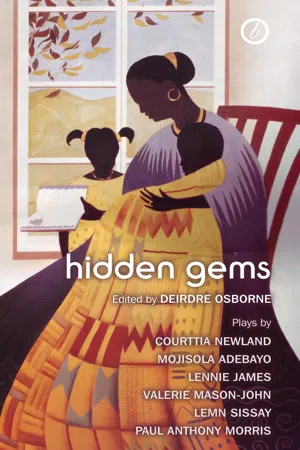
This distinctive new volume of drama by black British playwrights exemplifies how experiments with form, subject-matter and genre can serve to centralise the experiences of black people in local, national and international contexts of culture, politics and performance. Each play is critically introduced, to create an anthology of interactions - between the people who have long championed the work through teaching and writing about it and the people who produce, perform and explain their intentions behind it.
Something Dark by Lemn Sissay is now a set text on Edexcel's syllabus for A level English Literature and English Language and Literature.
- 432 pages
- English
- ePUB (mobile friendly)
- Available on iOS & Android
eBook - ePub
Hidden Gems: Contemporary Black British Plays
About this book
Information
B IS FOR BLACK
Politics, Multiculturalism and Performance: Courttia Newland’s B is for Black
Courttia Newland, the author of B is for Black, is an accomplished novelist and playwright. His first two novels, The Scholar (1997) and The Society Within (1999) are both popular – they have been reprinted several times – and critically acclaimed. These novels, set on the fictional Greenside Estate, West London, are gritty portraits of the culture and lives of their young, mostly black characters. Described variously as the new Irving Welsh, ‘the rising star of Brit-lit and chronicler of inner city life’ and ‘purveyor of urban realism’,1 Newland has consciously tried to move out of the ‘“ghetto-writing” niche I have been deposited in’.2 Not content with returning to the same successful formula and genre, he has written a series of well-received detective novels and more recently, a collection of short stories that experiment with the uncanny, entitled Music for the Off-Key: Twelve Macabre Short Stories (2006). Newland has also edited an anthology of black British writing, IC3: The Penguin Book of New Black Writing in Britain (2000) and is currently working on a film adaptation of his first novel. His career as a playwright began in 1997 with the production of Estate of Mind by The Post Office Theatre Company. After its successful first run at the Portobello Festival, London, Newland was confirmed as the company’s in-house writer and The Post Office Theatre Company, with Riggs O’Hara as its director, was formally established.
B is for Black is Newland’s fifth play: it continues to reflect and develop his preoccupation with the fraught and complex relationships between individual, cultural and class identities, but in this work these issues are represented through its main character Ben, a black Oxford graduate who grew up in Barnes, a cultural world away from the mean streets and walkways of the Greenside estate. Despite the dominant theme of cultural conflict, however, there are several moments of caring and affectionate interaction between the characters and Newland seems concerned to demonstrate, as he has in his later play Sweet Yam Kisses (2006) – co-written with Patricia Cumper – that there is the potential for positive, supportive relations across cultural divides and within the black community. This play is also about writing, performance and the difficult issue of public funding for the arts in a society where muted but damaging forms of racism continue to undermine its multicultural aspirations. Each scene is framed by introductions and commentary from a chorus of young actors, Jones, Lamming and Spencer, whose marginalised position in relation to the main drama is used to represent the often fraught relationship between small community theatres such as The Post Office, whose innovative work is often hidden or ignored, and the powerful interest groups that dominate the world of arts management and funding. Humorous asides are directed at O’Hara and ‘Courts’ (Newland); their interactions, suggesting a Brechtian influence, mirror the improvisation-led theatre for which The Post Office is known and emphasise the self-reflexive character of the play. The characters signal the use of dramatic irony and speak to its Shakespearean echoes: they debate the play’s concerns, one of which is to critique the rhetoric that frames the formal discourses of arts, culture, the media and public funding. Spencer’s comment, ‘It’ll be alright – Cultural diversity is in right now you know… There’s loads of award schemes and lottery money and initiatives set up to help people like us get a foothold in the market place! You have to believe it!’ is met with silence, before Lamming retorts: ‘You didn’t read the script did you?’ (29–30) This conversation serves as a preface to the play and provides an informed context for the action that unfolds.
Ben is introduced in the next scene, the first scene of the ‘main’ play, by his opposite, Imani, described as ‘your typical conscious sister [who has] modified her dress slightly in order to appear funky and not too militant’. (31) She is an administrative assistant in the local authority arts office and Ben is the newly employed, first black Senior Arts Officer. The drama is built around the interaction between these two characters and the tension that arises from the hints about their sexual attraction, their cultural difference and similarities and finally, their conflicting ambitions. Imani is intelligent and sexually attractive; she is also playful and outgoing and uses all these characteristics to manipulate and attempt to destroy Ben. She introduces him to ‘Children of Tamana’ (COT), the group that she and her boyfriend Don are involved with, and she exposes him to information and ideas about black civilisations and culture. She explains the origins of the word ‘Tamara’ and the aims of the group: ‘Tamara, a place in Ancient Kamit where many people believe the Black Civilisation grew to maturity. The project I’m involved in has vowed to continue that task, bringing positive teachings, spirituality and healing to sons and daughters of Kamit’. (61) In an ironic reversal of her name’s meaning – ‘faith’ in Swahili – she exercises bad faith, creating rifts and divisions where she could have enabled healing and nurturing.
Initially she is represented as both the conduit and an obstacle to his cultural growth and development. She encourages him to read but is also a reminder of who he is not and how far he has travelled from his cultural ‘roots’. As he learns more and more about African history and culture, he moves further away from his white father-in-law, who employed Ben to ‘enforce the Status Quo’ and his wife, who feels increasingly alienated by his preoccupation with what she perceives as his militancy. Ben’s increased consciousness of his cultural identity and the achievements of African culture are represented as positive and enriching. What the play seems to suggest, however, is that not everyone who is politically and culturally ‘conscious’ has Ben’s integrity, his kindness and his good nature. Although the information that Imani has is vital to the promotion of black cultural pride – and to any concept of multiculturalism and diversity – she uses what she knows in a project of self-aggrandisement rather than for the betterment of her community. By the end of the play Don’s successful theatre group, which has struggled without funding for eight years, is no nearer to being funded. The local authority could have been encouraged by Ben’s influence to take its commitment to diversity seriously but Raymond, the le...
Table of contents
- Front Cover
- Half-Title Page
- Title Page
- Copyright Page
- Contents
- INTRODUCTION
- B IS FOR BLACK
- MOJ OF THE ANTARCTIC
- THE SONS OF CHARLIE PAORA
- BROWN GIRL IN THE RING
- SOMETHING DARK
- 35 CENTS
- APPENDIX
- Bibliography
Trusted by 375,005 students
Access to over 1.5 million titles for a fair monthly price.
Study more efficiently using our study tools.
Frequently asked questions
Yes, you can cancel anytime from the Subscription tab in your account settings on the Perlego website. Your subscription will stay active until the end of your current billing period. Learn how to cancel your subscription
No, books cannot be downloaded as external files, such as PDFs, for use outside of Perlego. However, you can download books within the Perlego app for offline reading on mobile or tablet. Learn how to download books offline
Perlego offers two plans: Essential and Complete
- Essential is ideal for learners and professionals who enjoy exploring a wide range of subjects. Access the Essential Library with 800,000+ trusted titles and best-sellers across business, personal growth, and the humanities. Includes unlimited reading time and Standard Read Aloud voice.
- Complete: Perfect for advanced learners and researchers needing full, unrestricted access. Unlock 1.5M+ books across hundreds of subjects, including academic and specialized titles. The Complete Plan also includes advanced features like Premium Read Aloud and Research Assistant.
We are an online textbook subscription service, where you can get access to an entire online library for less than the price of a single book per month. With over 1.5 million books across 990+ topics, we’ve got you covered! Learn about our mission
Look out for the read-aloud symbol on your next book to see if you can listen to it. The read-aloud tool reads text aloud for you, highlighting the text as it is being read. You can pause it, speed it up and slow it down. Learn more about Read Aloud
Yes! You can use the Perlego app on both iOS and Android devices to read anytime, anywhere — even offline. Perfect for commutes or when you’re on the go.
Please note we cannot support devices running on iOS 13 and Android 7 or earlier. Learn more about using the app
Please note we cannot support devices running on iOS 13 and Android 7 or earlier. Learn more about using the app
Yes, you can access Hidden Gems: Contemporary Black British Plays by Deirdre Osborne in PDF and/or ePUB format, as well as other popular books in Literature & British Drama. We have over 1.5 million books available in our catalogue for you to explore.