Shortlisted as one of The Stage's top 10 training books of 2012
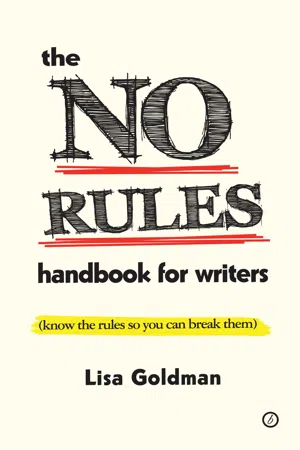
The No Rules Handbook for Writers is a timely, creative and refreshing antidote to prescriptive guides for writers. It will inspire playwrights, screenwriters and novelists; offer fresh insights toteachers, editors, dramaturgs, directors and producers.
Lisa Goldman takes 40 established conventions of creative writing. She explores why these rules persist, how to master them, bend or break them and why the most important rules to overturn are your own. The book weaves together industry experiences, psychological observations and inspirational tips. With practical advice from 40 rule-breaking writers:
Hassan Abdulrazzak, Oladipo Agboluaje, Ronan Bennett, Sita Bramachari, Trevor Byrne, Anthony Cartwright, Matthew Greenhalgh, Tanika Gupta, Neil Hunter, M.J. Hyland, Gurpreet Kaur Bhatti, Dennis Kelly, Bryony Lavery, Chris Paling, Stacy Makishi, Neel Mukherjee, Hattie Naylor, Anthony Neilson, Kim Noble, Tom Palmer, Lucy Prebble, Philip Ridley, Paul Sirett, Edmund White, Roy Williams.
The No Rules Handbook for Writers will be a valuable read for anyone curious about the craft, context and process of writing.
- 200 pages
- English
- ePUB (mobile friendly)
- Available on iOS & Android
eBook - ePub
About this book
Information
Rules 8-21

Principles or Prescriptions?
Story, Character, Dialogue
Are storytelling principles immutable? Can act divisions help or hinder? How do you create shape through metaphor? Are conventions about generating character and dialogue helpful to a writer, or are they just mental clutter?
RULE 8
‘Story is about principles not rules’
Robert McKee, Story
What makes a sequence of events a story? Are there principles to storytelling which, if they are not adhered to, destroy the notion of story altogether? If stories are universal why do we tell them and what do they mean to us?
The interest in the way stories are constructed has become a major industry. The quote above is the first line of Robert McKee’s bestselling screenwriting guide Story (1998) which is on the reading list of journalists and business leaders as well as writers.
Screenwriter Greg Dinner voices what many writers feel about the book:
‘I always tell my students ‘McKee’s very helpful. Pay close attention and then forget it.’ Firstly, writing in TV and film is mostly collaborative and you don’t always have much say in the process, secondly there are no hard and fast rules about structure, lastly you need to digest the rules then throw away the rule book and write who you are.’
I always liked McKee’s description of story as the conflict between subjective expectation and objective reality, the gap opening between what you think will happen and what does. Although this sounds obvious, mastery of it seems to be the key to all storytelling. In the gap there is every level of conflict. Each action the character takes to close the gap creates ever greater risk. I find it hard to imagine breaking this principle and still telling a story.
Without the opening of this gap, isn’t there simply boredom or overload?
I asked Greg what he thought the fundamentals of story were.
‘There needs to be a sense of journey and that is more about a character striving towards something than any plot mechanism. This is an emotional thing too, both for the audience who is being engaged to feel something and the writer who comes to a greater knowledge of themselves through emotional involvement in their story. Character is definitely more important to story than structure. The most important structure really is the moral framework which is why I make more use of Aristotle’s Politics than his Poetics when I teach screenwriting. It is the role of all writers to manipulate this structure, either upholding the status quo or challenging it.’
Greg’s approach to film structure mirrors my own in theatre. We know that stories are bearers of values. When we read, we interpret the meaning of a story and when we write, we create meaning. Certain writing jobs are both interpretive and creative.
Why do we need stories?
Anthropologists think that stories first came about to serve a function of communicating the social/cultural values of a group, including geographic or food gathering knowledge. We know that the unconscious is more powerful than the conscious mind and that stories appeal to our emotions, to our deepest fears and desires. Through stories, meaning is retained at a deeper level of memory.
I think the most important aspect of stories is that they teach us how to embrace change. Stories show us that we must resist attack but that we cannot do so imperviously. We must change ourselves, adapt to new circumstances or be destroyed. This is the basis of all evolution. Stories are at the heart of how we understand ourselves in the world.
If we don’t share stories (and some of us feel if we don’t write down those stories), we have an uneasy sense of jeopardizing our future. So when we hear the voices we write them down just as fast as our pens or keyboards can keep up. Creativity comes from a primal place. Children beg for stories and eagerly tell them too. Every known culture has stories which shape and are shaped by its people; yet across cultures, the deepest myths repeat. Psychoanalysts such as Carl Jung have viewed this as evidence of our ‘collective unconscious’.
Myths appear to come from deep in our psyche but they are also ideologically inscribed. Joseph Campbell in The Hero with a Thousand Faces outlines a universal story model. The main character starts in an ‘ordinary world’, as Christopher Vogler calls it. At first the hero refuses the call to adventure but eventually takes the decision to cross the threshold into the ‘special world’ on a quest. Here he must actively invest in the outcome of the story because the stakes are high, often life or death. When he has risen to the challenge and succeeded, he claims his reward and (usually) takes it home.
This mythic journey is reminiscent of the Aboriginal separation-initiation-return ritual. The young boy goes on walkabout in the wild to find another tribe, to be given its story as reward and then return home a man. Jung might say that the Great Snake hungrily awaiting the boy who is about to be circumcised is an image that is part of our collective unconscious. Some radical anthropologists argue that this very initiation right was a political freeing from the mother-bond, a repeated overthrowing of women’s once central role.5 In this paradigm, there was originally a version of these stories with a female-centred mythology that was stolen and reworked by the men. We know that Aboriginal women could be gang raped to death if they tried to discover the men’s stories. Stories make and remake us. To own the story is to have power.
As Richard Dawkins explained to us, we are the only species that can overturn the rule of our ‘selfish’ genes.6 We can act collaboratively, consciously and for the good of a future we may never see. Storytelling seems a vital link between our ability to talk and our ability to work together. When we stop competing, we exchange and share and therein lies the possibility of progressive change. Withholding the narrative then setting it free has helped us survive as human beings and given us the ability to turn what exists and what doesn’t into a whole collective alternative to what is. Like other aspects of our survival – eating, drinking and sexual reproduction – stories also give us pleasure.
The meaning of stories can emerge from compassion or cruelty, but if compassion is not apparent from the storyteller towards the story, generally the story will not be believed. What evokes compassion, like what evokes fear, depends on the context.
In 2010, on the day of the general election, I saw a matinee performance of Laura Wade’s superb attack on the violence and immunity of privilege in Posh at the Royal Court Theatre. The play follows an evening with the barbaric ‘Riot Club’ (based on the student Bullingdon Club of which David Cameron, now Prime Minister and Boris Johnson, Mayor of London were both members). The Royal Court sits in Sloane Square, one of the poshest areas of London. I was fascinated and a little frightened at the gulf between my laughter points and the laughter of the majority of the audience who appeared to identify with the murderous upper-class characters.
I felt a different kind of cultural divide watching Olivier runner-up and Alfred Fagon Award-winner Iya Ile (2009) by Oladipo Agboluaje, which we co-produced with Tiata Fahodzi at Soho Theatre. It attracted an audience that included many middle-class Nigerians. Laughter and horror revealed itself differently in this audience too, depending on many cultural/political references, among other things, whether or not you had grown up in a household where having/beating servants was viewed as normal. When a work is freed from mainstream thought, there tends to be a greater breadth of opinion around it. This might include making explicit the ideological premise of the work, as in the two plays above, rather than hiding that premise or pretending that it doesn’t exist.
Getting lost on your writer’s journey
One of the biggest paradoxes about writing stories, is that we can never get as close to ourselves in reality as we can through illusion, through the voices of ‘the others’. Through fiction you are permitted to speak the unspeakable through the mouths of your characters, to explore the edge of behaviour, a heightened, more adventurous version of reality, where each moment sings with meaning. It’s thrilling to invent new worlds and to experience them. It’s hugely pleasurable to explore the wildest world of your imagination whilst remaining physically safe. Like being in a dream that you know is a dream, however lost in the dream world you are, ultimately you can make the return to reality.
Sometimes you forget that this is true, your special world completely takes over. The world that you are lost in bleeds through into the objective world, RAS kicks in (see Rule 6) and you see references to your imaginary world everywhere. This validates the primacy of your fiction, keeps you feeling more authentic there than in a less intense reality. On the other hand, you might have reached for fiction to escape the intensity of your life, to lighten the load. You too may have a feeling of being outside of the real world when you return.
At Soho Theatre I had the pleasure of programming Spill Festival, which brought us a delicious Forced Entertainment show called Void Story (2009) by Tim Etchells. Unlike most of Forced Ents’ work it is not fragmented from many points of view, but instead is one hurtling, high-speed, apocalyptic narrative lurching from disaster to disaster, like a cartoon nightmare testing hopefulness in the face of being kidnapped, bombed, stabbed, run over, poisoned, murdered and brutalized in all manner of ways. It is a farcical rather than believable story but the tragedy seeps through and it becomes emotionally cathartic – or at least that was my experience. We find ourselves identifying with two flat characters in an unbelievable world. I think this is because though the lurches of narrative feel untrue, the horrors of their world are our own, and we identify with the passive characters who, in the face of disaster, refuse to die or submit, but just keep going, taking on the horrors faced by millions in reality every day. For more on passive characters see Rule 15.
Screenwriter Terry Hodgkinson trained as a painter and was first encouraged to write by director Fred Zinnemann when he was working for him as an assistant director. He never looked back.
‘I went to one of Robert McKee’s expensive seminars in London, years ago, but he just confirmed what I already knew, it’s all just logic and common sense. If the story entertains, you’ve got it. If it’s boring, start again.’
RULE BREAKER 8

You create principles
through story
through story
RULE 9
If you would have your play deserve success,
Give it five acts complete; nor more, nor less;
Horace, Ars Poetica (c.18 BCE)7
Horace took credit for inventing the five-act play so he would say that. The turning points became the breaks when the amphitheatre audiences stretched their legs, had a drink and a chat. Nowadays, there may be commercial breaks on TV, but in a five act film, for example, the act breaks are not marked but played straight through. So what purpose do they serve?
Well, for most writers, breaking down the natural movement of a story into sequences makes it easier to write those transitions which define the end of one section of the story and launch you into the next. You may also want to group certain series of events together into their own story arc and mood. This can help link the subplot to the main plot, for example, or allow the progression of one character’s journey in a multiplot. It’s rarer to find acts in modern plays, though sometimes there are grouped scenes. Three acts are more common in film these days and four or five acts to TV. In the novel, a chapter sometimes contains a sequence of many scenes, more akin to an act. However, these are all loose trends – as we know there are no rules.
The five-act structure has had a renaissance in BBC soaps. Shakespeare is generally evoked to prove its universality, though whether or not the Bard wrote in five acts is a moot point. We do know that he wrote quickly and for continuous action and if he literally wrote in five acts, which many do...
Table of contents
- Frontcover
- Titlepage
- Copyright
- Acknowledgements
- Dedication
- About the Author
- Contributing Writers
- Is The No Rules Handbook for me?
- Contents
- Introduction: Rules or No Rules?
- The Practice of Preparation
- Principles or Prescriptions? Structure, Character, Dialogue
- Conventions of Style, Economy and Consistency
- Principles of Freedom: Written and Unwritten Laws of Taste and Taboos
- The Rules of Rewriting
- The Writing Game: Maxims of process and profession
- Rules of being a Rule BreakerRule-Breaker
- Notes
- References
- Contributing Writers
- Index
- Oberonbooks
Trusted by 375,005 students
Access to over 1.5 million titles for a fair monthly price.
Study more efficiently using our study tools.
Frequently asked questions
Yes, you can cancel anytime from the Subscription tab in your account settings on the Perlego website. Your subscription will stay active until the end of your current billing period. Learn how to cancel your subscription
No, books cannot be downloaded as external files, such as PDFs, for use outside of Perlego. However, you can download books within the Perlego app for offline reading on mobile or tablet. Learn how to download books offline
Perlego offers two plans: Essential and Complete
- Essential is ideal for learners and professionals who enjoy exploring a wide range of subjects. Access the Essential Library with 800,000+ trusted titles and best-sellers across business, personal growth, and the humanities. Includes unlimited reading time and Standard Read Aloud voice.
- Complete: Perfect for advanced learners and researchers needing full, unrestricted access. Unlock 1.5M+ books across hundreds of subjects, including academic and specialized titles. The Complete Plan also includes advanced features like Premium Read Aloud and Research Assistant.
We are an online textbook subscription service, where you can get access to an entire online library for less than the price of a single book per month. With over 1.5 million books across 990+ topics, we’ve got you covered! Learn about our mission
Look out for the read-aloud symbol on your next book to see if you can listen to it. The read-aloud tool reads text aloud for you, highlighting the text as it is being read. You can pause it, speed it up and slow it down. Learn more about Read Aloud
Yes! You can use the Perlego app on both iOS and Android devices to read anytime, anywhere — even offline. Perfect for commutes or when you’re on the go.
Please note we cannot support devices running on iOS 13 and Android 7 or earlier. Learn more about using the app
Please note we cannot support devices running on iOS 13 and Android 7 or earlier. Learn more about using the app
Yes, you can access The No Rules Handbook for Writers by Lisa Goldman in PDF and/or ePUB format, as well as other popular books in Languages & Linguistics & Creative Writing. We have over 1.5 million books available in our catalogue for you to explore.