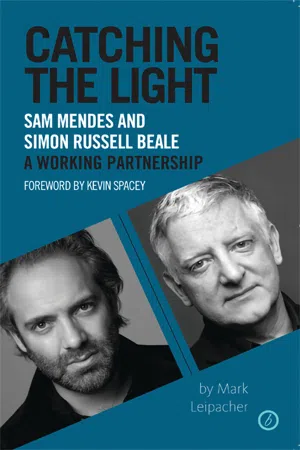
Sam Mendes and Simon Russell Beale have forged one of the most successful working partnerships in contemporary theatre history. Across twenty years and eight productions their collaboration has evolved, matured and keeps thriving through their work on stage; six Shakespeare and two Chekhov plays form their common body of work so far.
Mark Leipacher's correspondence with Mendes and Beale and his thorough research into archival material on their collaborations, offers the reader a detailed account of the productions and, uniquely, Mendes' and Beale's own observations on their method of work and on the discoveries they made in each of the plays. How do moments of magic on stage arise in the rehearsal room? Catching the Light, full of anecdotes and gems of knowledge, is an indispensable read for actors, directors, students and anyone who loves the theatre.
Features a foreword from Kevin Spacey, Artistic Director of the Old Vic.
eBook - ePub
Catching the Light
Sam Mendes and Simon Russell Beale, A Working Partnership
- 156 pages
- English
- ePUB (mobile friendly)
- Available on iOS & Android
eBook - ePub
About this book
Information
OTHELLO
“We were like mice menstruating together”
OTHELLO by WILLIAM SHAKESPEARE
FIRST PERFORMANCE: Cottesloe Theatre, National Theatre, 1 August 1997
FIRST PERFORMANCE: Cottesloe Theatre, National Theatre, 1 August 1997
SUBSEQUENT PERFORMANCES:
Salzburg Festival, Germany, 22 – 25 August 1997
Cottesloe Theatre, National Theatre, UK, 16 September 1997 (Press Night)
Herberger Theatre, Phoenix, Arizona, USA, 30 September – 4 October 1997
Dramatychny Theatre, Warsaw, Poland, 13 – 15 November 1997
Ginza Saison Theatre, Tokyo, Japan, 22 January – 8 February 1998
Seoul Arts Centre, Seoul, Korea, 11 – 20 February 1998
Academy of Performing Arts, Hong Kong, 24 February – 1 March 1998
Drama Academy, Beijing, China, 6 – 8 March 1998
State Opera House, Wellington, New Zealand, 19 – 23 March 1998
Majestic Theatre, Adelaide, Australia, 28 March – 2 April 1998
Brooklyn Academy of Music, New York, USA, 8 – 12 April 1998
Lyttelton Theatre, National Theatre, UK, 1 May – 13 June 1998
Salzburg Festival, Germany, 22 – 25 August 1997
Cottesloe Theatre, National Theatre, UK, 16 September 1997 (Press Night)
Herberger Theatre, Phoenix, Arizona, USA, 30 September – 4 October 1997
Dramatychny Theatre, Warsaw, Poland, 13 – 15 November 1997
Ginza Saison Theatre, Tokyo, Japan, 22 January – 8 February 1998
Seoul Arts Centre, Seoul, Korea, 11 – 20 February 1998
Academy of Performing Arts, Hong Kong, 24 February – 1 March 1998
Drama Academy, Beijing, China, 6 – 8 March 1998
State Opera House, Wellington, New Zealand, 19 – 23 March 1998
Majestic Theatre, Adelaide, Australia, 28 March – 2 April 1998
Brooklyn Academy of Music, New York, USA, 8 – 12 April 1998
Lyttelton Theatre, National Theatre, UK, 1 May – 13 June 1998
CAST
| SIMON RUSSELL BEALE | Iago |
| MAUREEN BEATTIE | Emilia |
| DAVID HAREWOOD | Othello |
| JAMES HAYES | 3rd Senator / Montano |
| JAMIE LEENE | 4th Senator / 2nd Soldier |
| CRISPIN LETTS | Roderigo |
| FRANCIS MAGUIRE | Servant / 1st Soldier |
| KEN OXTOBY | 1st Senator / 3rd Soldier |
| TREVOR PEACOCK | Brabantio / Gratiano |
| CLIFFORD ROSE | Duke / Lodovico |
| CLAIRE SKINNER | Desdemona |
| COLIN TIERNEY | Cassio |
| INDIRA VARMA | Bianca |
| FERGUS WEBSTER | 2nd Senator / Clown |
CREATIVE TEAM
| SAM MENDES | Director |
| ANTHONY WARD | Designer |
| PAUL PYANT | Lighting |
| PADDY CUNNEEN | Music |
| JONATHAN BUTTERELL | Movement |
| PATSY RODENBURG | Voice Director |
| TERRY KING | Fight Director |
“... Sam Mendes’s brilliant new production. The main point is that Mendes, like Trevor Nunn before him, strengthens the tragedy by allowing it to grow out of an accumulation of domestic detail. But who is the central figure? Othello, fatally flawed by his mixture of self regard and insecurity? Or Iago, the active embodiment of evil? Mendes shrewdly suggests they are absolutely interdependent: that Iago’s poison is able to work only because of some lurking doubt inside Othello. [...]Simon Russell Beale’s Iago, who at one point illustrates his diabolical plan with the help of playing cards, reminds one of Auden’s description of Iago as the joker in the pack. But Russell Beale is more than practical joker carrying out a scientific experiment: he memorably makes him a squat, shaven-headed, implicitly impotent nihilist, gnawed by the ‘daily beauty’ he sees in others’ lives. There is a superb moment when he sits beside Othello whispering into his ear the words that prompt the general’s epileptic fit: for this Iago, it’s the ultimate symbol of destruction, possession and power.”
(Michael Billington, The Guardian, 18 September, 1997)
Of all of Simon’s performances which he has directed, Sam’s personal favourite is Iago, because that was the character for which Simon transformed himself the most from the inside out. “It was the performance least dependent on effect. He went to a pretty dark place. I think for Simon, the self-hatred in Iago, the refusal of human contact and sex, the turning towards the dark in oneself, was absolutely something that he associated with at that point in his life. I thought Iago was an incredible performance, I mean really incredible.”
Assumed to have been written during the period 1603-1604, Othello is the second of Shakespeare’s late tragedies, sitting between Hamlet and King Lear. Yet unlike these monumental epics charting the fall of a central protagonist, Othello, though named after one character, is undoubtedly about its two central figures that are intrinsically linked. It is the dynamic between these two figures that forms the narrative arc of the play. There are no significant subplots and all the other characters are supporting this narrative thrust and are in relation to the central figures of Othello and Iago; this is particularly the case with their wives, Desdemona and Emilia.
Shakespeare’s primary source for the drama was a short story in the Hecatommithi by Giraldi Cinthio though, according to Sam, who read the source material, the knowledge of this is of greater use to “learn about the play by seeing what [Shakespeare]’s left out rather than what he’s put in.” In editorialising details from the Cinthio, Shakespeare has removed information about Iago and Emilia’s children for instance. In the source material Iago was considered to be a good father. Sam suggests that this is not a casual omission within the play, but a deliberate construction on Shakespeare’s part in suggesting a tension in the relationship. Once again, the absence of children is of great significance within Shakespeare’s work.
Sam was insistent upon the belief that Emilia wanted children. Her desire for children and the absence of them comes at the very root of the problems in their marriage and the unspoken conflict between them. “That’s the reason that Emilia exposes him to be the villain,” asserts Simon. “Discovering the idea about Emilia was a thrilling moment. Sounds pathetic, doesn’t it? But the big question about Iago is why he did it. There has to be a consistent argument. There’s no satisfactory answer, but the most satisfactory I’ve got is Emilia. And the thrill of that discovery was intellectual and emotional.”
Male-female relationships are at the centre of the drama, within Iago and Emilia’s childless marriage and of course within the love between Othello and Desdemona that slowly unravels with devastating consequences. The intense focus upon these relationships can be an exhausting and often bleak experience for the actors involved. “We were like mice menstruating together,” recalls Simon. “The big four – the two main men and the two main women – all had moments of real unhappiness in this miserable story: because it is a miserable story.”
With such concentration upon these relationships it was imperative that the pairs of actors worked well together and could quickly develop a shared history. Simon and Maureen Beattie (Emilia) were asked to construct a back story for how Iago and Emilia met. This is a marked difference from arriving at rehearsals without pre-conceptions or invented arrangements and from the independent conferences between Sam and Simon at the beginning of a day’s rehearsal or an image-based way of working. “We probably didn’t have time to go through the full details that we had worked out but Sam knew the basic outline: Emilia worked at the NAAFI [Navy, Army and Air Force Institutes] and Iago fancied her.”
Sam’s production was built on these small, almost undetectable details, not just from the source material and the subsequent omissions but also from the internal directions from within Shakespeare’s text itself. All throughout Act I of Othello there are many eccentric pieces of timing. According to Sam, “Shakespeare telescopes time. It says that they arrive in Venice in three days, and in reality the journey took three weeks, we discovered in doing our research.” Yet, where it is necessary and appropriate Shakespeare is very clear about times of day and places of setting. This matches Sam’s appreciation for the play as a very domestic piece with a high degree of specificity. More so than in any other production, Sam spent time at the beginning of the rehearsal process ensuring that the actors were aware of and adhered to the language, the structure, the verse and the rhyme schemes.
Detail is a hallmark of this collaboration. In the critical reception of this production, many critics evoked their mutual sense of specificity and closely observed details as a shared value and a reason for the success of the show. In The Times, Jeremy Kingston was particularly impressed that the servants would bring on more glasses than were needed for the characters arriving in the scene, as the hosts would not have known how many guests would ultimately be present.
Until the twentieth century, Othello was one of Shakespeare’s most popular tragedies, enjoying successful performances following its premiere at Whitehall on 1st November 1604, many of them indoors at the Blackfriars. There are far more textual references to interior rather than exterior scenes which may explain its success within a more intimate auditorium, and corresponds to Sam’s understanding of the play as a domestic piece, ripe for the comparable environment of the Cottesloe.
Matching the mood of misery and deception and the period setting of the 1950s, Paul Pyant’s initial lighting state for the opening moments of the production saw Iago and Roderigo navigating shafts of light and depths of shadow, evoking the chiaroscuro of film noir. This led the Independent on Sunday to dub the production ‘Black and White and Noir all over.’ “It was very noir-ish in China,” says Simon slyly. “At one venue we only had two lamps.”
Yet China provided the company with one of the most memorable experiences of the entire tour. In Beijing the auditorium was within a complex that contained the city’s Drama Academy. “There were students banging on the doors trying to get in and a huge crush all around the theatre. The atmosphere was amazing,” recalls Simon. “It also proved to me that Shakespeare is the most international of all writers.”
Working within a dark overriding mood can sometimes take its toll on the actors. Simon remembers at one point he simply had to walk out of the rehearsal room. “I suspect it happens quite a lot with Othello. We all had a moment when we thought we couldn’t cope with it anymore.” On this occasion, during “Give me the ocular proof,” David Harewood, as Othello, had thrust a gun into Iago’s neck to emphasise the danger of the command.
“It was absolutely planned and expected but it hurt and I was pissed off. I just went ‘I’ve had enough of this, I’m going to the loo,’ and I walked off. I washed my face, I stormed for a bit and eventually I came back in. Sam just said ‘I love it when you’re angry’ and then it was all okay.” Although Sam diplomatically and decisively eased the mood within the rehearsal room, Simon would never suggest that behaving that way was a regular occurrence. “Losing one’s temper is a very bad thing to do but I think if you get to know somebody very well then you’re allowed to a couple of times. It’s not great; though it does clear the air a little bit.”
These sudden lurches of behaviour in the rehearsal room are indicative of the atmosphere of the play. They are suggested from within the heart of the text itself, like Othello’s epileptic fit. Even then, drawing attention to these textual details can elicit responses that are unexpected. With Othello suffering from a debilitating disorder, Iago has the physical authority for the first time in the relationship. It is during these moments in the production that Iago whispered delicately into Othello’s ear and tenderly stroked Othello’s cheek.
Many read this as a revelatory new reading of Iago and his obsession with and for Othello, with The Telegraph suggesting that “a window is thrown open onto the play.” This was viewed as the manifestation of a guilty sexual desire or a subconscious yearning for intimacy between them and caused audiences to call into question Iago’s sexuality.
Sam would always say that he had no specific reading of Iago in mind when he started rehearsing; for him Othello is too complex and multi-dimensional a play to offer a single interpretation. However, this re-appraisal of Iago’s sexuality is clearly not what Sam had intended. “Iago is heterosexual. I think he has a fascination with Othello which is not homosexual, but the fascination of a different race, a different physical type, a different mind, a different sexual drive. I don’t think he’s in love with Othello, but I think that weirdly, as he destroys him, as he comes closer to him both physically and emotionally and begins to understand how he ticks, it sort of turns him on. It’s a power trip, and that can be very sexual. I think that’s where it shades over occasionally into accusations of homo-eroticism. But I don’t think it’s a homosexual love affair.”
There are undoubtedly some roles when Simon makes the decision that the character is homosexual, such as in Deborah Warner’s production of Julius Caesar for the Barbican. “Cassius, in my performance, was obviously gay”, he says wearily, “because of ‘I am who I am’ and his wife not being mentioned at all.” The absence of Cassius’ wife, like the absence of Iago’s children, is another omission from the source material which is arguably an internal direction within the writing and represents Shakespeare’s opinion of a character.
This returns to the idea of Simon’s sense of his own identity and his suitability for casting in certain roles, particularly in those roles that are alpha males. “Those are tricky for me. When I did Major Barbara at the National Theatre, part of the excitement of accepting the role of Undershaft was that he was an alpha male. I was playing opposite Paul Ready, who also isn’t usually cast as an alpha male. There was this big confrontation at the end of the play and we were both just stood there in rehearsals saying ‘What on Earth do we do?’ and we started giving ground and Nick [Hytner, the director of Major Barbara] had to stop us and force us into this real stag fight. Iago is also an alpha male, but perhaps as we’d done Richard III together Sam didn’t think that it was such a risk.”
One unexpected risk occurred during the rehearsal for Desdemona’s death scene. “I hate bad stage deaths,” says Sam. “When someone dies, it takes a long time, particularly when they’re suffocated. I think you have to feel the weight of the death, viscerally feel what it’s like to kill someone. Also I wanted Desdemona to be someone who fought hard to stay alive. You can tell by the scene that precedes it, she does not want to die.”
The first attempt at the scene took place about three weeks into rehearsal when the ensemble had continued to work through the play in Sam’s company-based way of investigation, playing through the scenes in different formats and using different exercises. During the rehearsal, Sam gave Claire Skinner the instruction to “fight him as much as you can.” Skinner was claustrophobic and in fighting Othello off during the suffocation, she induced a panic attack.
“It was very, very disturbing. I don’t think anyone in the room knew if Claire was acting or not. It turned out she wasn’t, but didn’t want to stop because she wanted to know what it felt like. I felt terribly guilty about it – you don’t want to put an actor’s life in danger – but I knew she was intelligent enough to stop if she wanted to.” What appeared on stage night after night throughout the tour ...
Table of contents
- Cover Page
- Half-title Page
- Title
- Copyright
- Contents
- FOREWORD
- INTRODUCTION
- DISCLAIMER (!)
- CASTING
- REHEARSALS
- THEATRICAL GESTURES
- ‘THE JUMP’
- TECH, DRESS, PREVIEWS AND PRESS
- A LONG RUN AND TOURING
- TROILUS AND CRESSIDA
- RICHARD III
- THE TEMPEST
- OTHELLO
- UNCLE VANYA
- TWELFTH NIGHT
- THE WINTER’S TALE
- THE CHERRY ORCHARD
- NEAR MISSES AND FUTURE PRODUCTIONS
- ACKNOWLEDGEMENTS
Trusted by 375,005 students
Access to over 1.5 million titles for a fair monthly price.
Study more efficiently using our study tools.
Frequently asked questions
Yes, you can cancel anytime from the Subscription tab in your account settings on the Perlego website. Your subscription will stay active until the end of your current billing period. Learn how to cancel your subscription
No, books cannot be downloaded as external files, such as PDFs, for use outside of Perlego. However, you can download books within the Perlego app for offline reading on mobile or tablet. Learn how to download books offline
Perlego offers two plans: Essential and Complete
- Essential is ideal for learners and professionals who enjoy exploring a wide range of subjects. Access the Essential Library with 800,000+ trusted titles and best-sellers across business, personal growth, and the humanities. Includes unlimited reading time and Standard Read Aloud voice.
- Complete: Perfect for advanced learners and researchers needing full, unrestricted access. Unlock 1.5M+ books across hundreds of subjects, including academic and specialized titles. The Complete Plan also includes advanced features like Premium Read Aloud and Research Assistant.
We are an online textbook subscription service, where you can get access to an entire online library for less than the price of a single book per month. With over 1.5 million books across 990+ topics, we’ve got you covered! Learn about our mission
Look out for the read-aloud symbol on your next book to see if you can listen to it. The read-aloud tool reads text aloud for you, highlighting the text as it is being read. You can pause it, speed it up and slow it down. Learn more about Read Aloud
Yes! You can use the Perlego app on both iOS and Android devices to read anytime, anywhere — even offline. Perfect for commutes or when you’re on the go.
Please note we cannot support devices running on iOS 13 and Android 7 or earlier. Learn more about using the app
Please note we cannot support devices running on iOS 13 and Android 7 or earlier. Learn more about using the app
Yes, you can access Catching the Light by Mark Leipacher in PDF and/or ePUB format, as well as other popular books in Literature & British Drama. We have over 1.5 million books available in our catalogue for you to explore.