This practical handbook takes us on a step-by-step journey from pre-production through the rehearsal process, followed by focused advice on each genre from comedy to tragedy, Shakespeare to new plays and musicals. Special chapters offer strategies for dealing with difficult actors, working with producers and taking on the job of an Artistic Director.
An indispensable guide to a director's craft, packed full of advice and peppered with priceless anecdotes about the highs and the lows of a lifetime's work in the theatre.
eBook - ePub
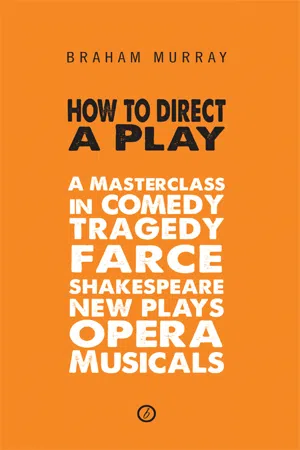
How to Direct a Play
A Masterclass in Comedy, Tragedy, Farce, Shakespeare, New Plays, Opera and Musicals
- 136 pages
- English
- ePUB (mobile friendly)
- Available on iOS & Android
eBook - ePub
How to Direct a Play
A Masterclass in Comedy, Tragedy, Farce, Shakespeare, New Plays, Opera and Musicals
About this book
Information
PRE-REHEARSAL
Choosing a play
This is more complicated than it sounds. I’ve been lucky in that I’ve been an Artistic Director since 1965, so I’ve never in that time had to do a play I actively didn’t want to do, but when you’re starting out as a director, or going through an out-of-work patch, you will be offered plays that you had not thought of doing and you will be inclined to accept, whatever they are.
The best scenario is straightforward. You have a play you are desperate to do. You feel at one with the author. The play is about something you care for passionately; you may even have a vision of how to do it. Even here, beware! You should be sure that you can cast it. It’s no good committing to do King Lear if you haven’t got an actor to play it.
I did Hamlet because I met and worked with Robert Lindsay. You might want to do Hamlet in the abstract but unless you find an actor who is your Hamlet, the one that speaks with the voice you can hear in your head, and unless you are sure he is developed enough emotionally and technically, there is no point in doing it. I did Othello because I met Paterson Joseph, I did Antony & Cleopatra because I met Josette Bushell-Mingo. I wanted to do those plays but I knew that there were few actors who could bring off those parts the way I envisaged them.
Most plays don’t work like that. Usually you know that you will be able to cast the plays you want to do because the leading roles are not so special and particular. It doesn’t mean to say that the casting is not so important but just that there are the actors who can play the parts.
One step down is choosing a play because your company or another one needs to complete a season and asks you to come up with, say, a comedy. It is remarkable how few directors have a comedy as a first choice.
Further down the ladder is when you are offered a play you have no interest in, or even actively dislike, but you can’t afford to turn down.
The complication is that you may be wrong about the play you want to do and equally wrong about the play you’re not interested in.
I was wrong to do A Midsummer’s Night Dream when I did because I was not in the right psychological state to direct it. Years later Tom Courtenay asked me to direct Molière’s The Miser. I read it and had no interest in it at all. I did it because of my admiration for Tom. It was a huge success. I agreed to do The Black Mikado in the West End in 1975 because I was out of work and needed the money. I had no initial interest in it. It was a long-running hit and certainly one of the best shows I have ever done. I agreed to another musical, Fire Angel, based on The Merchant of Venice, because I was out of work and needed the money. It was a massive flop. I actively disliked the rock Othello, Catch My Soul but people still say it was one of the best musicals they have ever seen.
How do you deal with this mystery? Sitting round a table after several bottles of wine, the creative team of a musical I did, Dr Heart, asked what in life gave you the most intense pleasure. We all expected everyone to say ‘sex’. Actually what each one said was the moment of creativity which seemed to come from somewhere else. For a director it is when you are in rehearsal and you suddenly find yourself saying something quite brilliant which you had never thought of before and that takes hold of the rehearsal room.
There are no rules about what plays are going to connect with your unconscious processes and release that creativity. Sometimes plays come and search you out, sometimes you find them. Sometimes a play you have never been attracted to seems to rewrite itself and become of pressing importance. For years I never wanted to do Hamlet. I thought it a silly play about a ditherer who dies through dithering. One day I picked it up again and found that Shakespeare had rewritten it into a thing of genius. The play hadn’t changed of course. I had.
There is no easy way through this maze, but as you make your choices and have your successes and failures, you will begin to find your way more surely. Certainly always try to do the plays you are passionate about. If you are wrong, if you are too close to the material to realize it properly, then you will learn. Making mistakes is inevitable, and crucial if you are to learn. When you dislike a play make sure it is not something in yourself that is censoring your reaction. It could be this is the very play you were meant to do.
Having thoroughly muddled you, I’m now going to assume that you’ve chosen your play and that it is a good choice and try and point you in the right direction during the pre-rehearsal process.
Choosing the team
The process of putting on a play is what makes theatre so extraordinarily wonderful. A group of people of different talents, all experts in their particular fields, coming together to create something much greater than any of them could do alone, and that includes the director. The forming of that group is critical. Harold Prince, the great director of musicals, said that the secret was not to have a group of stars but a real team who shared a sense of purpose and controlled their egos to work together towards a common end. He was talking about writers and composers but the same goes for the creative team of any production. If you’re running a company it goes for the stage management, the workshop, the wardrobe, for any of the countless people without whom the production could not happen.
The most important relationship you have is with your designer. You will note that most directors have their favourite designer who they work with on a regular basis. A production is going to have to nourish the audience visually and it is the designer who will provide that nourishment. You need to find someone whose approach to theatre chimes with yours, someone who wants to express the centre of the play visually rather than using it as a pretext for displaying their own talent.
Each production demands a different way of working, even with the same designer. Sometimes you will know exactly how you want a production designed and your designer will be working to a strict brief; sometimes even though you know and love the play, you haven’t a clue how to express it externally, or your designer has an immediate reaction on reading it and that is what happens on stage. Sometimes both of you know that the process will be deeply collaborative and take some time to evolve into the final design. Most of my working life I have worked with two designers, Johanna Bryant and Simon Higlett. You gradually build up a trust and a shared language. Your designer is an artist, just as you are. Even when you think you know what you want, listen to them.
I decided to direct The Tempest. I chose Johanna Bryant to design it. Neither of us had a clue initially what it should look like. Every production of The Tempest is completely different from each other, for the island is a magic island. Step one was to discuss the play together as much as possible. One character sees the island as lush, the other as barren: ...
Table of contents
- Cover
- Title page
- Copyright page
- Contents
- WARNING
- MOST OF THEM GET IN YOUR WAY
- WHY DO YOU DO IT?
- PRE-REHEARSAL
- THE REHEARSAL PERIOD
- MUSICALS
- OPERA
- NEW PLAYS
- FARCE
- COMEDY
- SHAKESPEARE
- GREEK TRAGEDY
- HOW TO HANDLE DIFFICULT ACTORS
- WORKING WITH PRODUCERS
- ARTISTIC DIRECTION
- GOOD LUCK,
Trusted by 375,005 students
Access to over 1.5 million titles for a fair monthly price.
Study more efficiently using our study tools.
Frequently asked questions
Yes, you can cancel anytime from the Subscription tab in your account settings on the Perlego website. Your subscription will stay active until the end of your current billing period. Learn how to cancel your subscription
No, books cannot be downloaded as external files, such as PDFs, for use outside of Perlego. However, you can download books within the Perlego app for offline reading on mobile or tablet. Learn how to download books offline
Perlego offers two plans: Essential and Complete
- Essential is ideal for learners and professionals who enjoy exploring a wide range of subjects. Access the Essential Library with 800,000+ trusted titles and best-sellers across business, personal growth, and the humanities. Includes unlimited reading time and Standard Read Aloud voice.
- Complete: Perfect for advanced learners and researchers needing full, unrestricted access. Unlock 1.5M+ books across hundreds of subjects, including academic and specialized titles. The Complete Plan also includes advanced features like Premium Read Aloud and Research Assistant.
We are an online textbook subscription service, where you can get access to an entire online library for less than the price of a single book per month. With over 1.5 million books across 990+ topics, we’ve got you covered! Learn about our mission
Look out for the read-aloud symbol on your next book to see if you can listen to it. The read-aloud tool reads text aloud for you, highlighting the text as it is being read. You can pause it, speed it up and slow it down. Learn more about Read Aloud
Yes! You can use the Perlego app on both iOS and Android devices to read anytime, anywhere — even offline. Perfect for commutes or when you’re on the go.
Please note we cannot support devices running on iOS 13 and Android 7 or earlier. Learn more about using the app
Please note we cannot support devices running on iOS 13 and Android 7 or earlier. Learn more about using the app
Yes, you can access How to Direct a Play by Braham Murray in PDF and/or ePUB format, as well as other popular books in Mezzi di comunicazione e arti performative & Regia e produzione teatrale. We have over 1.5 million books available in our catalogue for you to explore.