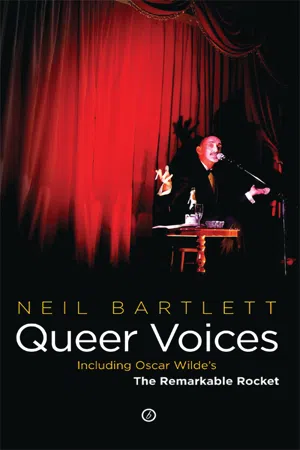
Although his mainstream career has recently included majorwork for the RSC and the National, the five new pieces collected here show just how close playwright and director Neil Bartlett has stayed to the radical queer cultural roots that first brought him to prominence in the early 1980s. Commissioned to be performed in spaces as various as South London's notorious Vauxhall Tavern, Brighton's Theatre Royal and the pulpit of Westminster Abbey, these hit-and-run dramatic monologues bring all of his trademark wit and passion to bear on the issues that run throughout his work – the power of love, and the necessity for anger. Together, they make up a trenchantly personal take on what it feels like to have spent nearly thirty years standing up and speaking one's mind.
The collection also includes his 2011 adaptation of Oscar Wilde's The Remarkable Rocket, which uses the diamond-sharp text of one of Wilde's children's stories as the springboard for a haunting meditation on the enduring power of Wilde to inspire, dazzle and move. A follow on from his earlier collection Solo Voices, this new collection is vivid, fierce and tender, with five provocative and highly actable new works from one of British theatre's most idiosyncratic voices.
www.neil-bartlett.com
- 96 pages
- English
- ePUB (mobile friendly)
- Available on iOS & Android
eBook - ePub
Queer Voices
About this book
Information
Oscar Wilde’s
‘The Remarkable Rocket’
(For Alfonso)
When Andrew Comben, Director of the Brighton Festival, asked me to make a new piece for the 2011 Festival, I immediately thought of two things. One was how much I love the atmospheric, story-soaked stage of my local theatre, Brighton’s Theatre Royal; the other was a story about one of the town’s most famous – and infamous – visitors.
According to evidence given at his trial, on the night of September 27th 1894 Oscar Wilde, half way through the family holiday in nearby Worthing during which he wrote part of The Importance of Being Earnest, took a young newspaper-seller called Alfonso Conway, who he’d picked up on the beach, out on the town in Brighton for a treat. The records indicate that they spent the night at the Albion Hotel. I’d always assumed that this meant the Royal Albion Hotel down by the Palace Pier – after all, it was the poshest joint in town, and Wilde was at the very height of his fame and extravagant lifestyle that summer. But no; checking out the details of the story, it turns out that their Albion Hotel was one of a row of distinctly ordinary establishments on the Queen’s Road, about two hundred yards down the hill from Brighton station on the right hand side (it’s now number 35, if you’re in Brighton, and want to go and have a look). Delighted by this discovery, I wondered how the evening worked…did the manager specialise in turning a blind eye to gentlemen of Mr Wilde’s persuasion, perhaps? Then I began to wonder about what actually happened in that hotel room…
As you’ll see, I ended up writing not a play, but an invitation to speculate. The speculation takes the form of a multi-voiced, multilayered dramatic reading of something that Wilde himself had written six years before he spent the night with Alfonso. It’s one of the collection of strange little childrens’ stories he wrote (or said he wrote, anyway) for his son Cyril, called The Remarkable Rocket. It’s full of laughter and charm, but has some characteristically sharp edges – and dark undercurrents. I’m not at all sure that what Oscar really wanted from young men like Alfonso was sex; I think what he wanted was a different, more intimate audience – a life-saving escape from the niceties of polite London society. So what if, I wondered, after they’d done the business, Mr Wilde – at the very height of his rocket-like rise to fame, but surely already with some sense that all fireworks must eventually go out – told this rather different kind of boy a rather different kind of bedtime story. Read with hindsight, this particular story seems full of remarkable echoes of the summer in which it was written – and of remarkable pre-figurings of what was about to happen to its author.
The piece was created for a Festival, and the intention was that it should be a sort of intimate, celebratory, laughing and definitely one-off recital, with scripts being referred to where appropriate, rather than a ‘play’. The four performers were in their own simple, glamorous clothes, and made no apology for being themselves where appropriate, or indeed for reading from their scripts (the first performance was rehearsed in a single day(. It is, after all, a bed-time story…in several senses of the word. The original performance was given late at night.
A note to actors and directors; although the local references made the first performance of this piece entirely ‘site specific’, with one minor amendment to the line about the Albion hotel being just a couple of streets away from the theatre, I trust it could be performed anywhere.
This piece was first performed by a remarkable line-up of actors; Bette Bourne, Guy Henry, Maggie Steed and Edmund Wiseman. I am proud to dedicate the text to them.
And to Alfonso.
All of the different voices – in both stories – as well as the shifts from the performer’s own voice to a character voice – should be distinctly coloured.
The four performers are;
‘A’, a handsome, well-built young man who represents and voices Alfonso;
‘B’, Wilde, and Wilde’s alter-ego in the story, The Rocket;
‘C’, a woman, who sometimes reflects Constance Wilde’s side of things;
and ‘D’, a man whose voice is sometimes documentary and , sometimes (when he is voicing the more judgemental characters in the story) judgemental – and sometimes deeply sympathetic.
The original staging of the piece was very simple. The curtain rose silently on a beautifully lit but bare stage; at the front of the stage were four gilt chairs, each with a music stand. At the rear of the stage were four identical chairs, with C, B, A and D sitting in them, looking at the audience. All of the actors had scripts with them, except A (Alfonso).
Oscar Wilde’s
‘The Remarkable Rocket’
(For Alfonso)
A silence.
A walks downstage, and eyes up the audience. He is dressed in a suit, but shirtless and barefoot.
A It’s a true story
On the night of September 27th, 1894, at about…oh –
He looks at his watch, and uses the actual time on the evening of the performance(this line can be changed as required).
At about 9.45 on a Saturday evening…
A boy called Alfonso –
D stands abruptly; A speaks if he was being interrogated;
Sorry Officer – full name? Alfonso Harold Conway, Number Five, Bath Place, Worthing –
Like I said, this is a true story…;
At 9.45 on the 27th September, 1894, a boy called Alfonso Conway found himself – not entirely unexpectedly – in a bedroom on the first floor of the Albion Hotel, which was at Number 35, Queens Road, Brighton; a shabby little establishment just down the road from the station, about five hundred yards…
He points upstage left.
that way. It’s flats now, just above the ‘Mr Noodles’ Chinese takeaway… Now; Alfonso was wearing –
D (Arriving at his chair.) According to the evidence he later gave to Mr Charles Russell, a Private Detective in the employ of the Marquess of Queensbury – as he said, this is a true story…
A Like I said, Alfonso was wearing a blue serge suit, a straw boater with a red and blue ribbon –
D And carrying a crook-handled silver-mounted walking stick.
A as if admiring himself in a mirror Nice. At about… (He checks his watch again.) 9.47, he took off the hat…took off his blue serge jacket –
As he says this, A – completely straightforwardly – takes off his clothes; he spends the rest of the evening in his underwear. D tries (unsuccessfully) not to look.
D (in the breast pocket of which was a silver cigarette case, engraved ‘For Alfonso, from his friend’)
A (With the cigarette case – to D.)D’you want one?
D No thank you.
A– suit yourself mate…took off his blue serge jacket – took off his blue serge trousers,
D – laid down the silver-topped cane,
A and got into bed. (He sits in his chair.)With Oscar Wilde.
D (Also sits.) Who, earlier in the day, had bought him the suit, the hat, the cane, the cigarette case – and asked him if he fancied a trip to Brighton for the evening. –
A Don’t mind if I do, Mr Wilde.
D The cigarette case had presumably clinched the deal. Alfonso sold newspapers from a kiosk on Worthing Pier – when this came up in evidence at Mr Wilde’s trial, he famously commented that he had had no idea that the boy was connected with literature in any form whatsoever – but they’d actually met on the beach –
C (Standing and moving downstage to her chair.) On the beach, with Wilde’s wife, Constance – and the elder of their t...
Table of contents
- Front Cover
- Halftitle
- Title Page
- Copyright
- Contents
- Introduction
- Helpless (2007)
- Sleeping Beauty (2010)
- Oscar Wilde’s The Remarkable Rocket (for Alfonso) (2011)
- The Book of Numbers (2011)
- What Can You Do? (2012)
Trusted by 375,005 students
Access to over 1.5 million titles for a fair monthly price.
Study more efficiently using our study tools.
Frequently asked questions
Yes, you can cancel anytime from the Subscription tab in your account settings on the Perlego website. Your subscription will stay active until the end of your current billing period. Learn how to cancel your subscription
No, books cannot be downloaded as external files, such as PDFs, for use outside of Perlego. However, you can download books within the Perlego app for offline reading on mobile or tablet. Learn how to download books offline
Perlego offers two plans: Essential and Complete
- Essential is ideal for learners and professionals who enjoy exploring a wide range of subjects. Access the Essential Library with 800,000+ trusted titles and best-sellers across business, personal growth, and the humanities. Includes unlimited reading time and Standard Read Aloud voice.
- Complete: Perfect for advanced learners and researchers needing full, unrestricted access. Unlock 1.5M+ books across hundreds of subjects, including academic and specialized titles. The Complete Plan also includes advanced features like Premium Read Aloud and Research Assistant.
We are an online textbook subscription service, where you can get access to an entire online library for less than the price of a single book per month. With over 1.5 million books across 990+ topics, we’ve got you covered! Learn about our mission
Look out for the read-aloud symbol on your next book to see if you can listen to it. The read-aloud tool reads text aloud for you, highlighting the text as it is being read. You can pause it, speed it up and slow it down. Learn more about Read Aloud
Yes! You can use the Perlego app on both iOS and Android devices to read anytime, anywhere — even offline. Perfect for commutes or when you’re on the go.
Please note we cannot support devices running on iOS 13 and Android 7 or earlier. Learn more about using the app
Please note we cannot support devices running on iOS 13 and Android 7 or earlier. Learn more about using the app
Yes, you can access Queer Voices by Neil Bartlett in PDF and/or ePUB format, as well as other popular books in Literature & British Drama. We have over 1.5 million books available in our catalogue for you to explore.