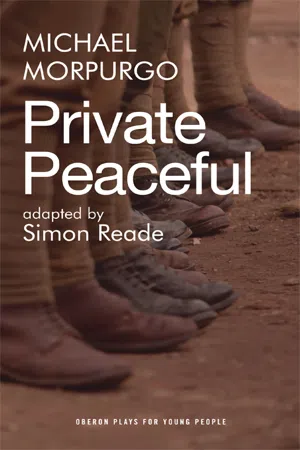
Private Peaceful relives the life of Private Tommo Peaceful, a young First World War soldier awaiting the firing squad at dawn. During the night he looks back at his short but joyful past growing up in rural Devon: his exciting first days at school; the accident in the forest that killed his father; his adventures with Molly, the love of his life; and the battles and injustices of war that brought him to the front line. Winner of the Blue Peter Book of the Year, Private Peaceful is by the third Children's Laureate, Michael Morpurgo, award-winning author of War Horse. His inspiration came from a visit to Ypres where he was shocked to discover how many young soldiers were court-martialled and shot for cowardice during the First World War.
This edition also includes introductory essays by Michael Morpurgo, Associate Director of Private Peaceful production Mark Leipacher, as well as an essay from Simon Reade, adaptor & director of this stage adaptation of Private Peaceful.
- 96 pages
- English
- ePUB (mobile friendly)
- Available on iOS & Android
eBook - ePub
Private Peaceful
About this book
Information
Private Peaceful
Ypres. 1916. No-man’s-land.
24th June. A barn, a prison. A bed. A bully tin of stew, potatoes.
A pair of boots.
1
(Private Peaceful – TOMMO, nearly 18 – looks at his watch.)
BARN
Five past ten.
I have the whole night ahead of me. I shan’t sleep. I won’t dream it away.
I want to remember everything, just as it was, just as it happened. I’ve had nearly eighteen years of yesterdays and tomorrows, and tonight I must remember as many of them as I can.
Tonight, more than any other night of my life, I want to feel alive!
ON THE WAY TO SCHOOL
Charlie’s leading me by the hand because he knows I don’t want to go (to school). I’ve never worn a collar before and it’s choking me. My boots are strange and heavy on my feet. My heart’s heavy too. I’m dreading it.
Big Joe doesn’t have to go and I don’t think that’s fair at all. He’s much older than me, even a bit older than Charlie. But Big Joe stays at home with Mother, and sits up in his tree singing ‘Oranges and Lemons’. He’s always laughing. I wish I could be happy like him. I wish I could be at home like him. I don’t want to go with Charlie. I DON’T WANT TO GO TO SCHOOL.
Charlie sees my eyes full of tears and knows how it is. He’s three years older than me, so he’s done everything, knows everything.
(CHARLIE.) Do you want a piggyback, Tommo?
I hop up and cling on tight round Charlie’s neck, trying not to whimper.
(CHARLIE.) First day’s the worst, Tommo. It’s not so bad. Honest.
Whenever Charlie says ‘honest’, I know it’s not true.
(Sound: bell.)
OUTSIDE SCHOOL
We line up in two silent rows, about twenty children in each. I recognize some of them from Sunday school. Charlie’s no longer beside me. He’s in the other line, and he’s winking at me. I blink back. I can’t wink with one eye. Charlie laughs.
(MR MUNNINGS.) Fall into line!
Mr Munnings: he of the raging temper Charlie’s told me so much about. Mr Munnings is pointing right at me and all the other children have turned to look.
(MR MUNNINGS.) Ah! A new boy. A new boy to add to my trials and tribulations. Name, boy?
(TOMMO.) Tommo, sir. Thomas Peaceful.
(MR MUNNINGS.) First a Charlie Peaceful, and now a Thomas Peaceful. Was not one Peaceful enough? Understand this, Thomas Peaceful, that here I am your lord and master. You do what I say when I say it. You do not cheat, you do not lie, you do not blaspheme. These are my commandments. Do I make myself clear?
(TOMMO.) Yes, sir.
Charlie and the big’uns follow Mr Munnings into one classroom. And then I’m taken with the tiddlers into Miss McAllister’s.
CLASSROOM
(MISS MCALLISTER.) Thomas, you will be sitting here –
– Miss McAllister is very proper –
(MISS MCALLISTER.) – sitting there, next to Molly. And your bootlaces are undone. Tie them up before you trip.
(TOMMO.) I can’t, miss.
(MISS MCALLISTER.) ‘Can’t’ is not a word we use in my class, Thomas Peaceful. We shall just have to teach you how to tie your bootlaces. That’s what we’re all here for, Thomas: to learn. You show him, Molly. Molly’s the oldest girl in my class, Thomas. She’ll help you.
Molly doesn’t look up at me while she’s tying them – but I wish she would. She has chestnut-brown hair the same colour as Father’s old horse – and shining – and I want to reach out and touch it. Then at last she looks up at me. I have a friend.
(Sound: schoolyard; kids playing.)
SCHOOLYARD
In playtime, in the schoolyard, I want to go over and talk to Molly, but I can’t because she’s surrounded by a gaggle of giggling girls. They keep looking over their shoulders and laughing at me. I look for Charlie, but he’s playing conkers with the big’uns. So I decide to undo my bootlaces and try doing them up again like Molly. I try again and again. It’s untidy, it’s loose – but I can do it! From across the schoolyard Molly sees, and smiles.
At home I never wear boots, except for church. Father always wore his great hobnail boots, the boots he died in.
IN THE WOODS
In the woods, Father was chopping away at a tree nearby, grunting and groaning at every stroke. At first I think he’s just groaning a bit louder. But then the sound seems to be coming from somewhere high up in the branches.
I look up: the great tree is swaying and creaking when all the other trees are standing still, silent. I stand and stare.
(Sound: tree falling like a roar of thunder.)
(FATHER.) Run, Tommo! Run!
(Silence. The tree has fallen.)
When I came to, I see him at once, see the soles of his boots with their worn nails. One arm is outstretched towards me, his finger points at me. His eyes are open, but I know they’re not seeing me. He’s not breathing. When I shout at him, when I shake him, he doesn’t wake up.
(Sound: solemn harmonium hymn.)
CHURCH
In the church we’re sat side by side at the front, Mother, Big Joe, Charlie and me. We’ve never in our lives sat in the front row before. It’s where the Colonel always sits. The coffin rests on trestles, Father inside in his Sunday suit. A swallow swoops over our heads all through the prayers and the hymns, flitting from window to window, to belfry, to altar, looking for a way out. And I know for certain it is Father trying to escape. I know because he told us more than once that in his next life he’d like to be a bird, so he could fly free wherever he wanted.
The Colonel gets up into the pulpit:
(COLONEL. Thumb tucked behind jacket lapel.) James Peaceful was a good man, one of the best workers I have known, the salt of the earth, always cheerful as he went about his work. The Peaceful family has been employed by my family for five generations. In all his thirty years as a forester on my estate James Peaceful was a credit to his family and village.
While the Colonel’s droning on I’m thinking of all the rude things Father used to say about him –
(FATHER.) – silly old fart, mad old duffer –
– and how Mother always said that –
(MOTHER.) – he might well be a ‘silly old fart’, but it’s the Colonel who pays the wages and owns the roof over our heads, so you all show him respect.
GRAVEYARD
The earth thumps down on the coffin (behind us) as we leave the graveside. He was trying to save me. If only I had run, he wouldn’t now be lying dead.
All I’ve ever thought is that I killed my own father.
2
(TOMMO looks at his watch.)
BARN
Twenty to eleven.
(He spoons his food unenthusiastically.)
I don’t want to eat. Stew, potatoes. I usually like stew, but I’ve no appetite. Not now.
Big Joe ate more than all the rest of us put together – potato pie, cheese and pickle, stew and dumplings, bread and butter pudding – whatever Mother cooked, he’d stuff it in and scoff it down. Anything Charlie and I didn’t like we’d shuffle onto his plate when Mother wasn’t looking.
Mother told us when we were older that Big Joe nearly died just after he was born. ‘Meningitis’, the doctor told her at the hospital, ‘brain damage’.
She was told ‘he wouldn’t live or even if he did, he’d be of no use to anyone.’
It was Big Joe who got me into my first fight.
(Sound: schoolyard; kids playing.)
SCHOOLYARD
It was playtime. Big Joe had come up to school to see Charlie and me. He stood and watched us from outside the gate, bright-eyed with excitement. I ran over to him. He opened his cupped hands just enough for me to see a slow-worm curled inside.
(TOMMO.) That’s lovely, Joe.
Then Big Joe wandered off, walking down the lane, humming:
(BIG JOE. Humming.) Oranges and Lemons (Etc.)
Someone taps me hard on my shoulder.
(JIMMY PARSONS. Sneering.) Who’s got a loony for a brother?
(TOMMO.) What did you say, Jimmy Parsons?
(JIMMY PARSONS. Chanting.) Your-brother’s-a-loony, your-brother’s-a-loony.
So I g...
Table of contents
- Front Cover
- Title Page
- Copyright
- Contents
- Finding Private Peaceful by Michael Morpurgo
- Staging Private Peaceful by Mark Leipacher
- Private Peaceful – Timeline
- The Last Laugh by Wilfred Owen
- Adapting Private Peaceful by Simon Reade
- Private Peaceful
- Characters
- Private Peaceful
Trusted by 375,005 students
Access to over 1.5 million titles for a fair monthly price.
Study more efficiently using our study tools.
Frequently asked questions
Yes, you can cancel anytime from the Subscription tab in your account settings on the Perlego website. Your subscription will stay active until the end of your current billing period. Learn how to cancel your subscription
No, books cannot be downloaded as external files, such as PDFs, for use outside of Perlego. However, you can download books within the Perlego app for offline reading on mobile or tablet. Learn how to download books offline
Perlego offers two plans: Essential and Complete
- Essential is ideal for learners and professionals who enjoy exploring a wide range of subjects. Access the Essential Library with 800,000+ trusted titles and best-sellers across business, personal growth, and the humanities. Includes unlimited reading time and Standard Read Aloud voice.
- Complete: Perfect for advanced learners and researchers needing full, unrestricted access. Unlock 1.5M+ books across hundreds of subjects, including academic and specialized titles. The Complete Plan also includes advanced features like Premium Read Aloud and Research Assistant.
We are an online textbook subscription service, where you can get access to an entire online library for less than the price of a single book per month. With over 1.5 million books across 990+ topics, we’ve got you covered! Learn about our mission
Look out for the read-aloud symbol on your next book to see if you can listen to it. The read-aloud tool reads text aloud for you, highlighting the text as it is being read. You can pause it, speed it up and slow it down. Learn more about Read Aloud
Yes! You can use the Perlego app on both iOS and Android devices to read anytime, anywhere — even offline. Perfect for commutes or when you’re on the go.
Please note we cannot support devices running on iOS 13 and Android 7 or earlier. Learn more about using the app
Please note we cannot support devices running on iOS 13 and Android 7 or earlier. Learn more about using the app
Yes, you can access Private Peaceful by Michael Morpurgo, Simon Reade in PDF and/or ePUB format, as well as other popular books in Literature & British Drama. We have over 1.5 million books available in our catalogue for you to explore.