It seems a long way from Moliere to Ray Cooney. There are immense distances between the worlds of Aristophanes, Plautus, Georges Feydeau, Ben Travers, Joe Orton and Basil Fawlty. But as one of the oldest genres in the history of the theatre, farce bridges the gaps by generating gales of helpless belly laughter across the generations.
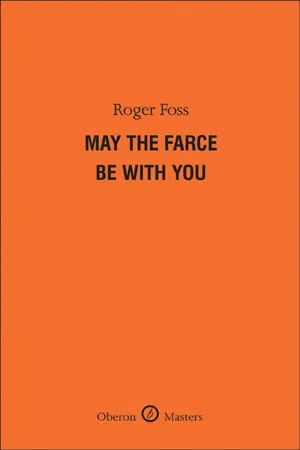
Inspired by John Mortimer's observation that farce is 'tragedy played at a thousand revolutions a minute', theatre critic Roger Foss embarks on a lightning tour of the rib-tickling world of confused characters, absurd situations, ruined reputations, sexual innuendo and bravura comic acting and finds out if farce really is a force to be reckoned with in the 21st century. The latest addition to the Oberon Masters series, May The Farce Be With You celebrates the great creators and performers of farce, notably master farceur Ray Cooney, who celebrates his 80th birthday in 2012, in essays that will inform and entertain both the aficionado and anyone with a sense of humour.
- 112 pages
- English
- ePUB (mobile friendly)
- Available on iOS & Android
eBook - ePub
May the Farce Be With You
About this book
Information
1. LOL and the world LOLs with you
‘Laughter is a noise that comes out of a hole in your face’
– Ken Dodd
– Ken Dodd
IF YOU COULD download theatre from iTunes, where would you put your farce? You’d end up having a genre crisis. Too niche to file under ‘Comedy’, too mainstream to file under ‘Classical’, farce doesn’t seem to go with a digital mindset. Even so, it’s probably only a matter of time before theatre audiences log out of real life and text ‘LOL’ to each other on smartphones rather than actually laugh out loud. Picture it: a West End theatre packed with rows of emoticon-type smiley faces watching the umpteenth revival of Feydeau’s A Flea in Her Ear, all madly sending text-speak to each other whenever the actors deliver a LOL moment. Silent comedy? No loud laughter? Unsmiley faces? Tragic.
FWIW (for what it’s worth, to non-texters), IMHO (in my humble opinion) the age-old tradition of people coming together to have a good laugh at people doing silly things is too culturally robust to surrender to the lost-in-cyberspace experience. The coupling of farce and laughter is a marriage made long ago in ancient showbiz Heaven: an arrangement that has had its conjugal (and critical) ups and downs, but was probably always destined for a laugh-out-loud ending.
When you trace the history of farce, it was Aristophanes who more than likely led the way with The Birds, and so it went on, right up to Basil Fawlty’s ‘Don’t mention the Germans’ and The Thick of It. But there’s always been a genre-slippage to farce, and it has has never been more slippy than in the past hundred years, when elements of farcicality have naturally flip-flopped between stage, film and television.
Even so, many of our major twentieth-century playwrights have adopted or explored farcical forms. Michael Frayn’s Noises Off, Alan Ayckbourn’s Bedroom Farce, Joe Orton’s Loot and What the Butler Saw, Peter Shaffer’s Black Comedy, Alan Bennett’s Habeas Corpus and Tom Stoppard’s Dirty Linen are all examples of writers taking the dramatic and the comic possibilities of farce as seriously as tragedy. More recently, a new generation of playwrights has discovered the power of farcicality. One Man, Two Guvnors, Richard Bean’s English reworking of Goldoni’s classic Italian comedy The Servant of Two Masters, owes most of its laugh-out-loud quotient to popular comedy forms harking back to the commedia dell’arte and traditional elements of farce, such as disguise, mistaken identity and slapstick. David Harrower’s Government Inspector, which premiered at the Young Vic in 2011, is another instance of a classic comedy given a broad comedic makeover, by transforming Nikolai Gogol’s classic social satire into an insane farcical nightmare.
At the mass consumption end of the spectrum of comedy, the world of the TV sitcom has thrived on farcicality. Watch reruns of I Love Lucy, Keeping Up Appearances, Rising Damp, Frasier and The Office and you’ll discover some humorous complication or other indelibly stamped with farce on the bottom.
John Cleese has acknowledged the influence of French farces on Fawlty Towers. The French, whose deep understanding of farce is probably embedded in the Gallic gene pool, are particularly adept at leaping the genre gap between farce onstage and farce on-screen. Jean Poiret’s 1973 play La Cage aux Folles began life as a stage farce. It then transferred successfully to film, and ended up back on the musical stage, with a book by Harvey Fierstein set to lyrics and music by Jerry Herman. Pierre Barillet and Jean-Pierre Grédy’s 1977-set play Potiche, with its women’s lib theme, is another example of a farcical stage situation working equally well on film in 2011.
From its earliest days, Hollywood comedians begged, borrowed or stole facets of farce they had used in vaudeville or music hall and turned them into silver screen comedy gold. In turn, Mack Sennett, Charlie Chaplin, Laurel and Hardy, The Three Stooges, Abbott and Costello and The Marx Brothers inspired the likes of Jerry Lewis, Billy Wilder and Woody Allen and the screwball capers of Frank Capra and Peter Bogdanovitch.
Nevertheless, farce is on home territory in a theatre full of people laughing out loud at other people onstage coping with unreal situations. From the fantastical farces and double entendres of Aristophanes and the scheming Roman-era slaves and libidinous old codgers of Plautus, to the contemporary domestic worlds of Ayckbourn, with the likes of Shakespeare, Goldoni, Molière, Feydeau, Arthur Wing Pinero, Ben Travers, Ray Cooney, John Chapman and numerous other expert farceurs in between, farce has made us laugh by putting a scalpel to the vices and vanities of flawed characters driven close to disaster by wonky moral satnavs.
But what is farce? American drama critic John Mason Brown once aptly described farce as ‘comedy written with a slapstick rather than a pen. Its business is to make us accept the impossible as possible, the deranged as normal, and silliness as a happy substitute for sense.’
According to actor-producer Brian Rix of Whitehall farce fame, the whole point of farce is that it is broad comedy teetering on the edge of tragedy: ‘It always threatens ultimate catastrophe, and this is what sustains the dramatic tension,’ Rix writes in his autobiography, Farce About Face, ‘but by a slight twist it makes people roll about with laughter. It is tragedy with its trousers down.’ Or as John Mortimer famously describes it in relation to Feydeau’s farcical adventures into adultery: ‘Tragedy played at a thousand revolutions per minute.’
Actor turned farceur Ray Cooney, who developed his craft as a writer in Rix’s Whitehall company, agrees with the tragi-comic connection: ‘What I write about as farce could easily be treated as tragedy in other hands. What Shakespeare does with kings, I do with taxi drivers.’
Today, many people would probably sign up to the idea that farce is tightly plotted comedy of bad manners, with protagonists (mostly men, rarely women) caught in potentially disastrous situations (usually in or near the bedroom) and employing split-second exits and entrances (invariably involving lots of door-slamming) that rev-up into a kind of face-saving relay race – low comedy based on human frailties with physical action that almost belongs to a race apart.
But before running away with the idea that farce is simply frantic fun with sexual overtones, as in Feydeau’s farces, it’s worth remembering that, over the years, farce meant different things at different times.
The French and the Italians first coined the word farci, or farcie, not in the theatre but in the kitchen and the medieval church. The term is derived from the Latin farcire, ‘to stuff’ meat or other foods. Originally the vernacular ‘stuffing’ inserted between passages of Latin liturgy or during the more serious parts of seasonal mystery play cycles, by the sixteenth century the ‘farce’ had evolved in France and in Italy into loose playlets designed to create laughter, often performed by the travelling troupes from which Molière emerged. The farcical influence was felt in puritanical England too, where tomfoolery, buffoonery and clowning had always been a part of medieval and Tudor drama.
By the Restoration, when the word farce was coined in England, it was not generally used to refer to a special type of comic stage technique at all, but to short, crude humorous plays which were becoming popular at the time. In 1667, Samuel Pepys was recording how a farce, The Feigned Innocence, or, St Martin Marr-All, made him laugh: ‘It is the most entire piece of mirth, a complete farce from one end to the other, that certainly ever was writ. I never laughed so in all my life’.
By the eighteenth and the nineteenth centuries ‘comedy’ and ‘farce’ could mean the same thing. The same play might be described as a ‘comedy of manners’ on one poster, a ‘farce’ on another. It was common practice to label any short piece opening or closing a bill as a ‘farce’, even if there was nothing farcical about it. The French constantly got their comedy knickers in a twist describing some farcical comedies as farce, but others as petite comédie or précieuses ridicules.
The Oxford English Dictionary definition of farce includes: ‘a dramatic work (usually short) which has for its sole object to excite laughter; an interlude.’ I’ll go with the laughter. At its heart, farce employs its theatrical ingenuity to make people laugh out loud. It’s a communal experience. And in good farces you’ll always find a subversive side lurking somewhere behind the funnies, whether it’s in Joe Orton’s What the Butler Saw or Ray Cooney’s Run For Your Wife. As Sir Peter Hall has noted, farce ‘allows us to watch the sort of bad behaviour that we could never publicly endorse, but which we secretly know we might be capable of.’ But farce’s prime purpose is to create characters, situations and action that tickle funny bones – a fun-poking experience that critic Laurence Kitchen, in his book Drama in the Sixties calls, rather snootily, ‘The pop art of canteens and seaside piers’.
For me, the cathartic experience of crying with laughter at a farce is every bit as potent as sniffling into a Kleenex during a romantic weepie. Laughter is as natural as breathing. We all arrive on the planet crying out loud first and laughing out loud next. Laughter is in the human DNA chain long before we learn to talk and toddle. Comedians die without it. Theatre audiences roll in the aisles doing it. Beauticians claim it loosens facial wrinkles.
Is laughter really all down to a chemical reaction within our pituitary glands? Does it simply rely on beta-endorphins triggering a humorous high? Has it evolved in humans over millions of years, or have the God-fearing creationists got it right when they claim that laughter simply comes direct from the Almighty. ‘Let there be laughter’… ‘and lo, Adam’s Rib was tickled pink.’ But then the Old Testament never was known for its jokes.
Lofty thinkers such as Aristotle, Kant, Darwin, Bakhtin and Bergson have pondered deeply on the nature of humour. Joke analyst Sigmund Freud even imagined the id, ego and superego as a sort of Three Stooges of the unconscious. Personally, I’ve always had trouble swallowing any of the various titter theories put forward by neuropsychologists, anthropologists and sociologists, because nobody has come up with a more definitive account of the true nature of laughter than Ken Dodd: ‘Laughter is a noise that comes out of a hole in your face. If it’s from anywhere else you are in trouble.’
Unless you are living in a permanently tragic state of the glums, we know from our own experience how that noise from a hole in the face is powerfully contagious, socially beneficial and utterly universal. In a theatre, you can’t beat laughing alongside others during those endorphine-rush moments in a farce when the entire house erupts as if a mighty mirthquake is shaking the foundations.
I can pinpoint the light bulb moment when I first discovered the ability of farce to create knockout laughter. This was not a theatre laugh out loud moment, but a television moment at our home in the East End of London during the summer of 1955. I was just turned ten when my hard-up parents scraped enough money together to rent a black and white television receiver. For me, the box-shaped telly in our front room immediately became a window on another world where brightness and laughter reigned; a world that I barely knew existed beyond the greyscale streets of Cockneydom.
The goggle box became my own private giggle box, from out of which came the likes of Richard ‘Mr Pastry’ Hearne, Charlie Drake and I Love Lucy. Here was a ten-year-old’s comedy escape route from the very unfunny reality of a large family coping with post-war poverty. I had already discovered a parallel universe of radio fun. But now, through the medium of the telly, I really could immerse myself in other worlds bubbling with laughter: more fun here, I thought, than cheering yourself hoarse when Old Mother Riley films came on the screen at the Saturday morning pictures. At home, watching comedy shows on the flickering screen, I could roll around laughing on the lino, whilst secretly imagining myself being part of the warmth of the mysterious studio audience that you heard but could never see.
Then, one summer evening, I stayed up late to see Dry Rot. I had no idea I was watching the live broadcast of Act Two of a rollicking stage farce, written by John Chapman, which had been packing the Whitehall Theatre for nearly a year. Actually, I had no idea that such things as ‘farce’ or even theatres existed. Apart from the annual trip to the London Palladium pantomime, theatre-going wasn’t for the likes of us. So this transmission must have been the first live play I ever saw.
Dry Rot’s fast and furious plot revolving around a racehorse swindle and three dubious crooks who are forced to take increasingly desperate measures to avoid being nabbed, sent continuous gales of laughter across the theatre footlights that seemed to woosh though the television screen and into our front room like laughing gas. If only I could be there at the Whitehall to breathe in the roar of that crowd…
This was the moment when the overwhelming atmosphere of people laughing out loud together in a theatre captured my schoolboy imagination. It has never let go. From then on, I’ve never been able, or willing, to get farce out of my system.
Of course, I did not have a clue that Dry Rot, presented by and starring young actor...
Table of contents
- Cover Page
- Half-title Page
- Title
- Copyright
- Contents
- 1. LOL and the world LOLs with you
- 2. More Farce Please, We’re British
- 3. A Conversation with Cooney
- 4. The Man Who Made Queen Victoria Giggle
- 5. Comedy of Terrors
- 6. Let’s Farce the Music
- 7. Spent Farce?
- 8. Fifty Farces to See Before You Die Laughing
- Bibliography of sources
Trusted by 375,005 students
Access to over 1.5 million titles for a fair monthly price.
Study more efficiently using our study tools.
Frequently asked questions
Yes, you can cancel anytime from the Subscription tab in your account settings on the Perlego website. Your subscription will stay active until the end of your current billing period. Learn how to cancel your subscription
No, books cannot be downloaded as external files, such as PDFs, for use outside of Perlego. However, you can download books within the Perlego app for offline reading on mobile or tablet. Learn how to download books offline
Perlego offers two plans: Essential and Complete
- Essential is ideal for learners and professionals who enjoy exploring a wide range of subjects. Access the Essential Library with 800,000+ trusted titles and best-sellers across business, personal growth, and the humanities. Includes unlimited reading time and Standard Read Aloud voice.
- Complete: Perfect for advanced learners and researchers needing full, unrestricted access. Unlock 1.5M+ books across hundreds of subjects, including academic and specialized titles. The Complete Plan also includes advanced features like Premium Read Aloud and Research Assistant.
We are an online textbook subscription service, where you can get access to an entire online library for less than the price of a single book per month. With over 1.5 million books across 990+ topics, we’ve got you covered! Learn about our mission
Look out for the read-aloud symbol on your next book to see if you can listen to it. The read-aloud tool reads text aloud for you, highlighting the text as it is being read. You can pause it, speed it up and slow it down. Learn more about Read Aloud
Yes! You can use the Perlego app on both iOS and Android devices to read anytime, anywhere — even offline. Perfect for commutes or when you’re on the go.
Please note we cannot support devices running on iOS 13 and Android 7 or earlier. Learn more about using the app
Please note we cannot support devices running on iOS 13 and Android 7 or earlier. Learn more about using the app
Yes, you can access May the Farce Be With You by Roger Foss in PDF and/or ePUB format, as well as other popular books in Littérature & Théâtre britannique. We have over 1.5 million books available in our catalogue for you to explore.