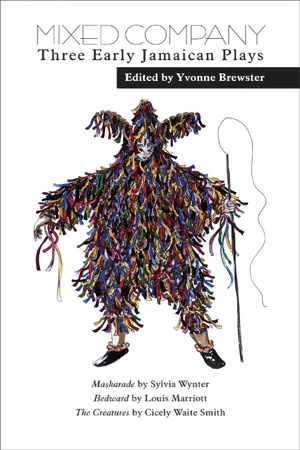
In 2012 Jamaica celebrates the 50th anniversary of Independence. Mixed Company is a collection of three of the finest early Jamaican theatrical works, written for the most part before the dawn of Independence.
Written in 1954 (The Creatures by Cicely Waite-Smith), 1960 (Bedward by Louis Marriott) and 1970 (Maskarade by Sylvia Wynter), the plays are examples of works conceived with a Jamaican audience in mind, a Jamaican audience conscious of the melting pot in which it lived. Each offers a unique perspective on the spirit of a people who held on to traditional beliefs and customs in the face of colonial opprobrium as the populace struggled to gain its political, social and cultural independence.
Yvonne Brewster talks to Woman's Hour about Jamaican indpendence
- 312 pages
- English
- ePUB (mobile friendly)
- Available on iOS & Android
eBook - ePub
About this book
Information
Introduction to Maskarade
YB: Your paper ‘Jonkunnu in Jamaica: Folklore as Cultural Process’ is a highly regarded academic paper, not a play. How did the play Maskarade come to be written?
SW: Firstly, it is in no way either an anthropological or an ethnographic disciplinary paper. It was first written as an essay for a UNESCO conference on folklore which explains its non-academic, and instead, politico-cultural dynamic as a paper… Jim Nelson1 would have responded to the paper in the way he did, especially given the fact that growing up in a then imperial colony like Jamaica, all things African had been systemically stigmatized. That is, until the anticolonial movements initiated the decolonisation of our hitherto British imperial domesticated consciousnesses. As a theatrical artist, Nelson would have been attracted to the other major aspect of what I myself had discovered in writing the Jonkunnu essay. This is the fact that, as in the English Morris dancing popular tradition, or indeed, as in the black American minstrel show, all of which had, like the African carnival tradition which gave origin to Jonkunnu, emerged from the immeasurably older, pre-Christian, pre-monotheistic, pagan religious, earth-centered popular religions.
As a tradition out of which pagan elements, such as those still carried over in Catholicism, had come to constitute, in our modern world, an ecumenically human popular tradition. One which we find, in contradiction to the brutal hierarchy of the slave master and the slave, had continued to be syncretized within the terms of what had become in Jamaica, the now matrix African-pagan carnival tradition.
With the result that the popular, farcical doctor plays common to them all had come to syncretically integrate themselves at a popular level, as carried, on the one hand, by the slaves, and on the other, in the case of the English Morris dancing, for example, by the lower bookkeeper overseer classes, who would have been the main carriers of the Anglo-Scottish variant of this tradition. This paradoxically then, as a tradition out of which the now global popular musical culture of the world was to emerge.
YB: Music plays an essential role in the play. How did you go about deciding on this element?
SW: This has always seemed to me to be provided by the popular musical tradition, whether in the United States or in Jamaica in its contemporary forms. What Sandra Richards did was use elements from the Jamaican folk tradition as well as from the emergent rap tradition. I would imagine that any version of the play would follow the same formula by incorporating the contemporary popular musical forms.
YB: The play script of Maskarade which appears in this collection is a later edition performed in the USA in 1983. Is there a reason for this choice?
SW: Originally the Miss Gatha character of the play had been imagined in the same terms as she had originally been in my novel The Hills of Hebron (1962). This explains my strong disagreement with Jim Nelson on this single aspect of her being made into the stereotyped figure of the yard woman tradition in the original productions. I felt that this was strongly at variance with the African tradition out of which the Jonkunnu ceremony of the play Maskarade had evolved. This especially so with respect to Miss Gatha, whom I had conceived as still embodying the major conception of Mother Earth and of the conception of justice, which is fundamentally different from that of the West’s legalistic conception. By the way, the latter itself is a conception of justice that is also completely different from what had been the West’s medieval tradition’s conception ...
Table of contents
- Front Cover
- Half-title Page
- Dedication
- Title Page
- Copyright
- Contents
- Introduction
- Maskarade: A ‘Jonkunnu’ Musical Play
- Introduction to Maskarade
- Introduction to Bedward
- Bedward: A Play in Two Acts
- Melodic lines for songs by Noel Dexter
- The Creatures
- Introduction to The Creatures
- Notes on Contributors
Trusted by 375,005 students
Access to over 1.5 million titles for a fair monthly price.
Study more efficiently using our study tools.
Frequently asked questions
Yes, you can cancel anytime from the Subscription tab in your account settings on the Perlego website. Your subscription will stay active until the end of your current billing period. Learn how to cancel your subscription
No, books cannot be downloaded as external files, such as PDFs, for use outside of Perlego. However, you can download books within the Perlego app for offline reading on mobile or tablet. Learn how to download books offline
Perlego offers two plans: Essential and Complete
- Essential is ideal for learners and professionals who enjoy exploring a wide range of subjects. Access the Essential Library with 800,000+ trusted titles and best-sellers across business, personal growth, and the humanities. Includes unlimited reading time and Standard Read Aloud voice.
- Complete: Perfect for advanced learners and researchers needing full, unrestricted access. Unlock 1.5M+ books across hundreds of subjects, including academic and specialized titles. The Complete Plan also includes advanced features like Premium Read Aloud and Research Assistant.
We are an online textbook subscription service, where you can get access to an entire online library for less than the price of a single book per month. With over 1.5 million books across 990+ topics, we’ve got you covered! Learn about our mission
Look out for the read-aloud symbol on your next book to see if you can listen to it. The read-aloud tool reads text aloud for you, highlighting the text as it is being read. You can pause it, speed it up and slow it down. Learn more about Read Aloud
Yes! You can use the Perlego app on both iOS and Android devices to read anytime, anywhere — even offline. Perfect for commutes or when you’re on the go.
Please note we cannot support devices running on iOS 13 and Android 7 or earlier. Learn more about using the app
Please note we cannot support devices running on iOS 13 and Android 7 or earlier. Learn more about using the app
Yes, you can access Mixed Company by Yvonne Brewster in PDF and/or ePUB format, as well as other popular books in Literature & British Drama. We have over 1.5 million books available in our catalogue for you to explore.