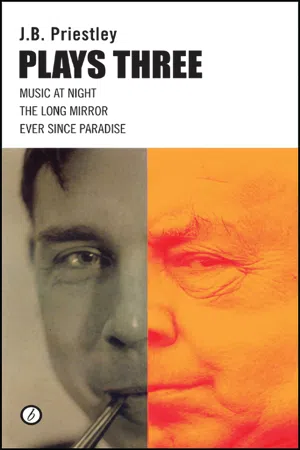
Music at Night centres on a group of people attending a musical evening to hear a new work. Each act follows a movement in the music, which inspires the listeners to react each in their own way, looking inside themselves for their true feelings and sometimes remembering significant moments from their past. As often in Priestley's work, the relations between the sexes play an important part, a theme which recurs in the other two plays.
The Long Mirror recounts the meeting between a composer and a young woman who seems to have been telepathically connected to him for some time, and has experienced much of his life before actually meeting him. Her knowledge of his past can help his future as an artist and a husband. It was based on a true incident.
Ever Since Paradise he described as 'A Discursive Entertainment, chiefly referring to Love and Marriage in Three Acts'. Three couples are made up of The Musicians, the Commentators and The Example, and together they illustrate various aspects of relationships, accompanied by appropriate music on two pianos.
- 264 pages
- English
- ePUB (mobile friendly)
- Available on iOS & Android
eBook - ePub
J.B. Priestley: Plays Three
About this book
Information
EVER SINCE PARADISE
A Discursive Entertainment,
chiefly referring to Love and Marriage, in Three Acts.
chiefly referring to Love and Marriage, in Three Acts.
Author’s Preface
This experimental comedy was originally written in 1939 and then much re-written at odd intervals. With some extremely adroit music by Dennis Arundel, with Ursula Jeans and Roger Livesey playing Helen and William (and all that involved), in a production I directed myself, with much valuable help from Roger Livesey and Osmund Wilson, Ever Since Paradise started on a long and very successful provincial tour in the summer of 1946. At the end of that tour there was no theatre for us in London, so we laid off the production for six months, and then opened at the New in June 1947. I think it is true, as several knowledgeable persons have told me, that we achieved a sparkle and gaiety in the original touring production that we never quite recaptured afterwards. Nevertheless, the reception this play had in London (though it ran for several months and made many friends) was a shock and bitter disappointment to me. Many of the notices were not merely inadequate but downright wilfully stupid. Let me give one example. One critic who, I know from personal observation, was not even in the auditorium during the funniest scenes of the play, condemned me – in this of all plays – for solemn preaching. Being producer as well as author, I often looked in at this play, and always the audiences appeared to be having an uproariously good time (as they have done since with it in many Continental capitals); yet it is a fact that fifty per cent of the Press was sullenly hostile. And why, I cannot imagine, unless it was because I was at least trying to do something new. One final point: although this play, if properly produced and acted, should often have the air of being a gay charade, it was in fact written and re-written with great care and made great demands on such technical knowledge as I possess.
But it was worth the time and trouble, not only because of all the fun we and the audiences had with it, but also because here and there it seemed to me to create a new and valuable relationship between players and audience, and because it might possibly drop a hint or two to younger and more hopeful playwrights.
J.B. Priestley, January, 1949
Characters
The Musicians
The Commentators
The Example
PHILIP
WILLIAM
PAUL
JOYCE
HELEN
ROSEMARY
The Action is in many different places,
and the time is the Present, but between Wars.
and the time is the Present, but between Wars.
Ever Since Paradise – Copyright, 1946,
by John Boynton Priestley.
by John Boynton Priestley.
First produced at the New Theatre, London, on June 4th, 1947, with the following cast:
| PHILIP | Dennis Arundell |
| JOYCE | Jane Carr |
| WILLIAM | Roger Livesey |
| HELEN | Ursula Jeans |
| ROSEMARY | Joy Shelton |
| PAUL | Hugh Kelly |
ACT ONE
The main curtain may or may not be used, according to the size of the stage. On each side of the stage, as far as possible, is a grand piano, each exactly alike, with the keyboard downstage, at an angle of about sixty degrees to the footlights. Near each piano, a little farther upstage, is a chair for each commentator. These are backed by dark curtaining, hiding the stage behind, and there is an entrance through this curtaining at each side, used only by WILLIAM and HELEN. Set a little farther back, occupying all the centre of the stage, with a small proscenium formed by a continuation of the curtaining behind the platforms, is a separate little stage, which may or may not be raised on small rostrum, and is eight or nine feet high, and it is essential that this can be pulled up or drawn along very easily, apparently at a touch. At the opening this curtain is down, and the inner stage cannot be seen.
House lights do down and both pianos are lit. PHILIP and JOYCE, two youngish people in simple evening dress (PHILIP in dinner jacket.) are seated at the pianos. PHILIP at the right and JOYCE at the left. They begin playing the overture, which goes along splendidly for two or three minutes, both keeping perfect time. Then they begin to sound ragged and look worried. He wants to increase the tempo and she is lagging behind. Finally, with a discordant crash, they stop, glaring at each other.
PHILIP: (Rising angrily.) There you are, you see!
JOYCE: (Rising angrily.) It’s not my fault.
PHILIP: Of course it is.
JOYCE: No it isn’t, it’s your fault.
PHILIP: No it isn’t, you were dragging it again.
JOYCE: I wasn’t. You were racing away at a ridiculous pace.
PHILIP: I wasn’t.
JOYCE: You were. Always the same! Want to rush everything.
PHILIP: I don’t want to rush everything.
JOYCE: Yes, you do. Going and taking the cottage!
PHILIP: (Very angrily.) What’s my taking that cottage got to do with your dragging the time again – ?
Enter WILLIAM in dinner jacket.
WILLIAM: (Reproachfully.) I say, I say, this won’t do, you know. You two ought to be playing, not shouting at each other. (To audience.) I’m so sorry about this. Do excuse us, please! (To the pianists.) You were playing so well too. I was just remarking to Helen how well you were playing – and then – no more music but another quarrel.
JOYCE: It’s his fault. He began to rush it again.
WILLIAM: Now, Philip, you musn’t rush it –
PHILIP: I wasn’t. She will drag it.
WILLIAM: Now, Joyce, you really mustn’t drag it –
JOYCE: I never do. That’s just his stupidity.
PHILIP: (Rising angrily.) It isn’t. It’s your-
WILLIAM: (Very forcefully.) Stop it, stop it, stop it! Now if one of you would condescend to rush a little less.
PHILIP and JOYCE both sit at their pianos.
then no doubt ...
Table of contents
- Front Cover
- Half-title Page
- Title Page
- Copyright
- Contents
- Introduction
- Music at Night
- The Long Mirror
- Ever Since Paradise
Trusted by 375,005 students
Access to over 1.5 million titles for a fair monthly price.
Study more efficiently using our study tools.
Frequently asked questions
Yes, you can cancel anytime from the Subscription tab in your account settings on the Perlego website. Your subscription will stay active until the end of your current billing period. Learn how to cancel your subscription
No, books cannot be downloaded as external files, such as PDFs, for use outside of Perlego. However, you can download books within the Perlego app for offline reading on mobile or tablet. Learn how to download books offline
Perlego offers two plans: Essential and Complete
- Essential is ideal for learners and professionals who enjoy exploring a wide range of subjects. Access the Essential Library with 800,000+ trusted titles and best-sellers across business, personal growth, and the humanities. Includes unlimited reading time and Standard Read Aloud voice.
- Complete: Perfect for advanced learners and researchers needing full, unrestricted access. Unlock 1.5M+ books across hundreds of subjects, including academic and specialized titles. The Complete Plan also includes advanced features like Premium Read Aloud and Research Assistant.
We are an online textbook subscription service, where you can get access to an entire online library for less than the price of a single book per month. With over 1.5 million books across 990+ topics, we’ve got you covered! Learn about our mission
Look out for the read-aloud symbol on your next book to see if you can listen to it. The read-aloud tool reads text aloud for you, highlighting the text as it is being read. You can pause it, speed it up and slow it down. Learn more about Read Aloud
Yes! You can use the Perlego app on both iOS and Android devices to read anytime, anywhere — even offline. Perfect for commutes or when you’re on the go.
Please note we cannot support devices running on iOS 13 and Android 7 or earlier. Learn more about using the app
Please note we cannot support devices running on iOS 13 and Android 7 or earlier. Learn more about using the app
Yes, you can access J.B. Priestley: Plays Three by J. B. Priestley in PDF and/or ePUB format, as well as other popular books in Littérature & Théâtre britannique. We have over 1.5 million books available in our catalogue for you to explore.