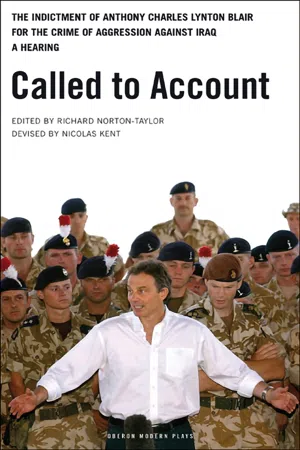
in 2007 year two leading barristers: Philippe Sands QC (for the prosecution) and Julian Knowles (for the defence) tested the evidence of the grounds for an indictment of the British Prime Minister for the crime of aggression against Iraq. They examined a number of distinguished witnesses, including MPs, diplomats, international lawyers, civil servants, UN officials, policy advisors, intelligence experts and journalists.
The arguments and testimony gathered, edited into a play by Richard Norton-Taylor, examine the criminal implications of the British Government's decision to use force against Iraq, and allow the audience to decide whether an indictment in this case is proven. Called to Account opened at the Tricycle Theatre, London in April 2007.
eBook - ePub
Called to Account
The indictment of Anthony Charles Lynton Blair for the crime of aggression against Iraq - a Hearing
- 120 pages
- English
- ePUB (mobile friendly)
- Available on iOS & Android
eBook - ePub
Called to Account
The indictment of Anthony Charles Lynton Blair for the crime of aggression against Iraq - a Hearing
About this book
Information
Act Two
SCENE 1: MICHAEL MATES
NÍ GHRÁLAIGH pours MICHAEL MATES a glass of water from a bottle on the table. As she pours:
MATES: I might need something stronger by the time I finish this. I should have brought Butler with me.
NÍ GHRÁLAIGH: (Handing MATES a copy of the Butler Report.) You can have that and give it back.
MATES: Here we go. (Looking at KNOWLES.)
KNOWLES: Shall I start then. Okay. You are Michael Mates.
MATES: Yes.
KNOWLES: And could you tell us a little bit about your career please?
MATES: I was an officer in the British army. I was elected to Parliament in 1974 – I have been there ever since. I was a Minister of State in John Major’s Government. I then joined the Intelligence and Security Committee when it was formed thirteen years ago.
KNOWLES: Now you, um, were a member of Lord Butler’s Committee that was appointed to look into intelligence matters after the war. I want to ask you a little bit about how the Committee carried out its work, you were working under constraints of time?
MATES: Yes, we were appointed as I recall in February and we were asked to report by the summer recess.
KNOWLES: This is February of 2004?
MATES: If you say so yes. Is there a list of all the people we saw? I’m not sure whether it’s public. Who we went to.
SANDS: There is a list.
KNOWLES: Oh yes, it’s page 161.
MATES: Oh, this is terrific.
Silence.
Yep, okay, it’s on the record. Sorry, I thought I’d try – be a bit careful. We started off with a series of informal meetings, I think I can tell you one, I can break one confidence, when we saw Lord Hutton we had a pretty interesting chat with him about the various aspects of what he’d done and at the very end Robin Butler said: ‘Well, thank you Lord Hutton very much, is there any final thing you’d like to say to us?’ and he leaned back and put his fingers together and said in the very dour way that he had, ‘Yes, don’t report’. Which he said without a smile, I think he was heavily scarred by what had happened to him.
KNOWLES: Were you in particular looking at the issue of whether there had been deliberate misuse by the Government of intelligence?
MATES: Well the challenge was to decide whether that was accidental or deliberate. Conspiracy or cock-up? It is nearly always the latter in my experience.
KNOWLES: So if you had found that there had been deliberate and knowing distortion, misuse, overstatement of intelligence by the Government, the decision makers. Did that fall within the remit of the Committee?
MATES: Certainly, and we did report on some aspects, I think one of the phrases was ‘more emphasis was put on this than the intelligence could bear’ – isn’t that a phrase that comes out of this somewhere? That may be wrong…but it’s close.
KNOWLES: Did you meet with the Attorney General as part of your work?
MATES: We did, we took evidence from him.
KNOWLES: One of the allegations is that the legal advice that he gave to the House [of Lords] fitted the answer he knew he was expected to give in order to support the Government’s case for war – that he gave dishonest legal advice is the suggestion.
MATES’ mobile phone rings.
MATES: Sorry I should have switched that off. I will switch it off.
He switches it off.
Where were we?
KNOWLES: What is your comment on that suggestion? The Attorney General’s section is 366 onwards.
MATES: 366?
KNOWLES: Yep.
MATES: Sorry, I must be very careful here.
Silence.
Now, the Attorney General was, and I think has never made any bones about it, in difficulty because his advice at some stage changed and that was really only over the United Nations resolutions. He was quite clear about why his advice changed, why he took one view initially and then took another.
KNOWLES: What did he say the reason was?
MATES: He said that things had moved on and that he had taken another look at the Second Resolution and I think it was difficult for him but he was, in the end, quite clear that yes his advice had changed and it had changed in good faith. He said he wasn’t put under pressure. There was no evidence to the contrary.
KNOWLES: On the 17th March, the day of the House of Commons debate, the Attorney General submitted a shorter document of what his view of the legal position of the war was. It has been suggested that was produced for reasons of political expediency. Could you just tell us about that?
MATES: The fact that it was contrived, as a parliamentary answer is neither here nor there, that’s just procedural. There was pressure, which actually was wrong, because people were saying the Chief of Defence staff refused to go to war without a certificate if you like.
KNOWLES: So the, just to be clear about it, the origin of the Parliamentary answer of the shorter statement, came from the soldiers, rather than the politicians?
MATES: No, no. My recollection is that there was enormous media pressure and political pressure, um to know what the legal advice was. At the same time, the Chief of Defence staff who was about to commit his troops said, ‘Well I need my piece of paper please, telling me that this is legal.’ And that would have happened in Kosovo, in Bosnia, you know, in all sorts of places.
KNOWLES: The allegation’s been made that the Prime Minister knowingly lied to the House of Commons in the course of the debate on the war in order to procure a favourable vote. What is your reaction to that charge, based on the material that you have seen?
MATES: Had we thought that, it would have been very difficult, we’d probably have said so. We didn’t think that. We did think that there was some extraordinary circumstances surrounding the facts, or alleged facts that the Prime Minister presented. I was going to come on to the 45 minute bit. It’s in this report?
KNOWLES: Yes.
MATES: Can you point me to it? Sorry.
SANDS: It starts at 504.
MATES: Thank you, can I just take a look at that?
Silence.
Ah, you see, we did comment on it as well. We said it was unhelpful. Sorry, the Intelligence Committee said it was unhelpful, Butler agreed with that and took the firm view that the JIC should have included that judgement in its assessment and in the dossier. Nobody, except the experts, knew what it was referring to. And then you’ll remember great maps appeared in the newspapers with rings around it, you know, that they could hit Cyprus within 45 minutes and all this and that.
KNOWLES: Private Eye said it could hit Neasden.
MATES: Yes, it was – Sorry what, was that?
KNOWLES: Private Eye said it could hit Neasden.
MATES: Ha, I missed that. And it was one of those things that there was fairly trenchant criticism about because it was a cock-up. We had no evidence that it was a conspiracy.
KNOWLES: The focus of this trial is on the Prime Minister’s personal responsibility, rather than his broader collective responsibility, so on the charge of lying to Parliament you would acquit him?
MATES: Yes.
KNOWLES: Yes, thank you very much.
SANDS: [In Butler] you didn’t express any view did you on the decision-making process on the political issues taken by the Prime Minister did you?
MATES: Yes we did, right at the end of the report we said that the ‘style of Government –’
SANDS: Paragraph 611, I think.
MATES: ‘– may have had something to do with some of the errors that occurred.’ I think that was it. Now that is a criticism, it’s what we’d call in shorthand ‘sofa-style’ government. That a number of things didn’t get minuted.
SANDS: Tab 12 [in the bundle], right at the end is the minute, ‘Iraq, Prime Minister’s meeting 23rd July [2002]’. Can I take you to the comment by the Foreign Secretary? ‘It seemed clear that Bush had made up his mind to take military actions even if the timing was not yet decided, but the case was thin.’ What we’re hearing is a meeting of the most senior Cabinet Ministers, being told that the evidence is thin, and six weeks later the Prime Minister writes a foreword to a report saying there is no doubt as to what is going on. Does not that raise certain questions?
MATES: Well, he would probably with retrospect wish to have put the word ‘reasonable’ in.
SANDS: So it wasn’t an accurate statement?
MATES: Well, I mean…
SANDS: Would you confirm that statement?
MATES: It’s not my job to defend the Prime Minister.
SANDS: You’re doing an excellent job at it, if I may say. But there’s no hint in the Butler Report, is there, that senior Cabinet Ministers thought that the intelligence was thin? [One] of our witnesses, Sir Murray Stuart Smith whose reputation you will know, when asked which other body the Prime Minister could turn to for advice on intelligence, apart from the JIC, concluded that he knew of none.
MATES: Well, that’s true.
SANDS: Is it then the case that the Prime Minister expressed his unequivocal view that Iraq was in further material breach i.e. after December 2002, without taking into account the views of the JIC? On what basis did he reach that view?
MATES: Well, I’m sure he reached it because he was in, at that stage, daily touch with the heads of the Intelligence Service, particularly SIS. And this is, if you like a further reflection of the informality with which these things were done.
SANDS: Is it an appropriate way to take such a decision as grave as this with such informality?
MATES: I don’t think it is, no.
SANDS: Well, let’s go back then to the Attorney’s advice. You voted for the war in March 2003.
MATES: I did.
SANDS: The resolution that was before the House referred to the opinion of the Attorney General and I think when you voted you had before you the one page document?
MATES: Yup.
SANDS: It’s now entered into the public domain that there was a longer document. Were you surprised when that longer document appeared before you?
Silence.
MATES: Well.
Silence.
He says he set out his views of the legal position to the Cabinet by producing and speaking to the written answer.
SANDS: So were you surprised to discover that not only was there a one-page document but also a thirteen-page document, written just ten days earlier?
MATES: I would not have been surprised per se, provided that the one page was a faithful reproduction of the thirteen pages.
SANDS: You don’...
Table of contents
- Front Cover
- Halftitle Page
- Title Page
- Copyright
- Contents
- Characters
- The Prosecution’s Opening Statement
- The Defence’s Opening Statement
- Act One
- Act Two
- The Prosecution’s Closing Statement
- The Defence’s Closing Statement
- Appendix
- Richard Norton-Taylor
Trusted by 375,005 students
Access to over 1.5 million titles for a fair monthly price.
Study more efficiently using our study tools.
Frequently asked questions
Yes, you can cancel anytime from the Subscription tab in your account settings on the Perlego website. Your subscription will stay active until the end of your current billing period. Learn how to cancel your subscription
No, books cannot be downloaded as external files, such as PDFs, for use outside of Perlego. However, you can download books within the Perlego app for offline reading on mobile or tablet. Learn how to download books offline
Perlego offers two plans: Essential and Complete
- Essential is ideal for learners and professionals who enjoy exploring a wide range of subjects. Access the Essential Library with 800,000+ trusted titles and best-sellers across business, personal growth, and the humanities. Includes unlimited reading time and Standard Read Aloud voice.
- Complete: Perfect for advanced learners and researchers needing full, unrestricted access. Unlock 1.5M+ books across hundreds of subjects, including academic and specialized titles. The Complete Plan also includes advanced features like Premium Read Aloud and Research Assistant.
We are an online textbook subscription service, where you can get access to an entire online library for less than the price of a single book per month. With over 1.5 million books across 990+ topics, we’ve got you covered! Learn about our mission
Look out for the read-aloud symbol on your next book to see if you can listen to it. The read-aloud tool reads text aloud for you, highlighting the text as it is being read. You can pause it, speed it up and slow it down. Learn more about Read Aloud
Yes! You can use the Perlego app on both iOS and Android devices to read anytime, anywhere — even offline. Perfect for commutes or when you’re on the go.
Please note we cannot support devices running on iOS 13 and Android 7 or earlier. Learn more about using the app
Please note we cannot support devices running on iOS 13 and Android 7 or earlier. Learn more about using the app
Yes, you can access Called to Account by Richard Norton-Taylor in PDF and/or ePUB format, as well as other popular books in Literature & British Drama. We have over 1.5 million books available in our catalogue for you to explore.