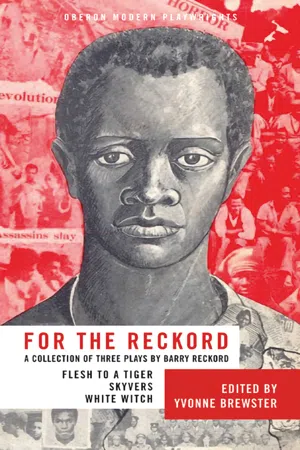
Includes the plays Flesh to a Tiger, Skyvers and The White Witch
Barry Reckord's place in the history of black playwriting in the United Kingdom unfortunately has been almost unrecognised previously. Reckord was among the first modern Caribbean playwrights to have work produced in England. As a Jamaican abroad in the '50s and '60s he laid a solid foundation for later emerging Caribbean playwrights such as Trinidadian Mustapha Matura, Guyanese Michael Abbensetts and Jamaican Alfred Fagon in the '70s, all of whom appreciated how well Reckord's work had paved their way forward. No scripts of Reckord's impressive body of work have been made available previously, many incomplete manuscripts exist but this is the first complete volume of Reckord plays. Here we present three, each from a different decade. These are 'Flesh to a Tiger', 'Skyvers' and 'The White Witch', each with an introduction by a prominent authority on the subject or author.
- 312 pages
- English
- ePUB (mobile friendly)
- Available on iOS & Android
eBook - ePub
About this book
Information
WHITE WITCH
White Witch
The play is loosely connected with a Jamaican legend of Annie Palmer, mistress of the Rose Hall plantation, who is said to have murdered four husbands and had many lovers. Reckord sets what he has called ‘a bloodstained comedy’ on a Jamaican plantation early in the nineteenth century.
White and wealthy Simon Palmer, who has fathered children with slaves, marries Annie, the daughter of a duke, and brings her from England to produce for him a legal white heir. The marriage agreement is a business transaction between Palmer and the duke. The buyer works relentlessly to impregnate his purchase, but she has multiple miscarriages on the voyage to the Caribbean. By the time she lands in Jamaica there is a rumour that Annie may be a witch. As Chloe, one of Palmer’s discarded lovers, declares, ‘Babies are a blessing from heaven, a gift from above, a benediction by Almighty God, and witches never carry these little angels for long.’
How much is merely rumour? What are the facts? Has Annie, like some of the slave women, been taking powders to induce abortions? Is she really a witch? She herself informs us early that, back in England, when two of her brothers burned to death in a barn after killing a stable-lad who was her lover, ‘there was talk of murder by witchcraft’ and she was married off to Mr Palmer. ‘My dear it was the dock or the altar. I had to leave the country to evade arrest.’ Palmer doesn’t know all this at first, and is more and more disturbed by the stories he hears.
Annie is a disruptive element on the plantation, where women exist for the pleasure of men and to bear them children. Women, even white women, are an underclass, somewhat analogous to slaves; but ‘milady’s brought rebellion with her. Disorder and confusion.’ Mistress of the great house, she makes common cause with slaves, confiding with some of the women like their equal and openly seducing black men. She submits to Palmer’s sexual labours but is determined not to have children for him, and she often addresses him in a manner implying superiority.
ANNIE: Today my lord came home from the wars, and pleasured me twice in his topboots.
PALMER: Which wars?
ANNIE: It’s a quotation sir.
PALMER: Kneel down, but I mustn’t be long.
ANNIE: (Kneels, resting on the bed.) You’re seldom up for long sir.
PALMER: I never know when you mock me.
Her sexual aggression is seen as unacceptable. Though black or mulatto women may be lively in bed, a white woman must not seem to enjoy sex. ‘Pleasure,’ says old Dr Baillie, ‘is not part of the divine prescription. See to it she lies perfectly still, and with her eyes shut.’ But as Annie tells a black man she has targeted, ‘Witches have fought for centuries for carnal insurrection.’ She is in tune with the blacks (deemed animals by Dr Baillie and by Palmer). As she and Lucinda (a young slave woman) say to and with each other, the black God summoned from Africa by fierce drumming on the plantation is ‘Bigger than bakkra…and we take him and grind him and possess him…And grab his back and shudder…And God sinting stand up well strong…And never go down…Till he pleasure us…And free us.’
Belief may free their minds, but their bodies are plantation property. ‘You think I went clear to England for a mule?’ Palmer, enraged, asks Annie. ‘No,’ she replies, ‘clearly you went for a breeding slave.’ Crassly as ever, he insists: ‘I’m going to man you and breed you and lock you up for nine months till you drop, and nine months after that, one a year, till my quiver’s full. So help me God.’ When a slave gets ground up with cane at the mill (‘Joko’s blood make good rum’) discussion centres on how much he was worth, and on the failure to save something of the investment by severing his arm in good time.
The dead, however, walk free – ‘who can chain up the dead?’ Much that challenges the status quo is attributed to the ghost of Herrera, an executed rebel. Annie, with supernatural insight, sees him returning whole. ‘What a torso. And there’s his bleeding head. I have no idea how I’ll get those two together… Yes, I think I know.’ Annie says that when she was only twelve she ‘started seeing the dead walk.’ She envisions Palmer’s end. There are other suggestions that she is, as rumoured, a witch. Immediately after she hears her husband’s horse gallop away, she bears a candle-lit breast to the young Jamaican black man she inten...
Table of contents
- Front Cover
- Half-title Page
- Title Page
- Copyright
- Dedication
- Contents
- PROLOGUE
- INTRODUCTION
- FLESH TO A TIGER
- SKYVERS
- WHITE WITCH
- EPILOGUE
- List of works
- Notes on Contributors
- Acknowledgements
Trusted by 375,005 students
Access to over 1.5 million titles for a fair monthly price.
Study more efficiently using our study tools.
Frequently asked questions
Yes, you can cancel anytime from the Subscription tab in your account settings on the Perlego website. Your subscription will stay active until the end of your current billing period. Learn how to cancel your subscription
No, books cannot be downloaded as external files, such as PDFs, for use outside of Perlego. However, you can download books within the Perlego app for offline reading on mobile or tablet. Learn how to download books offline
Perlego offers two plans: Essential and Complete
- Essential is ideal for learners and professionals who enjoy exploring a wide range of subjects. Access the Essential Library with 800,000+ trusted titles and best-sellers across business, personal growth, and the humanities. Includes unlimited reading time and Standard Read Aloud voice.
- Complete: Perfect for advanced learners and researchers needing full, unrestricted access. Unlock 1.5M+ books across hundreds of subjects, including academic and specialized titles. The Complete Plan also includes advanced features like Premium Read Aloud and Research Assistant.
We are an online textbook subscription service, where you can get access to an entire online library for less than the price of a single book per month. With over 1.5 million books across 990+ topics, we’ve got you covered! Learn about our mission
Look out for the read-aloud symbol on your next book to see if you can listen to it. The read-aloud tool reads text aloud for you, highlighting the text as it is being read. You can pause it, speed it up and slow it down. Learn more about Read Aloud
Yes! You can use the Perlego app on both iOS and Android devices to read anytime, anywhere — even offline. Perfect for commutes or when you’re on the go.
Please note we cannot support devices running on iOS 13 and Android 7 or earlier. Learn more about using the app
Please note we cannot support devices running on iOS 13 and Android 7 or earlier. Learn more about using the app
Yes, you can access For the Reckord by Barry Reckord in PDF and/or ePUB format, as well as other popular books in Literature & British Drama. We have over 1.5 million books available in our catalogue for you to explore.