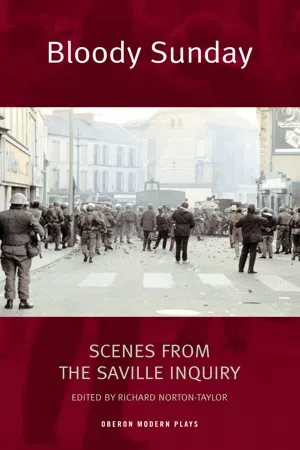
Sunday 30th January 1972: 13 civil rights marchers were shot dead, and another 13 wounded when British soldiers opened fire during an anti-internment civil rights march in Londonderry, Northern Ireland.
The 1972 inquiry by Lord Chief Justice, Lord Widgery – branded the Widgery Whitewash by many – suggested that the soldiers had been fired on first, and that there was a strong suspicion that some of the victims had fired weapons.
After a sustained campaign by the families of the victims, and in the light of new material collected by the Irish government, a second inquiry was set up in 1998 as part of the Northern Ireland Peace process.
Since March 2000 the Saville Inquiry has heard evidence from over one thousand witnesses, including civilians, military, paramilitary, media, experts and forensic scientists, politicians and civil servants, priests and members of the RUC. This play is a dramatic overview of some of that evidence.
Bloody Sunday was produced at the Tricycle Theatre in April 2005.
- 88 pages
- English
- ePUB (mobile friendly)
- Available on iOS & Android
eBook - ePub
About this book
Information
27 March 2000
C CLARKE: On Sunday, 30th January 1972, thirteen identified people are known to have died and a similar number to have been wounded, probably in the course of no more than thirty minutes on the streets of this city not far from where I now stand. Several of them were teenagers.
Serious, then, as were the immediate effects of the shootings, what happened on 30th January 1972 has affected the lives of many more people than those who were directly involved.
That those events should be fully understood and the facts publicly established is, therefore, not only a matter of acute, albeit private, interest to those most immediately affected, but also a subject with a wider public importance.
Whatever happened, whatever the truth of the matter, was a tragedy, the pain of which many have endured down the passage of years. The tribunal’s task is to discover as far as humanly possible in the circumstances, the truth. It is the truth as people see it. Not the truth as people would like it to be, but the truth, pure and simple, painful or unacceptable to whoever that truth may be. The truth has a light of its own. Although it may be the first casualty of hostility, it has formidable powers of recovery, even after a long interval.
Bishop Edward Daly 6 February 2001
Clapping in the gallery.
SAVILLE: Bishop Daly, if you look to your right you will see who is talking to you. I am the chairman of the Tribunal. The questions will come from counsel who are sitting in front of me. All I would ask you to do at this stage is to try and remember to keep your face fairly close to the microphone, more or less where it is now, so that everybody can hear what you have to say.
C CLARKE: Do you have with you, Bishop, your statement made to this Tribunal?
DALY: I have.
C CLARKE: You describe how you celebrated noon Mass at the cathedral and what you did between then and going down towards Rossville Street and William Street. Can you help us on this: had the church in Derry taken, as it were, any particular line about the march?
DALY: No, there was no line certainly amongst the priests in the cathedral that I was aware of, or city-wide that I was aware of.
C CLARKE: Was any announcement made about the march at the Mass?
DALY: Yes, towards the end of the Mass, the administrator in the cathedral, Father O’Neill, came to the altar and he said to me: ‘There is a lot of activity going on outside. There are paratroopers there and just ask the people to be calm and to go home and to not, not to get into any confrontation with them.’
C CLARKE: If we come to paragraph 5 of your statement, you describe how you came to go towards the Rossville Street area.
DALY: Yes, I moved on down past Rossville Street and went down. I stopped in the doorway of Porter’s [radio] shop and observed what was happening there. At the beginning there was shouting and cat-calling and then gradually it deteriorated into missiles being thrown and a response by the Army.
C CLARKE: You describe scenes we have seen on the television film: water cannon, CS gas and a ‘moment of panic’, I think you put it –
DALY: Yes, I remember – I have a clear recollection of the crowd racing to get away and another crowd rushing down to get a better view.
C CLARKE: You describe in paragraph 10 of your statement hearing two or three shots ring out which sounded much sharper and louder than the normal report of a gas grenade or a rubber bullet being fired, and them moving close to the wall at the end of Kells Walk to take cover.
Could you tell me in which direction the shots had been fired?
DALY: Well, it appeared they came from the west of William Street. The reaction of the people who were in Rossville Street was, they all looked in that direction and most people moved to take cover from gunfire coming from that direction.
C CLARKE: You describe speaking to a number of residents in Kells Walk who were concerned about the shooting, and seeing a number of stragglers at the end of the march and a number of young people still throwing stones sporadically at the Army.
DALY: Yes, I think down in William Street which would have been within my hearing. Rioting is a rather noisy business.
C CLARKE: Then you describe how your attention was drawn to the revving up of the engines of the Saracens and you saw them coming down Rossville Street followed by soldiers on foot and you, together with everybody else, ran in the opposite direction towards Free Derry Corner?
DALY: Yes, that moment, the revving up the engines is something I remember very, very clearly because it alarmed me and um, it alarmed most of the people there. They were revved up quite loud and then they started moving in our direction and –
C CLARKE: Had you – I did not want to interrupt, sorry.
DALY: They started moving in our direction and most people started just moving away slowly at first, but then they gathered speed, they came across to William Street and we expected them, I think most of the people expected them, to stop at the junction, I think, of Eden Place which would normally – there was almost a kind of choreography that everyone observed, and I think what caused the panic that day at the beginning was that the choreography was not followed and once the Saracens came past Eden Place, everyone there sensed that this was different than what had happened before. I think at that stage panic set in, people started running in all directions, including myself.
C CLARKE: You then ran with the crowd. Can you tell us where you were in the crowd, were you at the front, the middle, or the back?
DALY: I think I was towards the rear of the crowd, um people came from all directions, running and my memory is that I was towards the rear of the crowd.
C CLARKE: You describe running into the courtyard of the Rossville Street flats, looking back to see if the armoured cars and the soldiers were still coming. You describe a young boy running beside you.
DALY: I became conscious of him because he was smiling or laughing. That was the reason he caught my attention. I think it was – I have wondered since – but I think all of us were kind of excited, exhilarated, and frightened and scared, so I think the laughter is more of that than of humour.
C CLARKE: I think in your evidence to Lord Widgery you said that ‘he appeared to be smiling at the sight of the priest running so fast’?
DALY: I thought that at the time, but I have thought a lot about that; this is one of the events in my life I have thought an awful lot about over the years, and I think possibly all of us were frightened and scared. I think that possibly the reason he was laughing, it was nervous laughter more than anything else. We are just speculating but I know, I am quite clear in my mind, how I noticed him was the fact that he was laughing.
C CLARKE: Did you overtake him as you ran?
DALY: He was running and I was running. I know when he was struck he was just behind me.
C CLARKE: You describe when you reached the courtyard, you heard a shot?
DALY: Yes.
C CLARKE: You looked around and the young boy fell on his face.
DALY: I was running, I was looking back to see where the soldiers were coming or where the Saracens were moving to and, um, at one point the shot rang out.
It was a very clear – over the general noise the shot was quite distinctive, quite clear. With that he gasped and he fell on his face just behind me, just a few feet from me.
C CLARKE: Were you conscious, in addition to that shot, of rubber bullets being fired anywhere at this stage?
DALY: No, I do not think so. I think there was not any reports either of rubber bullets or anything else at that particular time.
C CLARKE: Had you noticed at this stage, by which I mean up to the time when you saw Jack Duddy fall, any form of hostile action against the Army, from stone throwing to firing guns?
DALY: Not at that time. People, at that time, were interested in getting clear. Most people were just trying to get out of the way as quickly as they could.
C CLARKE: You describe a mass of panic-stricken and frightened people, a woman screaming and yells and screams of fear, is that right?
DALY: Yes. There was, there was first of all a single shot. There was a single shot. Jack Duddy fell. I moved on seeking to get out of the area, and then there was a burst of gunfire and that really caused terror and panic, and that was the time the air was filled with yells and screams of fear. I think the priority changed from getting away from it to getting cover.
C CLARKE: The burst of gunfire, where did it appear to be coming from?
DALY: It came from the area of the waste ground.
C CLARKE: In the end, you got to the low...
Table of contents
- Front Cover
- Title Page
- Copyright
- Contents
- Characters
- Chapters
Trusted by 375,005 students
Access to over 1.5 million titles for a fair monthly price.
Study more efficiently using our study tools.
Frequently asked questions
Yes, you can cancel anytime from the Subscription tab in your account settings on the Perlego website. Your subscription will stay active until the end of your current billing period. Learn how to cancel your subscription
No, books cannot be downloaded as external files, such as PDFs, for use outside of Perlego. However, you can download books within the Perlego app for offline reading on mobile or tablet. Learn how to download books offline
Perlego offers two plans: Essential and Complete
- Essential is ideal for learners and professionals who enjoy exploring a wide range of subjects. Access the Essential Library with 800,000+ trusted titles and best-sellers across business, personal growth, and the humanities. Includes unlimited reading time and Standard Read Aloud voice.
- Complete: Perfect for advanced learners and researchers needing full, unrestricted access. Unlock 1.5M+ books across hundreds of subjects, including academic and specialized titles. The Complete Plan also includes advanced features like Premium Read Aloud and Research Assistant.
We are an online textbook subscription service, where you can get access to an entire online library for less than the price of a single book per month. With over 1.5 million books across 990+ topics, we’ve got you covered! Learn about our mission
Look out for the read-aloud symbol on your next book to see if you can listen to it. The read-aloud tool reads text aloud for you, highlighting the text as it is being read. You can pause it, speed it up and slow it down. Learn more about Read Aloud
Yes! You can use the Perlego app on both iOS and Android devices to read anytime, anywhere — even offline. Perfect for commutes or when you’re on the go.
Please note we cannot support devices running on iOS 13 and Android 7 or earlier. Learn more about using the app
Please note we cannot support devices running on iOS 13 and Android 7 or earlier. Learn more about using the app
Yes, you can access Bloody Sunday by Richard Norton-Taylor in PDF and/or ePUB format, as well as other popular books in Literatura & Arte dramático británico. We have over 1.5 million books available in our catalogue for you to explore.