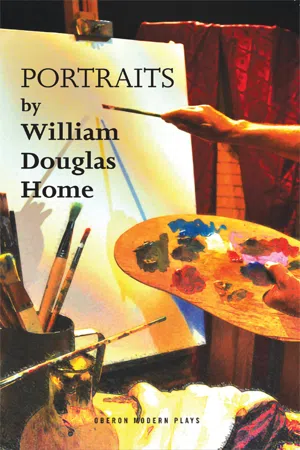
Augustus John's ability as portrait artist won him the admiration of fellow artists, public recognition and the Order of Merit. William Douglas Home's play presents various points in the Bohemian artist's turbulent life from 1944 – 1961 through a reconstruction of sittings with three of his subjects (all played by the same actor) – General Bernard Montgomery, fellow artist Mathew Smith and designer Cecil Beaton. This keenly observed, sensitive play is finely interwoven with the thread of John's gradually developing pacifism – from his certainty in spring 1944 that Monty's young ADC will not survive the second front, to war's devastating effect on Matthew Smith, to John's vibrant fear of the nuclear nightmare and his own approaching death. The first production of this play in 24 years, Portraits commemorates the 50th anniversary of the death of artist Augustus John.
- 96 pages
- English
- ePUB (mobile friendly)
- Available on iOS & Android
eBook - ePub
Portraits
About this book
Information
ACT I
SCENE I
A studio in Tite Street, Chelsea, London. Spring, 1944.
When the CURTAIN rises MONTGOMERY, wearing his well-known beret with two badges, is moving round, inspecting the contents of the studio — the pictures on the walls and on the floor, the furniture. The young Guards’ COLONEL stands there watching him.
MONTY: (Halting in his promenade, addressing the Colonel.) How much longer is this fellow going to keep us waiting?
COLONEL: He’ll be here any moment, sir, I’m sure.
MONTY: What time was the appointment made for?
COLONEL: Ten fifteen, sir.
MONTY: (Looking at his watch.) Well, it’s ten sixteen now. (He resumes his pacing. He picks up a dirty glass and puts it down and then runs a finger down a piece of furniture and notes the dust thereon. Holding up his dirty finger.) Look at that! He’s late, he’s dirty and he drinks. And there are women in it somewhere.
COLONEL: You’re dead on target, sir, as usual.
MONTY: What’s the name again?
COLONEL: John, sir.
MONTY: John what?
COLONEL: John nothing, sir. His name’s Augustus John. And John’s the surname.
MONTY: There’s a fellow in the Navy called John, with a fancy name.
COLONEL: That’s right, sir. Caspar. He’s his son.
MONTY: Poor fellow. He’s a captain, isn’t he?
COLONEL: That’s right, sir.
MONTY: I don’t know which this room smells of worst, drink or tobacco.
COLONEL: He’s a first-class artist, sir. He got the OM for it recently.
MONTY: I can’t see why.
COLONEL: Well, look at that, sir. (He points at a picture on the wall of the studio.)
MONTY: I am looking at it.
COLONEL: Well, it’s good, sir, isn’t it?
MONTY: It’s not by him … Unless he signs himself Gwen!
COLONEL: Sorry my mistake, sir. That’s his sister.
MONTY: Was that her who let us in?
COLONEL: No, sir. She’s dead.
MONTY: Well, who’s the woman?
COLONEL: She’s Dorelia. She’s famous.
MONTY: What for?
COLONEL: Well, she’s been the model for a lot of his best pictures.
MONTY: Since when?
COLONEL: Since his wife died, sir, if not before.
MONTY: When did his wife die?
COLONEL: Years ago, sir. Quite a bit before the first war.
MONTY: Have you done a course on John or something?
COLONEL: No, sir. I was taught about him at school.
MONTY: He’s as good as that, then, is he?
COLONEL: Better, sir. He’s probably our greatest artist.
MONTY: That’s what the art master told you, is it?
COLONEL: Yes, sir.
MONTY: What else did he tell you?
COLONEL: That he broke his first wife’s heart.
MONTY: Is that authenticated?
COLONEL: Don’t ask me, sir. The art master said he was a womanizer and he always had been.
MONTY: What was she called?
COLONEL: Ida – Ida Nettleship.
MONTY: And what was she like?
COLONEL: The art master told us that she was the perfect wife for somebody who didn’t want one.
MONTY: Poor girl! Why did she die so young?
COLONEL: After childbirth, sir.
MONTY: (Jerking a thumb towards the door.) Then he picked up this woman?
COLONEL: He’d picked her up already, sir. According to the art master Dorelia and Ida and Augustus were great friends.
MONTY: A ménage à trois, you mean.
COLONEL: That’s a fairly modest estimate, I’d say, sir, when you take in all his other mistresses and models.
MONTY: Quite a harem, eh?
COLONEL: Oh, yes, sir, over the years.
MONTY: And you learned all this from the art master at school, did you?
COLONEL: Yes, sir.
MONTY: And you’ve not forgotten it?
COLONEL: No, sir.
MONTY: Why not?
COLONEL: Because I found it fascinating, sir.
MONTY: Why?
COLONEL: Why not, sir?
MONTY: Because you want to be an artist or because you want to be a lecher when this war is over?
COLONEL: I’d like to be an artist, sir.
MONTY: And not a lecher?
COLONEL: No, sir.
MONTY: Well, you may not find it easy. Artists live on the excuse that they must have a free hand or they can’t paint. And, from what I’ve seen of you I’d say you were a steady and straightforward fellow with a pretty wife and pretty little daughter. And from that I would deduce you wouldn’t want a free hand. So you’d better cut the artist out and stick to soldiering. And finish up a general like me! How would you like that?
COLONEL: Not much, sir.
MONTY: So you’d rather be an artist.
COLONEL: Yes, sir.
MONTY: You’d rather be Augustus John than me,...
Table of contents
- Front Cover
- Title Page
- Copyright
- Contents
- Characters
- PROLOGUE
- Act I
- Act II
Trusted by 375,005 students
Access to over 1.5 million titles for a fair monthly price.
Study more efficiently using our study tools.
Frequently asked questions
Yes, you can cancel anytime from the Subscription tab in your account settings on the Perlego website. Your subscription will stay active until the end of your current billing period. Learn how to cancel your subscription
No, books cannot be downloaded as external files, such as PDFs, for use outside of Perlego. However, you can download books within the Perlego app for offline reading on mobile or tablet. Learn how to download books offline
Perlego offers two plans: Essential and Complete
- Essential is ideal for learners and professionals who enjoy exploring a wide range of subjects. Access the Essential Library with 800,000+ trusted titles and best-sellers across business, personal growth, and the humanities. Includes unlimited reading time and Standard Read Aloud voice.
- Complete: Perfect for advanced learners and researchers needing full, unrestricted access. Unlock 1.5M+ books across hundreds of subjects, including academic and specialized titles. The Complete Plan also includes advanced features like Premium Read Aloud and Research Assistant.
We are an online textbook subscription service, where you can get access to an entire online library for less than the price of a single book per month. With over 1.5 million books across 990+ topics, we’ve got you covered! Learn about our mission
Look out for the read-aloud symbol on your next book to see if you can listen to it. The read-aloud tool reads text aloud for you, highlighting the text as it is being read. You can pause it, speed it up and slow it down. Learn more about Read Aloud
Yes! You can use the Perlego app on both iOS and Android devices to read anytime, anywhere — even offline. Perfect for commutes or when you’re on the go.
Please note we cannot support devices running on iOS 13 and Android 7 or earlier. Learn more about using the app
Please note we cannot support devices running on iOS 13 and Android 7 or earlier. Learn more about using the app
Yes, you can access Portraits by William Douglas-Home in PDF and/or ePUB format, as well as other popular books in Media & Performing Arts & British Drama. We have over 1.5 million books available in our catalogue for you to explore.