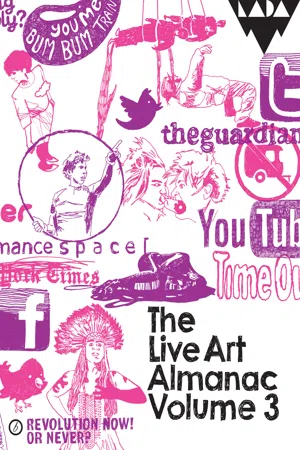
The Live Art Almanac Volume 3 is a collection of 'found' writings about and around Live Art that were originally published, shared, sent, spread and read between January 2010 and December 2011. Selected from an open call for submissions and produced with a network of international partners, Volume 3 reflects the dynamic, international contexts in which Live Art and radical performance-based practices are taking place and the many ways they are being written about.
Volume 3 features more traditional forms of writing such as newspaper reviews, journal articles, catalogue essays and lecture texts as well as new platforms for critical discourses like blogs, tweets and other emergent online media, to reflect the huge diversity of work and the seismic shifts that have happened in Live Art over the last few years, particularly the unprecedented institutional embrace of performance and the rise and rise of activist practices.
The publication is grouped into seven loosely themed sections: Performance and the Institution; The Presence of Performance in Pop Culture and New Media; Performance, Activism and Public Protest; Taste, Trash and Outrageousness; On Stage/Off Stage: Performance and the Theatrical; Festivals, Scenes and Strategies: From the Local to the Global; and obituaries, lectures and miscellaneous writings.
The Live Art Almanac Volume 3 is published by Live Art Development Agency and Oberon Books, and was developed in partnership with Live Art UK, Performance Space 122 (New York, USA), Performance Space (Sydney, Australia), La Pocha Nostra (San Francisco, USA), and Maska (Ljubljana, Slovenia), with additional support from Asia Art Archive (Hong Kong), ArteEast (New York/Middle East) and Ashkal Alwan (Beirut).
- 312 pages
- English
- ePUB (mobile friendly)
- Available on iOS & Android
eBook - ePub
About this book
Trusted by 375,005 students
Access to over 1.5 million titles for a fair monthly price.
Study more efficiently using our study tools.
Information
The Artist is Present
A brave new world of affective transmission or a quasi-religious ascension ceremony? Hari Kunzru popped in to witness the marathon sitting of Marina Abramović at MoMA
‘Is the “Marina Abramović Made Me Cry” badge the rarest foursquare badge of them all?’ asks the Hyperallergic blog, pinpointing the sensation of mild nausea provoked both by The Artist Is Present, Abramović’s wildly-successful show at MOMA, and another New York obsession du jour, the location-based app that allows users to track each other across the city, ‘checking in’ to various places and gaining virtual sweeties in return for offering up nice snapshots of their panties/lifestyle preferences to the nice marketing man in the dirty mac. Abramović sat down at a plain wooden table on 14 March and got up again on 31 May. During that time she stared 1500 people in the face over the course of 700 hours of performance. Her show was seen by half a million people, outperforming even the Tim Burton blockbuster, a schmaltzfest which created huge lines of young emo tourists outside the museum on the Friday evenings when entry was free. The show had two parts - a retrospective, in which documentation of Abramović’s career was accompanied by recreations of her major works enacted by (mostly young, mostly hot) performers, and her new piece, which was also some kind of major work, not just because of the quasi-religious hysteria that grew up around Abramović during its run, but because of the revelations it has provoked as it ripples through the local culture of kultur-industrial Manhattan - about the artist as celebrity, the meaning of participation, and the way in which art functions (or wishes to function) in this not-so secular society as a source of transcendence.
Abramović is part of a generation of artists (Chris Burden, COUM, Tehching Hsieh and so on) who have used personal presence -signified as authentic by endurance and risk - as their chief strategy. The retrospective’s recreations of old pieces gained most press attention in the early part of the show’s run, because of the naked bodies of those mostly-young-mostly-hot re-enactors. By the end, the consensus appeared to be that those bodies weren’t functioning satisfactorily. The absence of Abramović, the suffering artist, had drained them of anything but documentary significance. The preciousness of the staging -the labcoats, the trance-like walking through the space as the performers changed shifts - created an atmosphere of hollow reverence. The relic was missing from the monstrance, the geist from the corpus. Lots of ritual but no Madonna. After a couple of weeks, all the focus had shifted to what was happening downstairs.
I visited the show twice, once at the private view, and for the last two hours of the final day’s performance, so I never saw an ‘ordinary’ day of the run. On the opening night, Abramović sat at her table and began her eye-work. It was like watching the queen receive artworld courtiers. The artist’s presence was functioning (as you’d expect, given the location and the crowd) within the matrix of specular contemporary celebrity. Whatever exchange was taking place between the artist and the participants was affected by that context. It felt primarily economic. This was the Abramović who would, during the run, appear in the New York Times Home and Garden section, discussing the expensive (and somehow disappointingly conventional) minimalist interior design of her Soho loft and upstate weekend house [the loft is the location of this odd WSJ video in which actor James Franco eats a ‘golden ball’ dessert with her]. Nevertheless her silence and stillness lent the event an echo of the masque, a kind of specularity associated with Renaissance European monarchy, in which proximity to the body (and gaze) of Elizabeth I or Louis XIV was an indicator of status, and yet took place within stagings (presence-chambers, or in the case of court masque as a dramatic form, literal sets) in which only the gaze of the monarch afforded a perfect, total view. On this night, Abramović was the sole giver of light, fame, patronage.
So there were famous faces, nice canapés, and lots of money in the room. Since we were there for Abramović, the event was also providing a voguing-ground or runway or paddock or whatever for assorted performance artists, posers, fashionistas, and other visually-invested types. Everyone seemed libidinally charged-up, in the way a Manhattan crowd gets when it collectively decides it is attending an important party. The art world knows there’s nothing like naked people being abstract and disciplined to impart a gratifying air of kink; it sometimes seemed that the mostly-young-and-hots, who’d been trained by Abramović through the performance of grueling zen tasks like sorting seed, were engaged in nothing more than a very high-cultural form of go-go dancing.
Between my first and second visits, New York went crazy for the silent woman in the long robe, a robe which was rumored to conceal a potty, so she could relieve herself without having to call for a break. The blog, Marina Abramović Made Me Cry, did a lot to popularise the notion that tears were the ‘correct’ response to the piece. Soon, the question ‘have you sat?’ became an acceptable shorthand, and people began to camp out in front of the museum for a chance to experience the ineffable presence that made people feel with such intensity. The piece acquired a history. Teching Hsieh sat. Rufus Wainwright sat. Christiane Amanpour and Sharon Stone and a woman in a full burqa sat. Ulay sat, and the silent Madonna broke her impassivity, reached out a hand. A young performance-art wannabe pissed everyone off by sitting for six hours, and after that they imposed a ten-minute time limit. Celebrities cut the line. Someone placed a high heeled shoe on the table. After that they took away the table.
On 31 May, when I jostled for space to witness the climax, the courtly masque of the private view had been replaced by something more demotic, like a street fair or a medieval religious pilgrimage. A culture had grown up around the sitters. There were regulars, old-hands. A make-up artist called Paco had become a minor celebrity by returning to sit twenty-one times. A journalist friend had spent all night on the sidewalk, with a motley collection of meditators and art students. Her 2am arrival had put her forty-third in line. By late afternoon, tempers were frayed. Security was tight. There had been incidents - the naked girl, the guy who tried to vomit on Abramović, and was wrestled away. Some people had spent days either in or outside the museum. When someone asked her to sit down, as she was blocking the view, a girl in a spandex skeleton suit snapped that ‘some of us’ had ‘been here for 48 hours’ ‘I’m looking for my camp’ she explained scornfully, as if her elevated status in this situation ought to have been obvious. Another man was pointed out to me as the self-appointed leader of the sitters. Tall, grey haired, with an orange scarf, he had no official status, but had spent weeks at the show, counting heads, ‘negotiating’ with the museum staff over invented points of protocol. The sitters took their turn - the curly-haired boy in the white priest’s robe, echoing Abramović’s own, the deranged hippy in Hindu/Buddhist saffron and maroon, who advanced to the centre with his hands in pushan mudra, working his jaw and staring goggle-eyed, as if he was processing towards some personal satori - or a large lunch. He had, I’m told, spent much of the night striking a tuning fork against the sidewalk.
People put their hands to their hearts in salutation. They nodded, as if receiving etheric communication from the silent artist. Some cried. Others tried to cry, hyperventilating, wriggling, showing the crowd what an intense time they were having. When sitters finished, they headed back to their friends, where they hugged and did post-match analysis. A woman nearby asked my girlfriend if she’d ever sat. ‘It’s amazing,’ she told her. ‘You lose all track of time. It’s like hours go by without you noticing.’ Orlando Bloom arrived with a Victoria’s Secret model, and a space had to be cleared around them by security. Lauren Hutton had been there all afternoon. As the performance entered its final hour it became clear that lots of people who’d camped out wouldn’t get to sit. The curator, Klaus Biesenbach, allowed a young man to cut the line. Someone whispered that it was his boyfriend. Then a Buddhist monk was ushered to Abramović. Biesenbach, with all the egoism of an art impresario who has just won big in Manhattan, took the very last slot for himself. When he’d sat to his satisfaction, he kissed Abramović proprietorially on both cheeks and helped her from her seat. The crowd went nuts. Abramović did a lap of honor, touching hands and faces, healing scrofula, hugging Ulay and other friends, surrounded by the mostly-young-and-hots in their labcoats. Her fiercest hug was for a security guard who’d accompanied her for the whole performance. It was suddenly obvious how vulnerable she must have felt - like other Abramović works, the possibility of public violence had been hanging heavily in the air. Biesenbach spoke to CNN. ‘It is such a direct experience that we invented the museum, I think, again as a place where you are really one to one contemplating with the art.’ The artist had, apparently, been present.
The Artist is Present was originally written by Hari Kunzru in Mute, 11 June 2010, http://www.metamute.org/editorial/articles/artist-present
John Maus: Heaven
The scream, both audible through amplification or silent – either mimed or drowned out – is preeminent in the live work of John Maus, exemplified by a short support set yesterday evening at London’s Heaven. That was a gig; Maus is a musician, but the American’s stage act channels motifs of performance throughout.
Dispensing with a band in favour of doomy, prerecorded, bass-heavy synth backing tracks, Maus sings through a reverb vocoder. His movement is constant, and while the immediate assumption that his anguished howls are those of cliché of rock angst, they arguably channel something much more interesting. The manic vocal noise (or suggestion of noise, Maus frequently shifts the microphone away from his mouth) is not just a funnel for pain – existential or otherwise, and ingrained into the collective imagination by Edvard Munch – but also an animalistic intonation of ecstasy. As much as he sings from a position of being crumpled on the floor, Maus also stands on the edge of the stage, exalting the audience. Watching this movement – watching him shake, bent double as he roars out under a dozen tracks – he becomes the personification of the evangelical pastors caught up in their hyperbolic rapture. The only difference being that where those religious men channel an awesome god, Maus seems to be physically expunging similarly sublime inner demons.
It’...
Table of contents
- Cover
- Title Page
- Contents
- Introduction
- Aaron Wright
- Performance and the Institution
- The Presence of Performance in Pop Culture and New Media
- Performance, Activism and Public Protest
- Taste, Trash and Outrageousness
- On Stage/Off Stage: Performance and the theatrical
- Festivals, Scenes and Strategies: From the Local to the Global
- And the rest: Obituaries, lectures and miscellaneous writings
- Copyright
Frequently asked questions
Yes, you can cancel anytime from the Subscription tab in your account settings on the Perlego website. Your subscription will stay active until the end of your current billing period. Learn how to cancel your subscription
No, books cannot be downloaded as external files, such as PDFs, for use outside of Perlego. However, you can download books within the Perlego app for offline reading on mobile or tablet. Learn how to download books offline
Perlego offers two plans: Essential and Complete
- Essential is ideal for learners and professionals who enjoy exploring a wide range of subjects. Access the Essential Library with 800,000+ trusted titles and best-sellers across business, personal growth, and the humanities. Includes unlimited reading time and Standard Read Aloud voice.
- Complete: Perfect for advanced learners and researchers needing full, unrestricted access. Unlock 1.5M+ books across hundreds of subjects, including academic and specialized titles. The Complete Plan also includes advanced features like Premium Read Aloud and Research Assistant.
We are an online textbook subscription service, where you can get access to an entire online library for less than the price of a single book per month. With over 1.5 million books across 990+ topics, we’ve got you covered! Learn about our mission
Look out for the read-aloud symbol on your next book to see if you can listen to it. The read-aloud tool reads text aloud for you, highlighting the text as it is being read. You can pause it, speed it up and slow it down. Learn more about Read Aloud
Yes! You can use the Perlego app on both iOS and Android devices to read anytime, anywhere — even offline. Perfect for commutes or when you’re on the go.
Please note we cannot support devices running on iOS 13 and Android 7 or earlier. Learn more about using the app
Please note we cannot support devices running on iOS 13 and Android 7 or earlier. Learn more about using the app
Yes, you can access The Live Art Almanac by Lois Keidan, Aaron Wright, Lois Keidan,Aaron Wright in PDF and/or ePUB format, as well as other popular books in Art & Art General. We have over 1.5 million books available in our catalogue for you to explore.