eBook - ePub
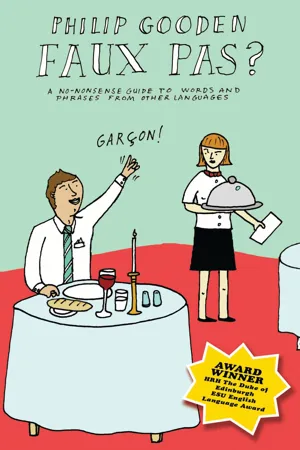
Faux Pas?
A No-Nonsense Guide to Words and Phrases from Other Languages
- 340 pages
- English
- ePUB (mobile friendly)
- Available on iOS & Android
eBook - ePub
About this book
If you have ever been bamboozled by the use of a foreign word or phrase, or simply want to spice up your vocabulary with some well-chosen bons mots, then this is the book for you. Thousands of foreign words and phrases have been absorbed into the language and are currently used in English, from the everyday (macho, tete-a-tete, spaghetti) to the relatively obscure (ultra vires, auto-da-fe). Faux Pas focuses on familiar terms and expressions as well as those that are new, curious or amusing. Each expression is 'translated', with an indication of its language of origin and pronunciation, a comment on its usefulness and a Pretentiousness Index.
Information
Publisher
A&C Black Academic and ProfessionalYear
2005Print ISBN
9780713674972
Edition
1eBook ISBN
9781408150108
A
AB INITIO ab in-ishio (Latin)
‘from the beginning’:
But he might care to remind himself – or understand ab initio, as the case may be – of the factors regarding the infantry order of battle. (Spectator)
PRETENTIOUSNESS INDEX !
This is a rarely used and rather formal – or stuffy – phrase which does not accomplish much more than English near-equivalents such as ‘in the first place’. There’s a rather magisterial quality to it. Appropriately, the article from which the Spectator example is taken was written by General Sir Mike Jackson, Chief of the General Staff.
A CAPPELLA ah kappella (Italian)
literally ‘in the church style’; ‘without instrumental accompaniment’:
Medulla, an almost entirely a cappella album […] was recognised by critics and Björk herself as a return to full-lunged, warm-blooded power.
(Daily Telegraph)
PRETENTIOUSNESS INDEX Nil
A cappella is a slightly specialist term to describe a style of singing which is, itself, something of a specialist taste.
ACCIDIE aksidi (French)
‘apathy’, ‘despair’:
And while Welles concluded his career advertising sherry on television, Tynan’s life drifted into inconsequence, silliness, cruelty and accidie.
(Daily Telegraph)
PRETENTIOUSNESS INDEX !
The English language is not fertile ground for terms connoting a kind of spiritual boredom, and we need to go to Europe for expressions such as ennui, malaise and weltschmerz (see entries). Accidie (in fact from Old French via Latin) is perhaps more extreme than these others but, like them, it gives dignity and (self?) importance to a condition which is more serious than anything produced by a wet Sunday afternoon.
ACTUALITÉ ack-tew-ali-tay (French)
‘actuality’, ‘objective reality’:
The tunnel, Kaletsky reckoned, had ‘made cross-Channel ferries technologically obsolete’ […] Seven and a half years on, the actualité is a slightly different story. (Guardian)
PRETENTIOUSNESS INDEX !!
The primary meaning of the word in French (where it is used in the plural, actualités) is ‘current affairs’ or ‘news’ but it occurs on this side of the Channel only in the sense of ‘truth’, often when the writer or speaker wants to make a distinction between what someone has said and the real state of affairs. The relative popularity of actualité can probably be traced back to a 1992 court case involving illegal arms-dealing. While he was giving evidence, Alan Clark – the one-time Defence Minister and all-round maverick Tory MP and diarist – talked about being ‘economic with the actualité’, a euphemistic reference to lying. The phrase has stuck.
À DEUX ah de (French)
‘of two’, ‘involving two people only’:
We’re even more romantic, because every penny we spend on sexy dinnersà deux is probably shaved off the mortgage. (Independent)
PRETENTIOUSNESS INDEX !
This phrase quite frequently occurs in the context provided by the example, implying some link (romantic, sexual) between the two people concerned. At the least, any meeting or activity which is à deux is likely to have some exclusive or confidential aspect to it.
AD HOC pronounced as spelled (Latin)
‘organised for a particular purpose rather than being permanent’:
No longer would massed-start races, on open roads from town to village and back again, be organised in that ad hoc way, without permanent facilities or even the vaguest notion of safety precautions. (Daily Telegraph)
PRETENTIOUSNESS INDEX Nil
Ad hoc is a versatile expression, applicable to almost anything for which one-off arrangements are required. There is generally the implication of ‘makeshift’ to the term.
AD HOMINEM pronounced as spelled (Latin)
literally ‘to the man’; ‘appealing to the known views of the listener or reader’, ‘personal’:
This kind of below-the-belt, ad hominem criticism is nothing new, but it seems suddenly to have become acceptable, even fashionable. (Observer)
PRETENTIOUSNESS INDEX !
An ad hominem argument is one which seeks to work on the other side’s known prejudices and feelings, rather than being based on reason. An ad hominem attack or criticism, not so unusual in the arts (as in the example), is aimed not at what someone has produced but at the producer. It may therefore be seen as unfair and ‘personal’ (which could usually be substituted for ad hominem in this context).
AD INFINITUM ad in-fi-nigh-tum (Latin)
‘to infinity’; ‘endlessly’:
Twelve hours later he [Michael Schumacher] revealed his intention to race on ad infinitum. There was, he said, no end in sight to a career that has already spanned 14 years. (Daily Telegraph)
PRETENTIOUSNESS INDEX Nil
Rarely applied to anything which genuinely goes on for ever (perhaps because very little does), ad infinitum tends to mean no more than ‘lasting a long time’ or ‘as far as the eye can see’. The Latin expression is sometimes useful as an alternative to equivalents such as ‘endless’ or ‘interminable’, since it sidesteps the faintly critical or threatening overtones of those English words.
AD LIB pronounced as spelled (Latin; abbreviated from ad libitem – ‘at will’)
‘spontaneous’, an ‘unrehearsed remark’:
Just before the end [of the speech], there was another interruption, the huge noise of his helicopter arriving to pick him up. Instinctively, the audience looked skyward, and in a beautiful ad lib Lord Hanson quipped: ‘Don’t worry, it’s one of mine!’ (The Times)
PRETENTIOUSNESS INDEX Nil
The term ad lib generally applies to an off-the-cuff remark rather than any other kind of response. It implies quickness of thought or wit (Lord Hanson’s remark quoted above hardly seems to qualify on either ground). It’s a widely used term, as shown by the formations ad-libber and ad-libbing.
AD LITEM ad lie-tem (Latin)
‘for the case in law’:
All parental submissions to the court had to be in before those of social services or the guardian ad litem (the voice of the child), so the professionals were always able to respond to Emma and Martin’s defence. (Daily Telegraph)
PRETENTIOUSNESS INDEX Nil
A technical and legal term, ad litem generally appears linked to ‘guardian’, as in the example, where it describes the person appointed by a court to speak or act for the interests of a child.
AD NAUSEAM pronounced as spelled (Latin)
‘to the point of disgust or sickness’:
You know a comedy cult is born when its catchphrases are quoted ad nauseam by unfunny people trying to be funny. (The Times)
PRETENTIOUSNESS INDEX Nil
Ad nauseam sounds worse in translation. Rarely if ever used about anything that would provoke genuine sickness, ad nauseam – a less polite version of ad infinitum (see entry) – conveys no more than the yawn-inducing tedium produced by something which is insistent and repetitive.
AFICIONADO affisheon-ah-doh (Spanish)
person who is an ‘enthusiastic and knowledgeable follower of some activity’:
Then creative kingpin Brian Wilson, through a combination of drugs and depression, was felled by a nervous breakdown, and the uncompleted album became the stuff of legend among aficionados. (Independent)
PRETENTIOUSNESS INDEX Nil
Originally used to describe devotees of bullfighting, aficionado is well accepted in English and occupies a useful middle ground between fandom and expertise. Perhaps the essential component is ...
Table of contents
- Cover
- Title Page
- Contents
- Introduction
- A
- B
- C
- D
- E
- F
- G
- H
- I
- J
- K
- L
- M
- N
- O
- P
- Q
- R
- S
- T
- U
- V
- W, Y, Z
- Imprint
Trusted by 375,005 students
Access to over 1.5 million titles for a fair monthly price.
Study more efficiently using our study tools.
Frequently asked questions
Yes, you can cancel anytime from the Subscription tab in your account settings on the Perlego website. Your subscription will stay active until the end of your current billing period. Learn how to cancel your subscription
No, books cannot be downloaded as external files, such as PDFs, for use outside of Perlego. However, you can download books within the Perlego app for offline reading on mobile or tablet. Learn how to download books offline
Perlego offers two plans: Essential and Complete
- Essential is ideal for learners and professionals who enjoy exploring a wide range of subjects. Access the Essential Library with 800,000+ trusted titles and best-sellers across business, personal growth, and the humanities. Includes unlimited reading time and Standard Read Aloud voice.
- Complete: Perfect for advanced learners and researchers needing full, unrestricted access. Unlock 1.5M+ books across hundreds of subjects, including academic and specialized titles. The Complete Plan also includes advanced features like Premium Read Aloud and Research Assistant.
We are an online textbook subscription service, where you can get access to an entire online library for less than the price of a single book per month. With over 1.5 million books across 990+ topics, we’ve got you covered! Learn about our mission
Look out for the read-aloud symbol on your next book to see if you can listen to it. The read-aloud tool reads text aloud for you, highlighting the text as it is being read. You can pause it, speed it up and slow it down. Learn more about Read Aloud
Yes! You can use the Perlego app on both iOS and Android devices to read anytime, anywhere — even offline. Perfect for commutes or when you’re on the go.
Please note we cannot support devices running on iOS 13 and Android 7 or earlier. Learn more about using the app
Please note we cannot support devices running on iOS 13 and Android 7 or earlier. Learn more about using the app
Yes, you can access Faux Pas? by Bloomsbury Publishing in PDF and/or ePUB format, as well as other popular books in Languages & Linguistics & Linguistics. We have over 1.5 million books available in our catalogue for you to explore.