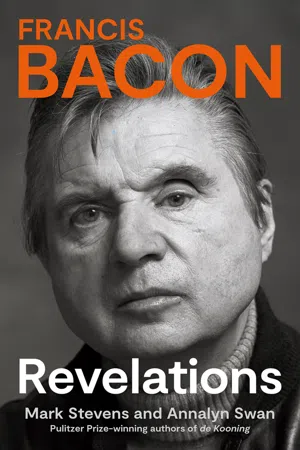
FRANCIS BACON EB
eBook - ePub

FRANCIS BACON EB

  1. English
  2. ePUB (mobile friendly)
  3. Available on iOS & Android
eBook - ePub

FRANCIS BACON EB

About this book

The Times Art Book of the Year 2021

FINALIST FOR THE PLUTARCH AWARD 2022

'Must surely be the definitive life of Francis Bacon … A biography that no Bacon fan – or indeed foe – can afford to overlook … Mesmerising' THE TIMES

'A magnificent triumph … I was captivated by every line' OBSERVER

A decade in the making, based upon hundreds of interviews and extensive new material, Pulitzer Prize winners Mark Stevens and Annalyn Swan have written a startlingly original portrait – rich, complex, and subtle – of a commanding modern figure.

Bacon concealed many important aspects of his life. He described himself as an asthmatic child in Ireland with foxhunting parents and a tyrannical father, but he was also rescued by a series of formidable women – women who in this biography emerge in their own right. He was never just a dissolute young man but was also a passionate reader, largely self-taught. Early on, influenced by Eileen Gray, he became a hard-working and ambitious designer, a brief career explored here in detail for the first time. He dreamed of remaking the modern room.

Bacon worked no less hard or ambitiously as a painter, at first with little success. Throughout the 1930s and early '40s he suffered ongoing failures, growing isolated and often ill. His health issues throughout his life were far more significant than he revealed. Then came his astonishing breakthrough in 1944, with Three Studies for Figures at the Base of a Crucifixion. In the following decades, he emerged as one of the great iconoclasts and bon vivants of his time, a Wildean figure whom one friend called 'a terrific grandee.' Bacon was typically celebrated as a sexual adventurer who liked rough trade, but he never stopped longing for a serious committed relationship, however painful. He continued to make disturbing images of the strangeness within, but developed into a more varied artist than has been recognised, creating in particular an extraordinary series of self-portraits. He was an artist who believed in chance and paradox: the iconoclast eventually became an icon.

This is a story, deeply researched and masterfully told, of a sickly boy who became one of the great figures of his time. The twentieth century does not know itself without Bacon.

Frequently asked questions

Yes, you can cancel anytime from the Subscription tab in your account settings on the Perlego website. Your subscription will stay active until the end of your current billing period. Learn how to cancel your subscription.
No, books cannot be downloaded as external files, such as PDFs, for use outside of Perlego. However, you can download books within the Perlego app for offline reading on mobile or tablet. Learn more here.
Perlego offers two plans: Essential and Complete
  • Essential is ideal for learners and professionals who enjoy exploring a wide range of subjects. Access the Essential Library with 800,000+ trusted titles and best-sellers across business, personal growth, and the humanities. Includes unlimited reading time and Standard Read Aloud voice.
  • Complete: Perfect for advanced learners and researchers needing full, unrestricted access. Unlock 1.4M+ books across hundreds of subjects, including academic and specialized titles. The Complete Plan also includes advanced features like Premium Read Aloud and Research Assistant.
Both plans are available with monthly, semester, or annual billing cycles.
We are an online textbook subscription service, where you can get access to an entire online library for less than the price of a single book per month. With over 1 million books across 1000+ topics, we’ve got you covered! Learn more here.
Look out for the read-aloud symbol on your next book to see if you can listen to it. The read-aloud tool reads text aloud for you, highlighting the text as it is being read. You can pause it, speed it up and slow it down. Learn more here.
Yes! You can use the Perlego app on both iOS or Android devices to read anytime, anywhere — even offline. Perfect for commutes or when you’re on the go.
Please note we cannot support devices running on iOS 13 and Android 7 or earlier. Learn more about using the app.
Yes, you can access FRANCIS BACON EB by Mark Stevens,Annalyn Swan in PDF and/or ePUB format, as well as other popular books in Art & Artist Monographs. We have over one million books available in our catalogue for you to explore.

Information

Year
2021
Print ISBN
9780007298419
eBook ISBN
9780007468812
Topic
Art

Notes

THE DARK CENTURY
“Nietzsche forecast”: Bacon, quoted in “Francis Bacon: Remarks from an Interview with Peter Beard,” Francis Bacon’s Recent Paintings 1968–1974 (New York: Metropolitan Museum of Art, 1975), 20.
The painter must be: John Russell, interview for Adam Low, director, Francis Bacon, Arena documentary, BBC Four archive, March 19, 2005.
The show was attracting: Martin Hammer, “Francis Bacon and the Lefevre Gallery,” Burlington Magazine, May 2010, 307–12.
They flinched: John Russell, Francis Bacon (New York: Thames & Hudson, 1985), 10.
So “shocked” was the writer: “Perspex” [Herbert Furst], “Current Shows and Comments on the Significance of a Word,” Apollo, May, 1945, 107–8.
He had perfect manners: John Moynihan, Restless Lives: The Bohemian World of Rodrigo and Elinor Moynihan (Bristol: Sansom & Company, 2002), 117.
Four years after: Caroline Blackwood, “Francis Bacon, 1909–1992,” New York Review of Books, September 24, 1992.
As late as 1941: Diana Keast, interview for Francis Bacon, Arena.
The painter Lucian Freud: William Feaver, The Lives of Lucian Freud: The Restless Years, 1922–1968 (New York: Knopf, 2019), 199.
Bacon would have agreed with Winston Churchill: Michael Richards, “Alcohol Abuser,” International Churchill Society, winstonchurchill.org.
In the 1950s: Richard Buckle, ed., “Sitting for Two Portraits, 1960,” in Self Portrait with Friends: The Selected Diaries of Cecil Beaton 1926–1974 (New York: The New York Times Book Company, 1982), 321–22.
“It was like looking into a light”: James Moores, in conversation with Mark Stevens, October, 2014.
One friend found him: Grey Gowrie, interview with Mark Stevens, November 2011.
He moved on the balls: Chesterton’s poem “The Aristocrat” begins “The devil is a gentleman.”
About late Matisse: Christopher Gibbs, interview with the authors, October 12, 2013.
Bacon and Auden: Once, at a dinner party given for Auden by Stephen Spender and his wife, Bacon and Auden fell into an argument that neither would abandon. Spender later wrote that it “was really one of those strangely unsatisfactory controversies between the prigs and the anti-prigs, in which both sides are both in the right and in the wrong, one through being very moralistic, the other amoralistic—and both being so on principle.” Stephen Spender, ed., Journals 1939–1983, ed. by John Goldsmith (London: Faber and Faber, 1985), 153.
Bacon put off more serious efforts: Daniel Farson published The Gilded Gutter Life of Francis Bacon (New York: Pantheon Books, 1993) the year after the artist’s death in 1992. Michael Peppiatt’s Francis Bacon: Anatomy of an Enigma (London: Weidenfeld & Nicolson, 1996), appeared four years after Bacon’s death.
As early as 1932: Martin Harrison, “Diana Watson’s Diaries,” in Inside Francis Bacon, Francis Bacon Studio III (London: The Estate of Francis Bacon publishing, in association with Thames & Hudson, 2020), 69.
In fact, Lacy: Lacy’s nephews Fr. David Lacy and Gerald Towell kindly provided the authors with documentation and details about not only Peter Lacy but also the family tree going back to the time of the Norman Conquest. Lacy and Towell, interview with the authors, February 16, 2009, and subsequent emails.
When his friend Roald: Roald Dahl collected Bacon paintings. He owned a portrait of Isabel Rawsthorne and a small triptych of George Dyer. Later, he and his wife Felicity Dahl collaborated on a cookbook that was partly a reminiscence, partly a collection of recipes, entitled Roald Dahl’s Cookbook (London: Penguin Cookery Library, 1996). Dahl solicited recipes from friends for a chapter called “Hangman’s Supper.” Bacon wrote to Roald on December 19, 1989: “For my last supper—I would like 2 lightly salted boiled very fresh eggs and some bread and butter. Yours very sincerely, Francis Bacon.” Felicity Dahl, interview with Annalyn Swan, April 2, 2008.
Bacon possessed: David Plante, “Bacon’s Instinct,” New Yorker, November 1, 1993.
After his death: David Sylvester, “A Farewell to Bacon,” short note in Paula Weideger, “Preaching Art,” The Independent, May 11, 1992.
His friends sensed: The anecdote about Kitaj was told to Mark Stevens by Kitaj’s son, Lem Dobbs.
1 BOY AT THE WINDOW
The house smelled of Potter’s Asthma Cure: Ianthe Knott, interviews with Mark Stevens, March 5 and 6, 2008. Stramonium, a hallucinogenic ingredient in Potter’s Asthma Cure, was often burned to help asthmatics breathe. Both Francis and Ianthe typically called their mother “Mummie,” and Ianthe worried that her brother would die.
In early twentieth-century Ireland: Ireland continues to have one of the highest rates of asthma in the world. See www.asthma.ie.
Francis Bacon was Anglo-Irish: Elizabeth Bowen, quoted in Lara Feigel, The Love-charm of Bombs: Restless Lives in the Second World War (London: Bloomsbury Publishing, 2013), 104.
To know Francis Bacon: Caroline Blackwood, “Francis Bacon (1909–1992),” New York Review of Books, September 24, 1992.
“The Irish believe”: Anne Dunn, interview with the authors, October 13, 2010.
His parents were proud: They were in residence in Ireland by late 1904, when Francis’s older brother, Harley, was born in Dublin.
The Bacons were an old: Bacon’s great-grandfather, Anthony Bacon, was the most illustrious military member of the family. See Alnod J. Boger, The Story of General Bacon (London: Methuen & Co., 1903). Anthony Bacon’s son joined the 18th Hussars. Bacon’s father was a career military man as well.
During the eighteenth century: For more on the history of the Anglo-Irish, see J. C. Beckett, The Anglo-Irish Tradition (Ithaca, New York: Cornell University, 1976).
It remained in Bacon’s day: Brendan Lehan, The Companion Guide to Ireland (Suffolk: Boydell & Brewer Ltd., 2001), 16.
The Kildare Street Club: See R. B. McDowell, Land and Learning: Two Irish Clubs (Dublin: The Lilliput Press, 1993).
The Harley men: The original Earl of Oxford title—held by the de Vere family for centuries and the second-oldest title in England—became extinct in 1703 when there were no direct male heirs. The Harley family’s title—Earl of Oxford and Earl Mortimer—was created in...

Table of contents

  1. Cover
  2. Title Page
  3. Copyright
  4. Dedication
  5. Contents
  6. Prologue: The Dark Century
  7. “I”
  8. Iconoclast
  9. “Icon”
  10. Picture Section
  11. Notes
  12. Documentation
  13. Index
  14. Acknowledgements
  15. Illustration Credits
  16. About the Author
  17. Also by Mark Stevens and Annalyn Swan
  18. About the Publisher