DIORAMA
[1]
I went to the address in the note because I didn’t want to go to work. The car came for me, dark and chrome and sleek, its shadow leaking across the windows of fast-food places, gas stations, and tanning salons. The radio whispered panic about the elections, and my driver, unsolicited, had already imagined, in a soft voice, black drones congregating at night to listen in on our conversations. Yet I knew from my job that this was old news.
I had no reason to remember the driver. Back then, I thought I was smart, for all the details I caught, but there was so much I never saw. He had a beard. He might have had an accent. I remember I feared he came from some place we were bombing. We didn’t talk about anything important. Why would we?
The driver might have believed I was a reasonable person, a normal person. Just a little larger than most. I dressed, in those days, in custom-made gray business suits because nothing store-bought fit right. I had an expensive black down coat. I didn’t think much about where the softness came from, at what cost. My faux heels were decoys: comfortable, just worn to preserve some ritual about what women should wear.
My main indulgence was a huge purse that doubled as a satchel. Behind my back, my boss called it “Shovel Pig,” which was another way of calling me shovel pig. Because I frightened him.
“So, what do you do?” the driver asked.
“Manager at a tech company,” I said, because that was simple and the details were not.
I stared out the window as he began to tell me everything he knew about computers. I could tell his greatest need, or mine, was to sit alone in a park for an hour and be as silent as a stone.
The downtown fell away and, with it, skyscrapers and gentrified loft apartments, and then, after streets of counterculture, zoned haphazard and garish, the suburbs took over. The driver stopped talking. So many one-story houses with slanted roofs and flat lawns, gravel driveways glinting through thin snow. The mountain range like a premonition twisted free of gray mist, distant but gathering.
I hadn’t done a search on the address. That felt too much like being at work. Didn’t make my pulse quicken.
When we reached the gates with flaking gold paint, I knew why I had a key in addition to an address. Emblazoned over the gates, the legend “Imperial Storage Palace.” Because I have to give you a name. It had seen better days, so call it “Better Days Storage Palace,” if you like. I’m sure, by the time you found it, the sign was gone anyway.
We glided down a well-paved road lined with firs and free of holiday decoration, while the base of steep, pine-strewn foothills came close. The light darkened in that almost-tunnel. I could smell the fresh air, even through the stale cigarette smoke of the backseat. Anything could exist in the thick mist that covered the mountainside. A vast forest. A tech bro campus. But most likely a sad logged slope, a hell of old-growth stumps and gravel the farther up you went.
The lampposts in front of the entrance lent the road only a distracted sort of light. The vastness of the storage palace, that faux marble façade, collected weight and silence. The murk felt like a distracting trick. What was it covering up? The pretentious nature of the Doric columns? The black mold on the plastic grass that lined the stairs?
Nothing could disguise the exhaustion of the red carpet smothering the patio. The threadbare edges, the ways in which pine cone debris and squirrel passage had been smashed into the design.
Beyond the shadow of the two-story complex lay a wall of deep green, merging with ever-higher elevations. The pressure of that pressed against the car, quickened my pulse.
This was the middle of nowhere, and I almost didn’t get out of the car. But it was too late. Like the ritual of accepting what is offered, once you reach your destination, you get out of the car.
Too late as well because the world was flypaper: you couldn’t avoid getting stuck. Someone was already watching. Somewhere.
“Should I wait for you?” the driver asked.
I ignored that, lurched out of the backseat. I am six feet tall and two-thirty, never mistaken for a small woman any more than a mountain for a valley, a heavyweight boxer for a gymnast. I need time to get up and depart.
“Are you sure I can’t wait?” he asked across the passenger seat out the half-opened window.
I leaned down, took his measure.
“Do you not understand the nature of your own business?”
The driver left me there, a little extra “pedal to the metal,” as my grandfather would’ve said.
Sometimes I am just like him.
[2]
Inside, gold wallpaper had turned urine yellow. The red carpet perked up as it ran past two ornate antique chairs with lion paws for feet. Beyond that lay a fortress outpost in the cramped antechamber: a barred cage jutting out and a counter painted black, from behind which a woman watched me. Beyond that lay the storage units, through an archway. A legend on a sad banner overhead read “Protecting your valuable since 1972.”
“What do you want?” the woman asked, no preamble. As if I might want almost anything at all.
“What do you think?” I said.
Showed her the key, as I wiped my shoes on the crappy welcome mat.
“Which one?”
“Seven.”
“Got ID?”
“I’ve got the key.”
“Got ID to go with that key?”
“I’ve got the key.”
She held out her hand. “Identification, please, and I’ll check the list.”
I considered pushing a twenty across the counter. That idea felt strange. But it felt strange to let her know who I was, too.
I handed her my driver’s license.
She was much younger than me. She had on a lot of black, had piercings, highlighted her eyes to make them look bigger, and wore purple lipstick. Practically a uniform in some parts of town.
She might’ve been a brunette. I remember her expression. Bored. Bottled up here. Doing nothing—and I wasn’t making her life less boring.
“I’ve come a long way,” I said. Which would be true soon enough. I would’ve come a long way.
“If you’re on the list, great,” she said, finger scrolling down a single sheet of paper with names printed impossibly small.
“Yes. That’d be great,” I said. Struck by how meaningless language can be. Yet I remember the conversation but not her face.
The woman found a line on the page with a ballpoint pen, gave me back my ID.
“So go in, then,” she said.
Like I was loitering.
“Where?”
“Over there.”
She pointed to the right, where another door waited, half disguised by the same piss-pattern wallpaper.
I stared at her for a moment before I walked through, as she picked up a magazine and ignored me. Somehow, I needed a list of life choices that had led this woman to be in this place at this time. To take my ID. To ignore me. To be sullen. To be anonymous.
I wouldn’t see her on my way out. The cage would be empty, as if no one had ever been there.
As if I had emerged years later and the whole place had been abandoned.
All those rows of doors. So many doors, and not the usual roll-down aluminum. More like a sanatorium or a teen detention center: thick, rectangular, the smudged square window crisscrossed with lines and a number taped on as an afterthought. Not all the doors had been painted the same color, and teal or magenta made the institutional effect worse somehow. The smell of mold was stronger. Sound behaved oddly, as if the shifting weight of clutter behind the doors was making itself known.
What did I know about storage units? Nothing. I’d only known our mother’s, a place we’d rented to appease our father, who didn’t want to become a hoarder. But, just maybe, if you drove all the way to the outskirts of the city, to the edge of the mountains, what you kept here you wanted at arm’s length. And what you wanted kept at arm’s length could be precious or fragile as memory. Even a bad memory.
Nine through eleven followed one through three. Had I missed a passageway? It was a warren, with several crossroads. Perhaps the storage units went on forever, the space wandering beneath the mountains in some terrifyingly infinite way. A moment of panic, at the thought of getting lost, as I kept walking and didn’t find number seven.
But I found the right door.
Or the wrong door, depending on your point of view.
[3]
“It was all meant to be” is a powerful drug. Crossing that threshold into Unit 7, I couldn’t have told you what was preordained and what was chance. Or how long it might take to separate the two.
All I saw at first was the emptiness of some square stripped-bare cliché of an interrogation room. A modest wooden chair stood near the back, under flickering fluorescent lights in the ceiling. A medium-sized cardboard box sat on the chair.
I stood in the doorway and stared at the box on the chair for a long time. Left the door open behind me, an instinct about doors slamming shut that wasn’t paranoid. The trap could be anywhere. It was so still, so antiseptic, inside. Except for one moldy panel of the back wall. I don’t recall dust motes even. Like a crime scene wiped clean.
But I checked the far, dark corner, the ceiling, before walking up to the chair. I did that much.
Just an ordinary cardboard box. The top flaps had been folded shut. Lightweight, when I gave it an experimental nudge. No sound coming out of it, either. No airholes. Nothing like a puppy or kitten, then. Immense relief in that.
I put down my purse, pulled back first one flap and then the other.
I think I laughed, nervously.
But there was no moment of misunderstanding, of recoiling in horror. A small object lay in the bottom of the box. A curio? Like the horse figurines my mother used to collect. Which is when it struck me this might all be an elaborate joke.
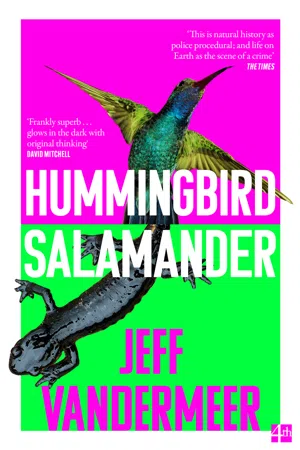
A tiny bird perched down there. Sitting dead. Taxidermy.
A hummingbird in midflight, attached by thick wire from below to a small pedestal. Frozen wings. Frozen eyes. Iridescent feathers.
Beside the hummingbird, I found a single piece of paper, with two words written on it and a signature.
Hummingbird
.. .. ..
Salamander
—Silvina
Oh, Silvina, thank you for not scrawling “Find me” across the bottom of your note.
Thank you for knowing that wasn’t necessary.
[4]
A man who could’ve been the brother of the first driver took me home, at the wheel of a car more anonymous and darker than the first. The landscape seemed compressed, moved past more quickly, so we were back in the city sooner. Or I just wasn’t paying attention.
Hummingbird. Salamander. One there, one not, and the one not there the creature I knew so well from childhood. The overturning of rocks. The swirl of the river and the sway of the tiny river plants. The deep-green moss. All those expeditions so long ago.
I sat silent in the backseat with the box guarded by my knees, arms engulfing it gently. So I wouldn’t crush it. Dead, but somehow alive, able to be wounded. I didn’t dare open the flaps to stare at it for fear the driver would see. I had no thought. Nothing at all. Or maybe I was held by the outline of memories I’d left behind. The look of rage on my grandfather’s face. The slack, pale form of my brother by the river.
No therapist ever told me I should forget my childhood, because I hated therapists and had never seen one. But I knew that forgetting was best. Let the dead stay dead. Make dead what was still alive. Move forward.
It wasn’t the box or the storage unit. I don’t know exactly what tried to pin me back there, trap me, except the sense of not being in control.
[5]
Early afternoon. No one would be home. I had already taken care of my boss and texted in sick. I set the box on the kitchen counter, next to my purse. Tossed my coat on the living room couch, came back to the counter, hesitated … then opened the box and removed the hummingbird.
I regarded it from a precarious kitchen island stool, on the edge of that expanse of wood and marble. Spotless stainless steel, double sinks, a cutting station on wheels, a sparkling black-and-white stove, a smart refrigerator I’d deliberately fucked up so it couldn’t report back.
Somehow, the hummingbird dominated that space beyond its size. Beyond even what I could’ve thought it meant at the time.
The hummingbird had a fierce aspect, jet-black feathers, smoothed out and yet bristling. Even the beak, long and slender, made me think of a blade or a needle meant to draw blood. I imagined a dozen of its kind circling someone’s head like guardians or a crown of thorns. Hard to imagine this species sipping delicate from a flower, but I didn’t know much about hummingbirds. Our neighborhood didn’t have them, nor any school I attended, and they’d been rare on the farm. We didn’t plant a lot of flowers.
The thick wire attached to the dead bird had the look of dull silver. The stand had a glossy look, almost a deep red. On the bottom I found the letters “R.S.” Plain, crudely carved. By the maker or by Silvina?
Taxidermy registered strange to me. The language of taxidermy made no sense. I didn’t like bars or restaurants where they signaled “macho” through deer or bear trophies on the wall. Macabre. Pathological. But this—this came from a different impulse. Secretive and elusive. The bird’s body caused a disconnect. The stillness, and then the way the eyes weren’t blank but staring at me.
The distance across the counter widened, and the silence grew unbearable. Who was “Silvina”? And why had she given me a hummingbird? And where was the salamander? Because the salamande...