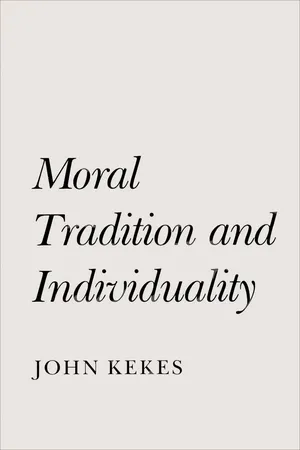
In this study, John Kekes develops the view that good lives depend on maintaining a balance between one's moral tradition and individuality. Our moral tradition provides the forms of good lives and the permissible ways of trying to achieve them. But to do so, the author argues, we must grow in self-knowledge and self-control to make our characters suitable for realizing our aspirations. In addressing general readers as well as scholars, Kekes makes these philosophical views concrete by drawing on a rich variety of literary sources, including, among others, the works of Sophocles, Henry James, Tolstoy, and Edith Wharton.
The first half of the work concentrates on social morality, establishing the conditions all good lives must meet. The second discusses personal morality, the sphere of individuality. Its development enables us to discover what is important to us and how we can fit our personal aspirations into the forms of life our moral tradition provides. Kekes's argument derives its inspiration from Aristotle's objectivism, Hume's emphasis on custom and feeling, and Mill's concentration on individuals and their experiments in living. This book is a nontechnical yet closely reasoned attempt to provide a contemporary answer to the age-old question of how to live well.
- 264 pages
- English
- PDF
- Available on iOS & Android
eBook - PDF
Moral Tradition and Individuality
About this book
Information
Publisher
Princeton University PressYear
2021Print ISBN
9780691023489
9780691078137
eBook ISBN
9780691223025
Topic
PhilosophySubtopic
Political PhilosophyTable of contents
- Cover Page
- Half-title Page
- Title Page
- Copyright Page
- Dedication Page
- Contents
- Acknowledgments
- Introduction
- Chapter One: Objectivity and Horror in Morality
- Chapter Two: Beyond Choice: The Grounds of Moral Disapproval
- Chapter Three: The Great Guide of Human Life
- Chapter Four: Decency
- Chapter Five: A Defense of Social Morality: Intuition of Simple Moral Situations
- Chapter Six: Self-Direction in Complex Moral Situations
- Chapter Seven: Good Judgment
- Chapter Eight: Moral Reflection and Conflict
- Chapter Nine: Moral Perspectives
- Chapter Ten: The Goods of Good Lives
- Chapter Eleven: The Justification of Eudaimonism
- Chapter Twelve: The Integrity and Purity of Good Lives
- Works Cited
- Index
Trusted by 375,005 students
Access to over 1.5 million titles for a fair monthly price.
Study more efficiently using our study tools.
Frequently asked questions
Yes, you can cancel anytime from the Subscription tab in your account settings on the Perlego website. Your subscription will stay active until the end of your current billing period. Learn how to cancel your subscription
No, books cannot be downloaded as external files, such as PDFs, for use outside of Perlego. However, you can download books within the Perlego app for offline reading on mobile or tablet. Learn how to download books offline
Perlego offers two plans: Essential and Complete
- Essential is ideal for learners and professionals who enjoy exploring a wide range of subjects. Access the Essential Library with 800,000+ trusted titles and best-sellers across business, personal growth, and the humanities. Includes unlimited reading time and Standard Read Aloud voice.
- Complete: Perfect for advanced learners and researchers needing full, unrestricted access. Unlock 1.5M+ books across hundreds of subjects, including academic and specialized titles. The Complete Plan also includes advanced features like Premium Read Aloud and Research Assistant.
We are an online textbook subscription service, where you can get access to an entire online library for less than the price of a single book per month. With over 1.5 million books across 990+ topics, we’ve got you covered! Learn about our mission
Look out for the read-aloud symbol on your next book to see if you can listen to it. The read-aloud tool reads text aloud for you, highlighting the text as it is being read. You can pause it, speed it up and slow it down. Learn more about Read Aloud
Yes! You can use the Perlego app on both iOS and Android devices to read anytime, anywhere — even offline. Perfect for commutes or when you’re on the go.
Please note we cannot support devices running on iOS 13 and Android 7 or earlier. Learn more about using the app
Please note we cannot support devices running on iOS 13 and Android 7 or earlier. Learn more about using the app
Yes, you can access Moral Tradition and Individuality by John Kekes in PDF and/or ePUB format, as well as other popular books in Philosophy & Political Philosophy. We have over 1.5 million books available in our catalogue for you to explore.