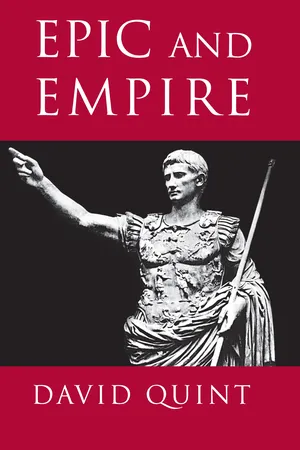
Alexander the Great, according to Plutarch, carried on his campaigns a copy of the Iliad, kept alongside a dagger; on a more pronounced ideological level, ancient Romans looked to the Aeneid as an argument for imperialism. In this major reinterpretation of epic poetry beginning with Virgil, David Quint explores the political context and meanings of key works in Western literature. He divides the history of the genre into two political traditions: the Virgilian epics of conquest and empire that take the victors' side (the Aeneid itself, Camoes's Lusíadas, Tasso's Gerusalemme liberata) and the countervailing epic of the defeated and of republican liberty (Lucan's Pharsalia, Ercilla's Araucana, and d'Aubigné's Les tragiques). These traditions produce opposing ideas of historical narrative: a linear, teleological narrative that belongs to the imperial conquerors, and an episodic and open-ended narrative identified with "romance," the story told of and by the defeated.
Quint situates Paradise Lost and Paradise Regained within these rival traditions. He extends his political analysis to the scholarly revival of medieval epic in the late eighteenth and nineteenth centuries and to Sergei Eisenstein's epic film, Alexander Nevsky. Attending both to the topical contexts of individual poems and to the larger historical development of the epic genre, Epic and Empire provides new models for exploring the relationship between ideology and literary form.
- 448 pages
- English
- PDF
- Available on iOS & Android
eBook - PDF
About this book
Information
Publisher
Princeton University PressYear
2021Print ISBN
9780691015200
9780691069425
eBook ISBN
9780691222950
Topic
LetteraturaSubtopic
Critica letteraria europeaPART
ONE
EPIC
AND
THE
WINNERS
Table of contents
- Cover Page
- Half-title Page
- Title Page
- Copyright Page
- Dedication Page
- Contents
- Acknowledgments
- Introduction
- Part One: Epic and the Winners
- Part Two: Epic and the Losers
- Part Three: Tasso and Milton
- Part Four: A Modern Epilogue
- Notes to the Chapters
- Index
Trusted by 375,005 students
Access to over 1.5 million titles for a fair monthly price.
Study more efficiently using our study tools.
Frequently asked questions
Yes, you can cancel anytime from the Subscription tab in your account settings on the Perlego website. Your subscription will stay active until the end of your current billing period. Learn how to cancel your subscription
No, books cannot be downloaded as external files, such as PDFs, for use outside of Perlego. However, you can download books within the Perlego app for offline reading on mobile or tablet. Learn how to download books offline
Perlego offers two plans: Essential and Complete
- Essential is ideal for learners and professionals who enjoy exploring a wide range of subjects. Access the Essential Library with 800,000+ trusted titles and best-sellers across business, personal growth, and the humanities. Includes unlimited reading time and Standard Read Aloud voice.
- Complete: Perfect for advanced learners and researchers needing full, unrestricted access. Unlock 1.5M+ books across hundreds of subjects, including academic and specialized titles. The Complete Plan also includes advanced features like Premium Read Aloud and Research Assistant.
We are an online textbook subscription service, where you can get access to an entire online library for less than the price of a single book per month. With over 1.5 million books across 990+ topics, we’ve got you covered! Learn about our mission
Look out for the read-aloud symbol on your next book to see if you can listen to it. The read-aloud tool reads text aloud for you, highlighting the text as it is being read. You can pause it, speed it up and slow it down. Learn more about Read Aloud
Yes! You can use the Perlego app on both iOS and Android devices to read anytime, anywhere — even offline. Perfect for commutes or when you’re on the go.
Please note we cannot support devices running on iOS 13 and Android 7 or earlier. Learn more about using the app
Please note we cannot support devices running on iOS 13 and Android 7 or earlier. Learn more about using the app
Yes, you can access Epic and Empire by David Quint in PDF and/or ePUB format, as well as other popular books in Letteratura & Critica letteraria europea. We have over 1.5 million books available in our catalogue for you to explore.