A gripping account of the paths that led postwar Russian migrants to Australia - and what they found when they arrived. More than 20, 000 ethnic Russians migrated to Australia after the Second World War - yet we know very little about their experiences. Some came via China, others from refugee camps in Europe.Many of the refugees who came from Europe preferred to keep a low profile in Australia, and some tried to 'pass' as Polish, West Ukrainian or Yugoslavian. They had good reason to do so- to the Soviet Union, Australia's resettling of Russians amounted to the theft of its citizens, and undercover agents were deployed to persuade them to repatriate. Australia regarded the newcomers with wary suspicion, even as it sought to build its population by opening its doors to immigrants.Making use of newly discovered Russian-language archives and drawing on a lifetime's study of Soviet history and politics, acclaimed author Sheila Fitzpatrick examines the early years of a diverse Russian-Australian community and how Australian and Soviet intelligence agencies attempted to track and influence them. While anti-communist 'White' Russians dreamed a war of liberation would overthrow the Soviet regime, a dissident minority admired its achievements and thought of returning home. This is immigration history at its vivid, grounded best.'Fitzpatrick's book brings this complex and conflict-wrought microcosm to life.' -Dr Roland Leikauf, Australian National Maritime Museum
eBook - ePub
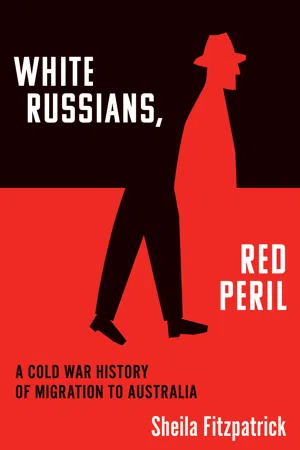
White Russians, Red Peril
A Cold War History of Migration to Australia
- 336 pages
- English
- ePUB (mobile friendly)
- Available on iOS & Android
eBook - ePub
About this book
Information
PART I.
DISPLACED PERSONS IN EUROPE
CHAPTER 1.
DISPLACEMENT
IN THE 1940S, ‘DISPLACEMENT’ WAS THE FASHIONABLE WORD for becoming a refugee. But the ‘displaced persons’ in Europe, who from 1947 were looked after by the International Refugee Organization (IRO), were refugees with a difference. Most of them had not fled their country of origin but been removed from it. Typically, they had been forced labourers, drafted from wartime occupied territories to work in Germany, or soldiers who became prisoners of war to the Germans and, as such, ended the war there. The term ‘displaced persons’ was inherited by the IRO from its predecessor, UNRRA (the United Nations Relief and Rehabilitation Agency), and it applied specifically to those whose displacement in the years 1939–45 was the result of ‘war and fascism’. Many of these displaced persons, or DPs, were Soviet prisoners of war and forced labourers from Russia and Ukraine. UNRRA’s solution to the problem of displacement was repatriation, but that became problematic when a ‘hard core’ of DPs in Germany and Austria refused to be repatriated to the Soviet Union.1 When the IRO came on the scene in 1947, it offered a new solution: resettlement of the displaced persons in countries outside Europe, including Australia.
In addition to the Russian and Soviet DPs, however, there was another category of Russian refugees to be dealt with – the ‘first-wave émigrés’, who had fled Russia following the Bolshevik Revolution of 1917. UNRRA was a left-leaning institution and its officials were inclined to see the old émigrés as Nazi collaborators and outside its mandate; as stateless persons who had not been prewar Soviet citizens, they were in any case not liable for repatriation. The IRO’s remit was broader, extending to included ‘refugees’ as well as ‘displaced persons’, and as the Cold War gathered force, the first-wave émigrés were increasingly seen, more positively, as anti-communists rather than Nazi collaborators. The result was that they, too, would become part of the story of Russian postwar immigration to Australia.
First-wave émigrés
It is estimated that about a million people left the Russian Empire after the 1917 Bolshevik Revolution and at the end of the civil war between ‘Reds’ (Bolsheviks) and ‘Whites’ a few years later, with the upper and professional classes among them disproportionately represented. Some exited Russia to the west, or south-west via Turkey, and ended up living in Europe between the wars; others exited east and ended up in China. They were often referred to as ‘White Russians’, ‘stateless’ or ‘Nansen passport holders’, a name derived from the identity documents issued by the Nansen International Office for Refugees, established by the League of Nations. According to the League’s figures, the largest concentrations of Russian émigrés in 1927 were in France (400,000), followed at a considerable distance by Poland (90,000) and China (76,000), with smaller numbers in Latvia (30,000), and Czechoslovakia and Yugoslavia (each 25,000).2 Germany, not included in the League’s figures, had accommodated between 230,000 and 250,000 refugees in 1922, but many left as a result of hyperinflation and political instability, bringing the numbers down to about 90,000 by 1930.3
Paris was generally regarded as the artistic and cultural centre of the Russian emigration, while Berlin was the political centre, for both far-left and far-right movements. Prague was the academic centre, and Belgrade (capital of Yugoslavia, then ruled by a Russophile King with Orthodox Serbs the largest population group) was notable for its concentration of White Russian officers who had fought the Reds in the civil war.4 Harbin, in China, was another major centre of the Russian emigration with an active cultural and political life in the 1920s and ’30s, but from the standpoint of the European emigration it was something of a provincial backwater. Belgrade and Harbin, with an admixture of Latvia, artistic Paris and far-right (but not far-or even centre-left) Berlin, were to be the most important sources of Australia’s postwar ‘first wave’ immigration.
In the years 1919–22, with the progressive defeat of the White armies in the Russian civil war, whole units departed precipitously via Constantinople in the west and Vladivostok in the east. Yugoslavia was the refuge chosen by White Army general Petr Wrangel after the retreat, and it became the headquarters of the Russian Military Union, which was formed to unite former White officers and prepare for a future resumption of war against the Soviet Union.5 Among Russians who, after the Second World War, reached Australian shores, so many claimed descent from White officers of noble estate that one suspects an inflation factor. Future Australian immigrants Konstantin and Irina Halafoff, Nikolai Kovalenko, Alexander Mokry, Natalie Baitch and Georgy Nekrasov were all children of White Russian officer fathers who grew up in Yugoslavia in the 1920s and ’30s.6
Many in the White emigration identified as Cossacks as well as Russians. The two identities were not incompatible – ‘We are Russians first, and then Cossacks’ was one formulation7 – and in some cases the ‘Cossack’ claim may have been essentially a romantic one, incorporating Russian and military self-identification. But Cossacks – living mainly on the outposts of empire, combining agriculture with military service and organised in regional-based ‘Hosts’, such as those of the Don, Kuban and Terek Cossacks in the south-west of the Russian Empire – had constituted their own social estate in tsarist times, with special rights and duties in relation to the state. Despite the strong late-tsarist connection to the empire and its military defence, western Cossacks also had a ‘freedom’ motif woven into their origin story, which was associated with the runaway serfs who formed part of the earliest Cossack communities on the borderlands, and by the twentieth century some supported the idea of a separate Cossack state (‘Kazakia’).8 Cossacks, many of whom were prosperous agriculturalists in the south at the time of the revolution, clashed sharply with the Bolsheviks and overwhelmingly supported the Whites in the civil war.
Both in Europe and China, the Russian emigration tended to remain isolated, focusing on itself rather than interacting with the surrounding community. This was perhaps natural in Harbin, which was a Russian city in the 1920s, not a Chinese one. But in Europe, too, the Russian emigration kept aloof from their hosts. Slow to assimilate, they were also unwilling to naturalise, even when this was possible, as in Yugoslavia. They wanted to preserve their and their children’s Russianness in the hope that the Bolsheviks would be overthrown and a speedy return to Russia possible. Russian academic high schools (‘gymnasia’) were established in all the major centres of emigration, although their numbers declined in the 1930s. At the tertiary level, there were initially so many Russians studying in Prague, Berlin and Belgrade – around 8000 in the early 1920s – that special faculties and scholarship programs were created for them. By the late 1930s, to be sure, only two specifically Russian tertiary institutions remained (the Institute of Orthodox Theology and the Russian Conservatoire in Paris), and the majority of Russian students, having learnt the language of their host country, went to normal universities. Among them were Konstantin and Irina Halafoff, who were architecture students at the University of Belgrade, and Lydia Fedorovsky (later Khramtsov) and Ivan Nikolajuk, who studied archaeology and engineering, respectively, at the University of Warsaw.9 Had the war not intervened, perhaps this generation would have lost some of their Russian separateness, but in the event a second wartime displacement only reinforced it.
The prewar Russian diaspora, sometimes referred to as ‘Russia abroad’, has been characterised as above all a cultural phenomenon, wherein members perceived themselves to be custodians of a Russian culture and spirit that Russia’s new rulers – whose reign they hoped would be temporary – repudiated.10 But that shared self-perception encompassed very different attitudes to the Russian intelligentsia, which was traditionally a critic of Russian autocracy. Émigré liberals and socialists in Berlin and Paris generally saw themselves as continuing the intelligentsia tradition, publishing ‘thick journals’ combining sociopolitical commentary and belles-lettres by such authors as the up-and-coming Vladimir Nabokov (under the pseudonym V. Sirin), who until 1937 was Berlin-based and still writing in Russian. The émigré artistic world had clear roots in the Russian ‘silver age’ of the 1910s. Modernist artists such as Igor Stravinsky and Sergei Diaghilev, founder of the Ballets Russes, had an international impact, especially on the avant-garde culture of Weimar Germany. But within the emigration, modernism was, as always, a minority taste. Of Russia’s earlier literary heritage, Fedor Dostoevsky, with his mystical leanings, was in the ascendant. The centenary of Russia’s great eighteenth-century poet Alexander Pushkin was celebrated with passionate enthusiasm throughout the Russian diaspora in 1937; in the Shanghai French Concession, local White Russians put up a monument to him.11
Readers of the thick journals were by no means as liberal as their editors, however, and tended to have the conservative monarchist views characteristic of the emigration as a whole.12 From the standpoint of the average émigré conservative, the Russian intelligentsia had, by its Western-derived radicalism, helped to produce the disaster of the Russian Revolution, and there was a consequent revulsion of feeling against it. Such views became more deeply entrenched when, in the second half of the 1930s, most of the liberals, socialists and artistic modernists departed Europe for the United States to escape Nazi rule. Vladimir Nabokov (married to a Russian-Jewish wife), Igor Stravinsky and all the leading socialists of the Russian emigration, several of them Jewish, were among those who left. These departures also contributed to a narrowing of the definition of Russianness and Russian culture. The expansive definition generated by the realities of empire, which had covered Russian speakers of all ethnicities and religions (in Russian, rossiiskoe), was giving way to a narrower one based on Russian ethnicity and Russian Orthodoxy (in Russian, russkii). The great historian of the Russian intelligentsia and Russia abroad Marc Raeff, brought up in the emigration by a Jewish father and Lutheran mother, was faced with the paradox that people like his family, in their own eyes members of the Russian intelligentsia and Russian emigration, were not necessarily accepted as such by the majority of their fellow émigrés.13
At least until the beginning of the twentieth century, Russian Orthodoxy had generally been alien to the mainstream of Russia’s educated (and Westernised) classes. This changed dramatically after the revolution, when the Russian emigration embraced Orthodoxy with a fervour equal to that shown by the Soviet government in repudiating it. It felt like a spiritual renaissance, with religious philosophers Nikolai Berdyaev and Georgy Fedotov – sometime Marxists who embraced Christianity after the revolution and spent most of the interwar years in emigration in France – both reinterpreting Russian culture to put Orthodoxy at its centre. In the 1930s, a homespun version of this intellectual trend had general currency in White Russian circles in Belgrade or Riga, where a non-intellectualised conservative monarchism, with military valour and anti-communism as its central values, was much more widely diffused than artistic modernism, let alone the anti-Bolshevik socialism that could still be occasionally encountered among Russians in Paris.
At the more mundane level, the Orthodox Church and its priests played a major role in the everyday life of the Russian emigration in Europe, endorsing patriotic, military, monarchist and anti-communist associations, liberation armies and Russian Boy Scouts with an equal hand. For most of the Orthodox clergy in emigration, the superordinate ecclesiastical authority was the Russian Church Abroad, formed after the revolution in opposition to the Soviet-dominated Moscow Patriarchate.14 Traditionally, Orthodox clergy were largely recruited from the (socially inferior) clerical estate, but in the interwar emigration some scions of the nobility became priests. One such was Konstantin Jesensky, brought up in emigration in Latvia after his father, a noble, was killed by the Bolsheviks during the revolution; he would later become Bishop of Brisbane. Alexey Godjaew – a graduate of the Munich Polytechnic, where he specialised in cheesemaking, and an opera singer who was offered a job at La Scala – came from a clerical family in the Soviet Union but was a latecomer to the clergy himself, being ordained as a priest as a DP in Vienna when he was nearly fifty, just a few months before he celebrated the first Orthodox service at Bonegilla Migrant Camp in Australia.15
Scouting had not been a common part of the upbringing of Russian children before the revolution, but in emigration the Russian Boy Scout movement had a resurgence, in both Europe and China, which would continue in Australia. ‘It was felt [the Scouts] stimulated and promoted precisely those qualities that had proved deficient in Russia at the time of the great test of war and revolution’ – physical strength, practical competence and patriotism – while preventing demoralisation and the loss of a sense of Russianness. Almost all the children of Russian émigrés in Europe joined Scout troops: Konstantin Halafoff and his wife Irina were both active as teenagers in the Russian Scout movement in Belgrade, while Leonid Artemev, in Vilnius (Lithuania), had to make do with a Polish Scout troop.16
While most émigrés ‘were monarchists in a vague, sentimental way’, writes Marc Raeff, ‘only a minority of intellectuals and some former army officers [in the Russian emigration in Europe] were concerned with politics’.17 Anti-communism was a core commitment of both minority and majority, however, and under the circumstances of the 1930s, right-wing activists were disproportionately visible and influential. White Russians in Munich had had some influence on the Nazi movement in its very early days,18 and as the Germans’ reach into Eastern Europe broadened over the course of the 1930s, they set up a Directorate of Russian Émigré Affairs, into which some right-wing members of the Russian émigré community were drawn. Vladimir Jankowski, a White Russian brought up in Estonia, seems to have made contact with the directorate while working as a journalist in Belgrade in the lat...
Table of contents
- Cover Page
- Title Page
- Copyright
- Dedication
- Contents
- Acknowledgements
- A note on transliteration
- Introduction
- Part I. Displaced persons in Europe
- Part II. Russians in China
- Part III. Resettlement in Australia
- Conclusion
- Statistical note
- Abbreviations used in notes
- Notes
- Bibliography
- Index
- About the Author
- Back Cover
Trusted by 375,005 students
Access to over 1.5 million titles for a fair monthly price.
Study more efficiently using our study tools.
Frequently asked questions
Yes, you can cancel anytime from the Subscription tab in your account settings on the Perlego website. Your subscription will stay active until the end of your current billing period. Learn how to cancel your subscription
No, books cannot be downloaded as external files, such as PDFs, for use outside of Perlego. However, you can download books within the Perlego app for offline reading on mobile or tablet. Learn how to download books offline
Perlego offers two plans: Essential and Complete
- Essential is ideal for learners and professionals who enjoy exploring a wide range of subjects. Access the Essential Library with 800,000+ trusted titles and best-sellers across business, personal growth, and the humanities. Includes unlimited reading time and Standard Read Aloud voice.
- Complete: Perfect for advanced learners and researchers needing full, unrestricted access. Unlock 1.5M+ books across hundreds of subjects, including academic and specialized titles. The Complete Plan also includes advanced features like Premium Read Aloud and Research Assistant.
We are an online textbook subscription service, where you can get access to an entire online library for less than the price of a single book per month. With over 1.5 million books across 990+ topics, we’ve got you covered! Learn about our mission
Look out for the read-aloud symbol on your next book to see if you can listen to it. The read-aloud tool reads text aloud for you, highlighting the text as it is being read. You can pause it, speed it up and slow it down. Learn more about Read Aloud
Yes! You can use the Perlego app on both iOS and Android devices to read anytime, anywhere — even offline. Perfect for commutes or when you’re on the go.
Please note we cannot support devices running on iOS 13 and Android 7 or earlier. Learn more about using the app
Please note we cannot support devices running on iOS 13 and Android 7 or earlier. Learn more about using the app
Yes, you can access White Russians, Red Peril by Sheila Fitzpatrick in PDF and/or ePUB format, as well as other popular books in Social Sciences & Australian & Oceanian History. We have over 1.5 million books available in our catalogue for you to explore.