How the philosophers and polemicists of eighteenth-century Britain used ridicule in the service of religious toleration, abolition, and political justice
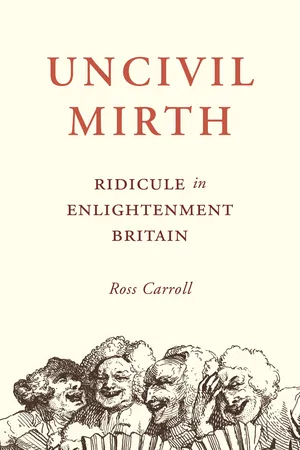
The relaxing of censorship in Britain at the turn of the eighteenth century led to an explosion of satires, caricatures, and comic hoaxes. This new vogue for ridicule unleashed moral panic and prompted warnings that it would corrupt public debate. But ridicule also had vocal defenders who saw it as a means to expose hypocrisy, unsettle the arrogant, and deflate the powerful. Uncivil Mirth examines how leading thinkers of the period searched for a humane form of ridicule, one that served the causes of religious toleration, the abolition of the slave trade, and the dismantling of patriarchal power.
Ross Carroll brings to life a tumultuous age in which the place of ridicule in public life was subjected to unparalleled scrutiny. He shows how the Third Earl of Shaftesbury, far from accepting ridicule as an unfortunate byproduct of free public debate, refashioned it into a check on pretension and authority. Drawing on philosophical treatises, political pamphlets, and conduct manuals of the time, Carroll examines how David Hume, Mary Wollstonecraft, and others who came after Shaftesbury debated the value of ridicule in the fight against intolerance, fanaticism, and hubris.
Casting Enlightenment Britain in an entirely new light, Uncivil Mirth demonstrates how the Age of Reason was also an Age of Ridicule, and speaks to our current anxieties about the lack of civility in public debate.
- 248 pages
- English
- ePUB (mobile friendly)
- Available on iOS & Android
eBook - ePub
About this book
Information
Publisher
Princeton University PressYear
2021Print ISBN
9780691241777
9780691182551
eBook ISBN
9780691220536
Topic
StoriaSubtopic
Storia britannicaCHAPTER ONE
A Polite Diogenes?
RIDICULE IN SHAFTESBURY’S POLITICS OF TOLERATION
IN THE SUMMER of 1706 three Huguenot refugees—Elie Marion, Durand Fage, and Jean Cavalier—arrived in London from the Cévennes region of southern France, fleeing war and religious persecution. A large number of their co-religionists had already settled in the city, but the new arrivals quickly found themselves shunned by the more established Huguenot community. The divisive issue was their reputation for ecstatic acts of devotion, false miracles, and (particularly from Marion) millenarian prophesies, one of which foretold the destruction of London itself. More alarming still was that members of the gentry soon began imitating the French Prophets (as they came to be known) sparking fears of a general contagion. Sir John Lacy and Sir Richard Bulkley allowed the prophets to use their homes as meeting houses, helped publicize their activities, and even began speaking in tongues and uttering their own prophecies. By 1708 the ranks of the French Prophets had swelled considerably and although the group had no explicit political agenda, they caused enough of a stir to strain the government’s commitment to religious toleration.
Shaftesbury was among those who personally bore witness to the prophesizing of these new converts and was present for one of Lacy’s spiritual agitations.1 Reflecting on what he had seen, the Earl composed a letter to former Lord Chancellor John Baron Somers that, when published anonymously in 1708 as the Letter Concerning Enthusiasm, quickly became one of the most controversial religious tracts of the early eighteenth century. Its darkly humorous tone led some early readers to suspect Jonathan Swift the author, a misattribution that amused Swift far more than it did Shaftesbury.2 However, Shaftesbury’s Letter was not only humorously written; it also championed ridicule as an antidote to the religious enthusiasms the French Prophets had generated. The effectiveness of this antidote could, he further alleged, already be seen. As Shaftesbury saw matters, the puppet shows that parodied Marion and his colleagues in Smithfield’s Bartholomew Fair had already diminished their standing in the eyes of the public, obviating the need for more repressive measures inconsistent with toleration.
Had he stopped there, Shaftesbury’s Letter might have served as an unremarkable addition to the enormous outpouring of pamphlets occasioned by the French Prophet controversy.3 After all, the Earl had not even been the first to recommend ridicule as an appropriate response to the crisis. Richard Kingston in his Enthusiastick Impostors No Inspired Prophets (1707) reckoned that no one should ‘forebare ridiculing and exposing a Buffoon’ who was ‘usurping the Office and Name of a Prophet’.4 What set Shaftesbury’s Letter apart, however, was that it seemed to elevate ridicule from a light-hearted response to enthusiasm into a general test of religious imposture. The ‘test of ridicule’, he suggested, could and should be applied to all religious doctrines to verify if they were genuinely worthy of respect or only spuriously so.5
Unsurprisingly, this ambitious proposal met with stiff resistance. Some readers suspected that the Letter’s author had used the affair of the French Prophets as a smokescreen for a disparagement of Christianity itself. The Tory pamphleteer Mary Astell accused Shaftesbury of inviting readers to treat religion ‘with less respect and reverence’ and predicted that ridicule, once given free reign, would quickly become ‘boundless’, with the innocent and sincerely pious suffering humiliation alongside false prophets and enthusiasts.6 Edward Fowler, the Bishop of Gloucester, was similarly in no doubt that the Letter aimed at ‘Rejecting entirely the Church of God’ and balked at the notion that ridicule could serve any useful purpose in religious life.7
Much of the difficulty surrounding Shaftesbury’s proposal stemmed from his use of the term ‘ridicule’ ahead of less ominous alternatives. Whereas humour could be good-natured, amiable, and self-deprecating, ridicule was flinty and contemptuous, closer to a scoff or sneer than a laugh. Writing later in the century the poet and polemicist John Brown accused Shaftesbury of conflating ‘good humour’ (which he found unobjectionable) with ‘ridicule’, a form of speech whose sole purpose was to ‘excite contempt’ in an audience.8 And while good humour, Brown asserted, was a boon to religion, ridicule was a ‘broiler and incendiary’ that could discredit religious truths, expose the innocent to harm, and ‘destroy mutual charity between Christians’.9 John Leland, in an influential overview of Deist writers, was similarly convinced that Shaftesbury was ‘making merry with his reader’ by equating ‘raillery and ridicule’ with ‘good-humour’.10 Even Shaftesbury’s most ardent sympathizers recognized the troubling ambiguity surrounding the Earl’s choice of terms, explaining it away by supposing that ‘his Lordship uses the word ridicule as synonimous [sic] with freedom, familiarity, good humour and the like’.11 More recent scholars have echoed this interpretation, arguing that Shaftesbury’s loose terminology reflected his style as a writer and that his aim was merely to inject levity into a religious culture plagued by an oppressive solemnity.12
In this chapter I argue that neither his critics nor his defenders appreciated the complexity of Shaftesbury’s test of ridicule and its role in his religious politics. Shaftesbury defended ridicule in full awareness of its troubling association with contempt. In spite of this, and of his own misgivings about the practice, he refused to draw the sting out of ridicule by equating it with affability or good-natured raillery.13 Instead, Shaftesbury in the Letter offered a multi-layered defence of ridicule, one that made full and unapologetic use of its corrosive potential. Superficially, the Earl celebrated ridicule as an alternative to persecution for those concerned about the spread of enthusiasm. More fundamentally, he identified a particular kind of ridicule that could therapeutically treat the passions that gave rise to persecution in the first place. Drawing on Stoic interpretations of the ancient Cynics, I argue Shaftesbury saw the test of ridicule as a way of shocking his readers into re-evaluating their religious beliefs and becoming better humoured in their disposition towards God, the universe, and ultimately each other.14 The good humour he sought to instil by this shock therapy was not an insipid cheerfulness or polite amiability but rather a radical transformation of character indispensable for a tolerant society. Appreciating this, I maintain, can help explain why a philosopher sensitive to the dangers of ridicule would rely on it so often in his own religious criticism.
Early Misgivings about Ridicule in Shaftesbury’s Manuscripts
Shaftesbury began assessing the dangers associated with ridicule long before he sat down to write the Letter. We can say this with some confidence thanks to the survival of two unpublished Askêmata or ‘exercise’ journals that the Earl kept during two periods of self-imposed political exile in Rotterdam, the first of which he began in 1698 after a demanding stint in the House of Commons (he would not ascend to the title of Earl until the following year). Temporarily freed from the demands of public life, Shaftesbury embarked during these retreats on what he called, in a letter to his mentor John Locke, ‘a hearty application to the ancients’, a course of study heavily emphasizing the Stoic philosophers Epictetus and Marcus Aurelius.15 The Askêmata provide a partial record of these intellectual pursuits. More than that, however, they contain the collected remnants of intense, even violent, exercises in Stoic self-examination.
Several of these exercises directly concerned Shaftesbury’s laughing habits and how he might amend them. In one particularly jarring entry he severely admonished himself for his witty behaviour and tried to purge his desire to excite laughter in others. Even ‘tho’ Laughter be a Passion which may be employed … against the Pomp and rediculouse solemnity of human affaires’, he wrote, ‘yet there is nothing more unsafe, or more difficult of management.’16 If others considered him to have crossed the fine line between polite restraint and downright moroseness, to have ‘grown dull’ and lost ‘whatever he had either of Witt or humour’ then so much the better. On such occasions, he told himself, ‘all is well and thou must rejoice’.17
What made laughter so risky for the aspirant to Stoic virtue? From Shaftesbury’s scattered warnings to himself in the Askêmata we can identify a number of key dangers. The first concerns Shaftesbury’s preoccupation with cultivating self-mastery. For Shaftesbury, the desire to laugh along with companions or generate new laughter in their company was a subset of a more general yearning for the ‘pleasure in pleasing’, a pleasure which compromised his independence by making his happiness contingent upon the response of the company around him.18 If he was to laugh at all then it must be within the ti...
Table of contents
- Cover
- Title Page
- Copyright
- Dedication
- Epigraph
- Contents
- Acknowledgements
- Introduction
- Chapter 1. A Polite Diogenes? Ridicule in Shaftesbury’s Politics of Toleration
- Chapter 2. Sociability, Censorship and the Limits of Ridicule from Shaftesbury to Hutcheson
- Chapter 3. Against ‘Dissolute Mirth’: Hume’s Scepticism about Ridicule
- Chapter 4. Scoffing at Scepticism: Ridicule and Common Sense
- Chapter 5. ‘Too Solemn for Laughter’? Scottish Abolitionists and the Mock Apology for Slavery
- Chapter 6. An Education in Contempt: Ridicule in Wollstonecraft’s Politics
- Conclusion
- Bibliography
- Index
Trusted by 375,005 students
Access to over 1.5 million titles for a fair monthly price.
Study more efficiently using our study tools.
Frequently asked questions
Yes, you can cancel anytime from the Subscription tab in your account settings on the Perlego website. Your subscription will stay active until the end of your current billing period. Learn how to cancel your subscription
No, books cannot be downloaded as external files, such as PDFs, for use outside of Perlego. However, you can download books within the Perlego app for offline reading on mobile or tablet. Learn how to download books offline
Perlego offers two plans: Essential and Complete
- Essential is ideal for learners and professionals who enjoy exploring a wide range of subjects. Access the Essential Library with 800,000+ trusted titles and best-sellers across business, personal growth, and the humanities. Includes unlimited reading time and Standard Read Aloud voice.
- Complete: Perfect for advanced learners and researchers needing full, unrestricted access. Unlock 1.5M+ books across hundreds of subjects, including academic and specialized titles. The Complete Plan also includes advanced features like Premium Read Aloud and Research Assistant.
We are an online textbook subscription service, where you can get access to an entire online library for less than the price of a single book per month. With over 1.5 million books across 990+ topics, we’ve got you covered! Learn about our mission
Look out for the read-aloud symbol on your next book to see if you can listen to it. The read-aloud tool reads text aloud for you, highlighting the text as it is being read. You can pause it, speed it up and slow it down. Learn more about Read Aloud
Yes! You can use the Perlego app on both iOS and Android devices to read anytime, anywhere — even offline. Perfect for commutes or when you’re on the go.
Please note we cannot support devices running on iOS 13 and Android 7 or earlier. Learn more about using the app
Please note we cannot support devices running on iOS 13 and Android 7 or earlier. Learn more about using the app
Yes, you can access Uncivil Mirth by Ross Carroll in PDF and/or ePUB format, as well as other popular books in Storia & Storia britannica. We have over 1.5 million books available in our catalogue for you to explore.