One of the central issues in the study of the Chinese Communist Party and its foreign policy is its relations with Moscow. Was the CCP a Chinese nationalist party antagonistic to an intrusive Soviet Union or was it rather an internationalist party with ideological-political and strategic-military ties to Moscow, faithfully adhering to Marxist-Leninist principles as well as to Stalin's policy advice? For the past two decades a number of historians have argued that the CCP was a nationalist movement and that the United States missed its opportunity to establish friendly relations because U.S. leaders were blinded by fears of an international Communist threat. In his provocative book, Michael Sheng strongly challenges this position.
On the basis of extensive new information obtained from recently available Chinese sources, Sheng demonstrates that the foreign policy of the CCP under Mao Zedong did, in fact, follow the directions recommended by Joseph Stalin. Sheng reveals that Mao and Stalin were in frequent and direct contact by radio and by correspondence, beginning in 1936, and that Mao consistently acted on Stalin's advice. Battling Western Imperialism analyzes the CCP's relations with both the Soviet Union and the United States and provides conclusive evidence that there was no "lost opportunity" for the U.S. in China. He shows that the CCP viewed the United States as a hostile capitalist power that opposed its revolutionary aims. The author has drawn on an unprecedented collection of Chinese-language materials to make a powerful new argument.
eBook - ePub
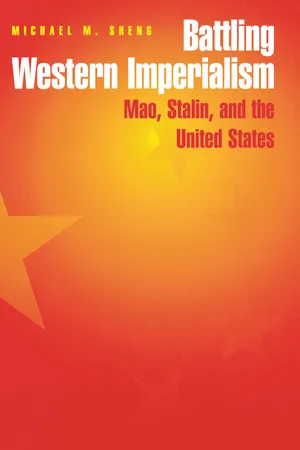
Battling Western Imperialism
Mao, Stalin, and the United States
- English
- ePUB (mobile friendly)
- Available on iOS & Android
eBook - ePub
About this book
Information
____________ CHAPTER I ____________
The Roots of Mao’s Pro-Soviet Policy before 1937
IN a historical perspective, the Sino-Soviet Pact of 1950 should be seen as the end result of a long process from the very beginning of the CCP’s history. If the Mao generation’s spiritual conversion to Marxism-Leninism made them a part of the Comintern early in the 1920s, the following decades of their life-and-death struggle for power reinforced their political-ideological identity as communist internationalists. Their loyalty toward the Moscow-led proletarian world revolution was continuously rewarded by Moscow’s material or immaterial supports. Suffice it to say that the intellectual-psychological, political-institutional, and military-strategic ties between the CCP and Moscow were so extensive and strong that Mao repeatedly stated throughout the pre-1949 period, publicly and privately, that the “Chinese people’s interest” (read the CCP interest) was inseparable from the Soviet interest.
This history of CCP-Moscow relations was, however, obscured and distorted by Mao himself in the post-Stalin era for his own contemporary reasons. In numerous occasions after Stalin’s death Mao purposely discredited Stalin’s contribution to the CCP cause, thereby creating a myth that Stalin was always wrong in his China policy, and Mao was always correct and he resisted Stalin and saved the CCP revolution single-handedly.1 The myth of Mao’s own making has been influential in the western scholarship in the field.2 It is time to use new historical evidence to straighten out the basic facts; first of all, whether or not Mao was in conflict with Moscow before 1935, the year in which he rose to power in the Party.
CCP-MOSCOW RELATIONS BEFORE 1935
Mao told P. F. Yudin, the Soviet Ambassador to China, in 1956 that Stalin committed a “grave mistake” in 1926 by ordering the CCP to “subordinate itself to the GMD,” thereby “undermining the CCP’s independent work to mobilize the masses.” Then, Mao charged that Stalin ignored the Central Committee of the CCP, and treated Wang Ming or Li Lisan as the “only mouthpiece” of the CCP. Mao himself, on the other hand, was accused of being a “rightist opportunist and narrow-minded empiricist.”3 What one sees here is an ambitious Mao attempting to seize the leadership of the world communist movement after the death of Stalin; his memories were selective and distorted, purposely or not. To use “history” for political purposes was not something new to Mao, nor was he the “inventor” of it. His memories about Stalin’s policy in 1926 contradicted the historical evidence.
In fact, Mao was very much a part of the adventure under the Comintern-CCP leadership; these men, despite their courage and conviction, had not found the charted route to power. They were experimenting in dangerous revolution collectively, although they would blame each other after suffering a defeat. The most intricate and fundamental dilemma for the Moscow-CCP leadership in 1921-27 was how to maintain the united front with the GMD, and at the same time wage a class struggle to build the CCP’s strength so that it could eventually take over power from the GMD. After the CCP adopted the Comintern policy of a united front with the GMD in 1923, the party membership increased dramatically, and CCP influence penetrated into every GMD political and military establishment as well as the mass movements in the cities and countryside. This, however, also made it inevitable that the GMD’s animosity toward the CCP was increasing, especially in the spring of 1925, when Sun died and the May Thirtieth Movement radicalized China’s mass movement. The Comintern-CCP leadership reached the conclusion that the GMD was internally divided into three groups: the left, the center, and the right. Accordingly, the CCP should join hands with the left-wingers, win over the middle-of-the-roaders, and defeat the right-wingers. This policy, however, did not prevent more and more GMD members from turning toward the right. Shortly after the “West Hill Clique” split from the GMD Central Committee, Jiang, who was regarded by the CCP as a left-winger, turned on the Communists.4
This crisis triggered immense anxiety within the Comintern-CCP leadership, and opinions divided. According to the Maoist history, Mao advocated a radical policy to take over control of the GMD Central Committee into CCP hands. Mao said that because the CCP members and the left-wingers still formed the majority of the Second Congress of the GMD in January 1926, they could elect themselves into power to check Jiang. The Chen Duxiu-Borodin leadership, however, promised Jiang that the CCP would take no more than one-third of the seats in the Central Committee, but Jiang was not appeased. Two months later he staged the “March Twentieth coup” against the CCP. Mao argued again that the CCP should split with Jiang immediately, for the CCP together with the “left-wingers” still controlled superior military forces and Jiang could have been defeated. The Chen-Borodin leadership again ruled out Mao’s policy proposal.5 Mao later claimed to be “always correct,” and his fellow comrades were “always wrong.”
The new evidence, however, reveals that the CCP-Comintern leadership did consider the option of using force against Jiang, as the CCP Center’s letter of 9 June 1926 indicated. The CCP leadership calculated that among the four armies under the Guangzhou coalition the combined strength of the Second and Third Armies could not compete with the First Army under Jiang’s control. If the CCP had allied itself with the Fourth Army, which was led by generals trained in the Baoding Military Academy, to defeat Jiang, the result could have been worse, because the “Baoding Clique” was more reactionary than Jiang. Furthermore, the CCP leadership realized the infighting in the south would strengthen the hands of northern warlords. If the South was to be defeated by the North, the CCP would have a more difficult time to survive. Thus, the only option was to continue the united front with Jiang for now, while building the strength of “left-wingers” and increasing the CCP’s control over the mass movements.6 After the decision had been made, Mao actively carried it out, and it worked well for about one year up to April 1927. In this year, the so-called left-wing GMD headed by Wang Jingwei took control of the party apparatus and a part of the GMD armed forces loyal to the Wuhan Government. At the same time, the peasants’ movement in Hunan also developed dramatically. Had Mao’s radical policy prevailed early in 1926, he would have lost his chance to write his famous report on Hunan’s peasant movement, and the CCP could have been crushed by Jiang then and there. If the Comintern failed to provide the CCP with a winning policy under the circumstances, Mao’s policy proposal could have been more disastrous.
The so-called “rural strategy,” which has been attributed to Mao, had in fact originated in Moscow, and Mao only followed the Comintern’s policy to organize and arm the peasantry.7 As early as 1924, Borodin, discouraged by Sun’s conservatism, proposed that the CCP go to the countryside to disarm landlords, to organize peasants, and to confiscate large estates to redistribute land to the landless.8 In late 1926, Stalin urged the CCP to radicalize the peasant movement, and to discard “the fear that the aggravation of the class struggle in the countryside will weaken the united anti-imperialist front.”9 Mao’s “Report on Hunan’s Peasant Movement” in early 1927 became well known only because the Comintern-CCP leadership supported it. Because it was Stalin’s policy to radicalize China’s peasant movements, Xiangdao, the CCP Centre’s official organ, published Mao’s report in March with an introduction by Qu Qiubei, a Moscow-trained young revolutionary and then the chief of the CCP; in May and June, both the Russian and English versions of the Communist International carried Mao’s article as well. In the same period, Bukharin, then the head of the ECCI, praised Mao’s report highly at a Comintern meeting.10 Without Moscow’s support, Mao’s popularity within the movement would not have been nearly as high.
If the CCP revolutionaries had thought of “armed struggle” in terms of workers’ and peasants’ insurrections, Stalin was the first one who called upon the CCP to form a Party-controlled professional army. On 1 June 1927, he personally instructed the CCP not only to take over the leadership of the GMD by packing “a large number of new peasant and working-class leaders” into the GMD Central Committee in Wuhan, but also to “mobilize about 20,000 Communists and about 50,000 revolutionary workers and peasants . . . to form several new army corps. . . and organize your own reliable army before it is too late.”” This was, however, easier said than done. In July, Wang Jingwei and his armed forces turned on the Russian advisors and the CCP, and the first united front thus ended disastrously. Stalin’s directive, however, dictated the CCP’s new strategy in 1927-35, and this policy was officially adopted by the CCP in an emergency meeting on 7 August 1927. Mao was then named by the presiding Comintern agent to direct the fall insurrection in Hunan.12 Mao was very much a part of the collective experimentation of the Comintern-CCP leadership. Together they made progress; together they made mistakes as well.
This is also true in the development of the CCP’s military strategy in which Mao was far from being “always correct.” In reality, in the so-called first and second “leftist-opportunist” period, Mao was as eager as everyone else to win an instant victory, and he actively led his troops to attack major cities, a fundamental feature of the “leftist opportunism.” For instance, after the 7 August 1927 meeting, the CCP Center instructed that the insurrection in Hunan should take place in the southern rural part first, and then spread all over to include Changsha. But when Mao was in charge of the provincial committee meeting on 18 August, the meeting decided to take on Changsha first. Only after the Changsha campaign failed did Mao decide to retreat to the remote border area in Jiangxi. Even so, Mao still remained over-optimistic about national victory in the near future. In October 1928, Mao claimed that due to the divisions and wars among domestic and international reactionaries, the small-sized base areas of the CCP would grow, and “[we] are approaching nationwide victory daily.”13 This statement was typical of “leftist adventurism.”
In the summer of 1930 when the so-called Li Lisan line was at its peak, Mao was active in carrying out Li’s plan to “strive for victory in one or several provinces” as the first step toward nationwide takeover. He led the First Army Corps to attack Ji’an, and then, Nanchang. Only when the troops came close to their targets and he discovered that the enemy forces there were too strong to crack, did Mao change the original plan. Nonetheless, he soon miscalculated that his Red Army had a better chance to win in his home province. He ordered his men to march from Jiangxi back to Hunan to launch the second Changsha campaign. On 10 September, however, Mao’s troops suffered a great loss in the attempt to seize Changsha, and he was forced to call off the campaign the next day. One week later, Moscow ended Li’s “leftist adventurism” by removing him from the party chief post. At the same time, Mao was elected as an alternative member of the politburo. Due to inefficient communication, however, this news didn’t reach Mao until the end of the year. Mao continued to pursue the “adventurist” policy in the following two months.
For instance, after taking Ji’an, Mao reported to the Center that the Ji’an battle was only the beginning of the struggle for victory in the whole of Jiangxi province, and, within a week, his troops would be attacking Nanchang again. At the time, Jiang was gathering his troops to crush Mao’s Jiangxi base. On 25 October, the CCP Center, which was criticized by Maoist historians for committing the “third leftist deviation,” issued a directive to instruct Mao that the first priority at the moment was not to seize Changsha or Nanchang, but to defend the home base. This eventually ended Mao’s “leftist” military policy. It did not, however, curb his impulsiveness which led him to envision a quick final victory. Early in December 1930, Mao claimed that the current international situation favored a “final battle of class warfare against imperialism,” and the domestic situation favored a “final battle of class warfare against Jiang Jieshi.”14 For these reasons, Mao was criticized at the Ningdu meeting of 17 April 1931, and its resolution pointed out that his military policy followed the Li Lisan line until after the second Changsha campaign. Mao admitted his error.15 His “leftism” in fact reflected a general mood of the CCP and the Comintern at the time. Jiang’s bloody purge had made them vengeful and they were impatient to endure a long and bitter struggle in the rural areas.
However, Mao’s narcissistic personality continued to lead him to argue that had the Party followed his policy, a failure could have been avoided. At the Zunyi conference in January 1935, Qing Bangxian, then the Party chief, stated that the Red Army’s defeat in 1933-34 in Jiangxi was due to the overwhelming strength of the GMD. Mao disagreed, and he contended that it was due to the incorrect strategy of the Qing-Braun leadership which abandoned guerrilla strategy. In reality, after pacifying the rebellions of the GMD local factions, Jiang gathered massive forces to attack the CCP using the blockhouse strategy. Facing the new situation, Mao too doubted the efficacy of guerrilla warfare. He proposed on 20 November 1933 that the Red Army abandon the Jiangxi area and thrust into the Zhejiang-Jiangsu-Anhui region to wage mobile warfare in Jiang’s home base.16 Mao’s idea was too bold and its result too unpredictable for the CCP Center, which refused to adopt it. The Qing-Braun leadership decided to defend the soviet area in Jiangxi at any cost. The defeat of the CCP was predictable. The Qing-Braun strategy failed; nonetheless, this should not be taken as proof that Mao’s could have succeeded. One could well argue that the CCP armed forces would have been totally wiped out, had they marched into Jiang’s home base.
Nor was Mao demoted by the Comintern and the “returned students” for his failure to follow Moscow’s strategy. The opposite is true: Mao was Moscow’s chosen man. The story started on 21 July 1932, when the Shanghai Center criticized the Central Bureau in Jiangxi headed by Zhou Enlai of not being aggressive enough in military operations. Zhou thus left the rear base to join Mao, Zhu De, and Wang Jiaxiang at the front. In September, the four men at the front disagreed with the other members of the Central Bureau who remained in the rear. The former wanted to give the troops a seven-day respite since they had fought three successive battles in the past month, while the latter wanted them to fight a battle in Yongfeng where enemy troops had gathered. The difference between the two sides was purely technical, if not trivial; there was no “two-line struggle” whatsoever. The four men at the front proposed on 25 September that a meeting of all members of the Central Bureau be held. When all the members met in Ningdu in the first week of October, Mao’s argument apparently became unpopular, and he was criticized for being “rightist.” Some proposed that Mao leave the military command, and Zhou, who was presiding over the meeting, suggested two alternatives: either Mao be the commander while Zhou served as overseer; or Zhou take command, with Mao acting as assistant. Mao rejected the first alternative. The meeting accepted the second one, but M...
Table of contents
- Cover Page
- Title Page
- Copyright Page
- Dedication
- Contents
- Acknowledgments
- Introduction
- Chapter I. The Roots of Mao’s Pro-Soviet Policy before 1937
- Chapter II. CCP-Moscow Relations during the Anti-Japanese War, 1937-1945
- Chapter III. From Enemies to Friends: CCP Policy toward the United States before Pearl Harbor
- Chapter IV. Courting the Americans: The CCP’s United Front Policy toward the U.S., 1942-1945
- Chapter V. Postwar Alignment: CCP-Moscow versus GMD-Washington in Manchuria, August-December 1945
- Chapter VI. Mao Deals with George Marshall, November 1945-December 1946
- Chapter VII. The CCP and the Cold War in Asia: Mao’s “Intermediate-Zone” Theory and the Anti-American United Front, 1946-1947
- Chapter VIII. Mao’s Revolutionary Diplomacy and the Cold War in Asia, 1948-1949
- Conclusion
- Notes
- Select Bibliography
- Index
- About the Author
Trusted by 375,005 students
Access to over 1.5 million titles for a fair monthly price.
Study more efficiently using our study tools.
Frequently asked questions
Yes, you can cancel anytime from the Subscription tab in your account settings on the Perlego website. Your subscription will stay active until the end of your current billing period. Learn how to cancel your subscription
No, books cannot be downloaded as external files, such as PDFs, for use outside of Perlego. However, you can download books within the Perlego app for offline reading on mobile or tablet. Learn how to download books offline
Perlego offers two plans: Essential and Complete
- Essential is ideal for learners and professionals who enjoy exploring a wide range of subjects. Access the Essential Library with 800,000+ trusted titles and best-sellers across business, personal growth, and the humanities. Includes unlimited reading time and Standard Read Aloud voice.
- Complete: Perfect for advanced learners and researchers needing full, unrestricted access. Unlock 1.5M+ books across hundreds of subjects, including academic and specialized titles. The Complete Plan also includes advanced features like Premium Read Aloud and Research Assistant.
We are an online textbook subscription service, where you can get access to an entire online library for less than the price of a single book per month. With over 1.5 million books across 990+ topics, we’ve got you covered! Learn about our mission
Look out for the read-aloud symbol on your next book to see if you can listen to it. The read-aloud tool reads text aloud for you, highlighting the text as it is being read. You can pause it, speed it up and slow it down. Learn more about Read Aloud
Yes! You can use the Perlego app on both iOS and Android devices to read anytime, anywhere — even offline. Perfect for commutes or when you’re on the go.
Please note we cannot support devices running on iOS 13 and Android 7 or earlier. Learn more about using the app
Please note we cannot support devices running on iOS 13 and Android 7 or earlier. Learn more about using the app
Yes, you can access Battling Western Imperialism by Michael Sheng,Michael M. Sheng in PDF and/or ePUB format, as well as other popular books in History & Chinese History. We have over 1.5 million books available in our catalogue for you to explore.