A cornerstone of applied probability, Markov chains can be used to help model how plants grow, chemicals react, and atoms diffuse--and applications are increasingly being found in such areas as engineering, computer science, economics, and education. To apply the techniques to real problems, however, it is necessary to understand how Markov chains can be solved numerically. In this book, the first to offer a systematic and detailed treatment of the numerical solution of Markov chains, William Stewart provides scientists on many levels with the power to put this theory to use in the actual world, where it has applications in areas as diverse as engineering, economics, and education. His efforts make for essential reading in a rapidly growing field.
Here Stewart explores all aspects of numerically computing solutions of Markov chains, especially when the state is huge. He provides extensive background to both discrete-time and continuous-time Markov chains and examines many different numerical computing methods--direct, single-and multi-vector iterative, and projection methods. More specifically, he considers recursive methods often used when the structure of the Markov chain is upper Hessenberg, iterative aggregation/disaggregation methods that are particularly appropriate when it is NCD (nearly completely decomposable), and reduced schemes for cases in which the chain is periodic. There are chapters on methods for computing transient solutions, on stochastic automata networks, and, finally, on currently available software. Throughout Stewart draws on numerous examples and comparisons among the methods he so thoroughly explains.
- 564 pages
- English
- PDF
- Available on iOS & Android
eBook - PDF
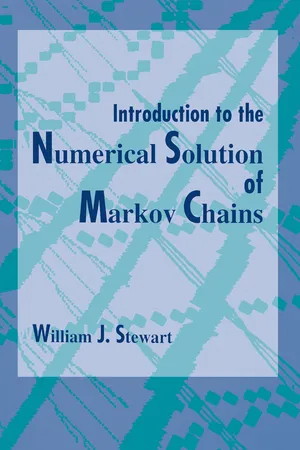
Introduction to the Numerical Solution of Markov Chains
About this book
Information
Table of contents
- Cover Page
- Half-title Page
- Title Page
- Copyright Page
- Dedication Page
- Contents
- Preface and Acknowledgments
- 1. Markov Chains
- 2. Direct Methods
- 3. Iterative Methods
- 4. Projection Methods
- 5. Block Hessenberg Matrices and Solution by Recursion
- 6. Decompositional Methods
- 7. P- Cyclic Markov Chains
- 8. Transient Solutions
- 9. Stochastic Automata Networks
- 10. Software
- Bibliography
- Index
Trusted by 375,005 students
Access to over 1.5 million titles for a fair monthly price.
Study more efficiently using our study tools.
Frequently asked questions
Yes, you can cancel anytime from the Subscription tab in your account settings on the Perlego website. Your subscription will stay active until the end of your current billing period. Learn how to cancel your subscription
No, books cannot be downloaded as external files, such as PDFs, for use outside of Perlego. However, you can download books within the Perlego app for offline reading on mobile or tablet. Learn how to download books offline
Perlego offers two plans: Essential and Complete
- Essential is ideal for learners and professionals who enjoy exploring a wide range of subjects. Access the Essential Library with 800,000+ trusted titles and best-sellers across business, personal growth, and the humanities. Includes unlimited reading time and Standard Read Aloud voice.
- Complete: Perfect for advanced learners and researchers needing full, unrestricted access. Unlock 1.5M+ books across hundreds of subjects, including academic and specialized titles. The Complete Plan also includes advanced features like Premium Read Aloud and Research Assistant.
We are an online textbook subscription service, where you can get access to an entire online library for less than the price of a single book per month. With over 1.5 million books across 990+ topics, we’ve got you covered! Learn about our mission
Look out for the read-aloud symbol on your next book to see if you can listen to it. The read-aloud tool reads text aloud for you, highlighting the text as it is being read. You can pause it, speed it up and slow it down. Learn more about Read Aloud
Yes! You can use the Perlego app on both iOS and Android devices to read anytime, anywhere — even offline. Perfect for commutes or when you’re on the go.
Please note we cannot support devices running on iOS 13 and Android 7 or earlier. Learn more about using the app
Please note we cannot support devices running on iOS 13 and Android 7 or earlier. Learn more about using the app
Yes, you can access Introduction to the Numerical Solution of Markov Chains by William J. Stewart in PDF and/or ePUB format, as well as other popular books in Mathematics & Probability & Statistics. We have over 1.5 million books available in our catalogue for you to explore.