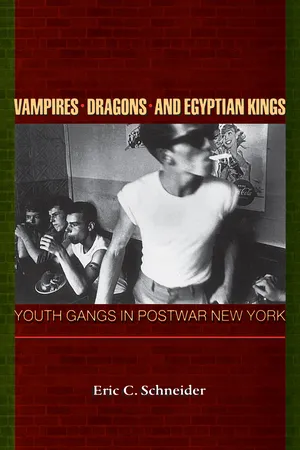
They called themselves "Vampires," "Dragons," and "Egyptian Kings." They were divided by race, ethnicity, and neighborhood boundaries, but united by common styles, slang, and codes of honor. They fought--and sometimes killed--to protect and expand their territories. In postwar New York, youth gangs were a colorful and controversial part of the urban landscape, made famous by West Side Story and infamous by the media. This is the first historical study to explore fully the culture of these gangs. Eric Schneider takes us into a world of switchblades and slums, zoot suits and bebop music to explain why youth gangs emerged, how they evolved, and why young men found membership and the violence it involved so attractive.
Schneider begins by describing how postwar urban renewal, slum clearances, and ethnic migration pitted African-American, Puerto Rican, and Euro-American youths against each other in battles to dominate changing neighborhoods. But he argues that young men ultimately joined gangs less because of ethnicity than because membership and gang violence offered rare opportunities for adolescents alienated from school, work, or the family to win prestige, power, adulation from girls, and a masculine identity. In the course of the book, Schneider paints a rich and detailed portrait of everyday life in gangs, drawing on personal interviews with former members to re-create for us their language, music, clothing, and social mores. We learn what it meant to be a "down bopper" or a "jive stud," to "fish" with a beautiful "deb" to the sounds of the Jesters, and to wear gang sweaters, wildly colored zoot suits, or the "Ivy League look." He outlines the unwritten rules of gang behavior, the paths members followed to adulthood, and the effects of gang intervention programs, while also providing detailed analyses of such notorious gang-related crimes as the murders committed by the "Capeman," Salvador Agron.
Schneider focuses on the years from 1940 to 1975, but takes us up to the present in his conclusion, showing how youth gangs are no longer social organizations but economic units tied to the underground economy. Written with a profound understanding of adolescent culture and the street life of New York, this is a powerful work of history and a compelling story for a general audience.
- 358 pages
- English
- PDF
- Available on iOS & Android
eBook - PDF
About this book
Information
Publisher
Princeton University PressYear
2021Print ISBN
9780691074542
9780691001418
eBook ISBN
9780691223308
Table of contents
- Cover Page
- Half-title Page
- Title Page
- Copyright Page
- Dedication Page
- Contents
- List of Illustrations
- Acknowledgment
- Preface: Crossing 96th Street
- Introduction: The Capeman and the Vampires
- Chapter One: Remaking New York
- Chapter Two: Discovering Gangs: The Role of Race in the 1940s
- Chapter Three: Defending Place: Ethnicity and Territory
- Chapter Four: Becoming Men: The Use of the Streets in Defining Masculinity
- Chapter Five: Making a Gang Culture: Form, Style, and Ritual in the Gang World
- Chapter Six: Leaving the Gang: Pathways into Adulthood
- Chapter Seven: Intervening in Gangs: The Problems and Possibilities of Social Work
- Chapter Eight: Drugs, Politics, and Gangs, 1960-1975
- Conclusion: Comparing Gangs: Contemporary Gangs in Historical Perspective
- Notes
- Index
Trusted by 375,005 students
Access to over 1.5 million titles for a fair monthly price.
Study more efficiently using our study tools.
Frequently asked questions
Yes, you can cancel anytime from the Subscription tab in your account settings on the Perlego website. Your subscription will stay active until the end of your current billing period. Learn how to cancel your subscription
No, books cannot be downloaded as external files, such as PDFs, for use outside of Perlego. However, you can download books within the Perlego app for offline reading on mobile or tablet. Learn how to download books offline
Perlego offers two plans: Essential and Complete
- Essential is ideal for learners and professionals who enjoy exploring a wide range of subjects. Access the Essential Library with 800,000+ trusted titles and best-sellers across business, personal growth, and the humanities. Includes unlimited reading time and Standard Read Aloud voice.
- Complete: Perfect for advanced learners and researchers needing full, unrestricted access. Unlock 1.5M+ books across hundreds of subjects, including academic and specialized titles. The Complete Plan also includes advanced features like Premium Read Aloud and Research Assistant.
We are an online textbook subscription service, where you can get access to an entire online library for less than the price of a single book per month. With over 1.5 million books across 990+ topics, we’ve got you covered! Learn about our mission
Look out for the read-aloud symbol on your next book to see if you can listen to it. The read-aloud tool reads text aloud for you, highlighting the text as it is being read. You can pause it, speed it up and slow it down. Learn more about Read Aloud
Yes! You can use the Perlego app on both iOS and Android devices to read anytime, anywhere — even offline. Perfect for commutes or when you’re on the go.
Please note we cannot support devices running on iOS 13 and Android 7 or earlier. Learn more about using the app
Please note we cannot support devices running on iOS 13 and Android 7 or earlier. Learn more about using the app
Yes, you can access Vampires, Dragons, and Egyptian Kings by Eric C. Schneider in PDF and/or ePUB format, as well as other popular books in History & North American History. We have over 1.5 million books available in our catalogue for you to explore.