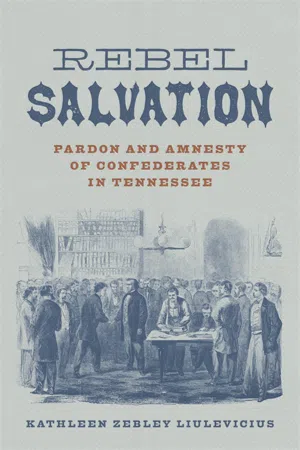
Winner of the Tennessee History Book Award In Rebel Salvation, Kathleen Zebley Liulevicius examines pardon petitions from former Confederate soldiers and sympathizers in Tennessee to craft a unique and comprehensive analysis of the process of Reconstruction in the Volunteer State after the Civil War. These underutilized petitions contain a wealth of information about Tennesseans from an array of social and economic backgrounds, and include details about many residents who would otherwise not appear in the historical record. They reveal the dynamics at work between multiple factions in the state: former Rebels, Unionists, Governor William G. Brownlow, and the U.S. Army officers responsible for ushering Tennessee back into the Union. The pardons also illuminate the reality of the politically and emotionally charged post–Civil War environment, where everyone—from wealthy elites to impoverished sharecroppers—who had fought, supported, or expressed sympathy for the Confederacy was required by law to sue for pardon to reclaim certain privileges. All such requests arrived at the desk of President Andrew Johnson, who ultimately determined which petitioners regained the right to vote, hold office, practice law, operate a business, and buy and sell land.Those individuals filing petitions experienced Reconstruction in personal and profound ways. Supplicants wrote and circulated their exoneration documents among loyalist neighbors, friends, and Union officers to obtain favorable endorsements that might persuade Brownlow and Johnson to grant pardon. Former Rebels relayed narratives about the motivating factors compelling them to side with the Confederacy, chronicled their actions during the war, expressed repentance, and pledged allegiance to the United States government and the Constitution. Although not required, many petitioners even sought recommendations from their former wartime foes. The pardoning of former Confederates proved a collaborative process in which neighbors, acquaintances, and erstwhile enemies lodged formal pleas to grant or deny clemency from state and federal officials. Indeed, as Rebel Salvation reveals, the long road to peace began here in the newly reunited communities of postwar Tennessee.
eBook - ePub
Rebel Salvation
Pardon and Amnesty of Confederates in Tennessee
- 368 pages
- English
- ePUB (mobile friendly)
- Available on iOS & Android
eBook - ePub
Rebel Salvation
Pardon and Amnesty of Confederates in Tennessee
About this book
Information
Subtopic
American Civil War HistoryIndex
History1
ANTEBELLUM TENNESSEE
Prior realities shaped Tennessee’s experiences of the war and its aftermath. The “three grand divisions” of the state of Tennessee, the east, middle, and west portions of the state developed different economic interests and pursuits, competed among themselves for political power in the decades before the Civil War, and then expressed differing political loyalties during the debate over secession. The wartime adventures in each of these sections shaped the tenor of Reconstruction for the inhabitants. Ironically, the middle and western parts of the state (where residents hoped for the success of the Confederacy) were quickly subjugated by Union forces in 1862, while East Tennessee (with its preference for the Union) languished under Rebel control and pined for rescue from federal troops. These disparate encounters would later surface in the pardon petitions as supplicants recalled the intoxicating events of late 1860 and early 1861, remembered the motivating factors goading them to side with the Confederacy, revealed the extent of their affiliation with the Rebels, and attempted to persuade President Andrew Johnson of their renewed fealty to the federal government.
The eastern third was the earliest settled part of Tennessee starting at the end of the 1760s when the area was part of North Carolina. But as more people moved into the state, whites spread into the middle and western portions of the state, often accompanied by slaves. East Tennessee’s inhospitable climate and soil hindered plantation cotton agriculture and widespread slaveholding. In fact, slaves constituted 12.5 percent of East Tennessee’s total population in 1860. Instead, small-scale farmers traded livestock and wheat grown along river bottomlands.1
Middle Tennessee enjoyed the natural blessings of much more fertile soil, which grew cotton, tobacco, and corn, and the benefit of the Duck, Elk, and Cumberland Rivers, which provided easy access to the center of politics and commerce, Nashville. West Tennessee, with proximity to the Mississippi River and rich soil saw its population and economy boom in the years before the Civil War. Plantations with large populations of slaves dotted the landscape cultivating cotton, tobacco, and corn.2 Sectional rivalry became so intense that by the 1840s some East Tennesseans even contemplated separation but without result.
The three divisions of Tennessee continued to develop independently of one another. Even the construction of railroads reflected the divisions of the state. In the stretch of a decade, 1850–60, Tennessee went from not having a single mile of railroad track to boasting 1,268 miles. Paradoxically, these various tracks did not unite the three regions of the Volunteer State but linked each area with commercial markets in other states and tended to deepen division. For example, the East Tennessee and Virginia Railroad transported the products of East Tennessee farmers from Knoxville to Bristol, Virginia, and the East Tennessee and Georgia Railroad ran from Knoxville to Chattanooga and Dalton, Georgia.3
The antebellum political landscape in Tennessee was dominated by a dynamic two-party system by 1839, which allowed voters to express their ideas and concerns by affiliating with a particular party and voting for its candidate in contested races. Control of the General Assembly shifted between Whigs and Democrats until the 1849–50 session, when the parties evenly split the one hundred seats. Even during the politically turbulent 1850s when other Southern states witnessed the dissolution and subsequent cobbling together of parties, Tennessee maintained consistent competition between two parties.4
Within the three regions of Tennessee, Whigs and Democrats found receptive audiences. Democrats relied on eleven counties in the East, Whigs counted twelve favorable counties, and the remaining six were up for grabs. Whigs dominated the counties close to Knoxville and to Chattanooga, since these cities functioned as commercial centers. It was these Whig counties clustered around Knoxville that formed the core support for the Unionism that saturated the East Tennessee region. The Democratic Party found support in the counties in upper East Tennessee and in the southeastern section of the region where the people lived at a distance from trading hubs. Similarly, voters in Middle and West Tennessee who resided near markets embraced the Whig platform. The Democrats’ defense of slavery and distrust of banks scored points with West Tennesseans whose welfare depended on slave labor and who favored a weak national government.5 This pattern continued until the national Whig Party’s demise in the 1850s when the issue of slavery fractured the party. Former Whigs gravitated toward a succession of short-lived organizations such as the American or Know-Nothing Party, the Opposition Party, and the Constitutional Union Party.6
During the tumultuous decade of the 1850s, Whigs and Democrats vied for the allegiance of voters, and each party claimed to defend the voters against the wiles of political opportunists. Both parties framed their state platforms in terms of national issues, appealing to political identity at the national level. Democrats warned against the insidious plots of abolitionists and linked the Whigs with the Republicans at the national level. Meanwhile the Whig and later Opposition Party defended the Union and characterized the Democrats as allies of the South Carolina nullifiers. After more than a decade of hearing about slavery and abolition, Union and states’ rights, Tennesseans understood the salient issues.7
In the presidential election of 1860, a plurality of Tennesseans threw their support behind native son John Bell of the Constitutional Union Party, who pledged to uphold the Constitution and support the Union. However, the Republican Party’s nominee, Abraham Lincoln, emerged victorious, and most Tennesseans regarded his election to the presidency as valid.8
In the fall of 1860, Tennessee adopted a cautious attitude in the wake of Lincoln’s election and the secession of lower South states to form the Confederacy. Economic and political considerations oriented the Volunteer State toward other border states rather than the cotton states of the lower South. Thus, quite remarkably, widespread dedication to the Union, and the interests of businessmen and planters emboldened many Tennesseans to sustain their affiliation with the United States. Upper South entrepreneurs envied the success of Northern states in developing diversified agricultural, industrial, and commercial pursuits. They worried that their economic concerns would be superseded and distorted by the cotton-growing states of the Deep South. Even many of those who owned slaves believed secession was the wrong course of action and might even encourage more slaves to run away to the North. East Tennessee was home to such outspoken Unionists as US Senator Andrew Johnson, Representatives T. A. R. Nelson and Horace Maynard, and newspaper editor William G. Brownlow who stoked the fires of loyalty to the federal government.9 The role of personalities proved crucial in this period of realignment.
After Lincoln’s election, Unionists and secessionists plotted strategies to win voters’ support for their respective agendas. Unionists in the Volunteer State and in the rest of the upper South presented a common set of arguments grounded on economic, social, and political considerations. Appealing to southerners’ pocketbooks, Unionists explained that a healthy economy would continue only as long as the upper South remained in the Union. Otherwise, an uncertain financial future awaited those states choosing to secede. They also advanced a more concrete argument concerning the continued existence of slavery. Unionists reminded southerners of the Constitution’s protection of slavery and warned that seceding from the Union might expedite that institution’s demise. Moreover, if Tennessee joined the Confederacy, the state would forfeit the benefit of the Fugitive Slave Law. Northerners would no longer be bound by law to return runaway slaves, and Tennesseans would no longer be permitted to possess slaves in the territories of the United States. Lastly, the Unionists, mainly former Whigs, tried to discredit the secessionists by linking them with demagogues, usually Democrats, wedded to preserving the rule of the elite. Some Unionists, offering a class analysis, perceived the secession of the Deep South states as the culmination of decades of work by fire-eaters eager to establish a landed oligarchy. As proof, Unionists pointed at the ringleader of the Confederacy, South Carolina. Loyalists highlighted the undemocratic features of the Palmetto State’s political system. No outlet existed in South Carolina to enable the people to express their views. For example, the state did not have political parties, and the citizens did not vote for the governor or presidential electors. Unionists hoped to demonstrate that South Carolina did not believe in equality and aimed to unmask those who they claimed had orchestrated the drive for Southern independence for selfish aims.10
Furthermore, Unionists reminded Tennesseans that the US government had natural checks and balances such as the Constitution, the Congress, and the Supreme Court to prevent Lincoln or any chief executive from wielding too much power.
However, if the president issued belligerent orders, Tennessee would not hesitate to join the other Southern states in the Confederacy. Tennessee Governor Isham G. Harris assumed an active role in priming the state for its secession, which he favored. Harris summoned the state legislators and spoke to them on January 7, 1861, about the state’s future at this critical juncture. While he believed the legislature had the power to schedule a state convention, he suggested the state representatives and senators allow the people to have a voice whether to hold a convention, which would then give it more legitimacy if secession triumphed. The legislators followed the governor’s advice and designated February 9, 1861, as the day for the referendum.
On that day, Tennessee voters went to the polls to decide whether to have a convention and to select Unionist or secessionist delegates to represent the people at the proposed convention. Remarkably, the voters defeated a call for a convention. East Tennesseans roundly voted against it, while Middle Tennessee voters registered a small majority for secession. Not surprisingly, West Tennesseans provided the greatest majority of votes in favor of separation. Thus, a potent combination of Whig voters and Democrats who refused to support secession meant that Tennessee would continue its affiliation with the Union for the immediate future.11 But another reality was a politically divided state.
Even after the referendum, both Unionists and secessionists recognized the stakes in this contest over the voters’ loyalties and continued to travel the state and speak to audiences. Unionists realized they must work assiduously to maintain the delicate allegiance of fellow southerners. Their rhetorical task was a difficult and nuanced one. While the Unionists spoke of Southern rights, they vehemently denied the doctrine of secession, believing that withdrawing from the United States would only lead to war. Having learned a valuable lesson from the nullification debacle in 1832, secessionists carefully chose their words and spoke in ominous tones about the dangers of “coercion” by the federal government. The benefits of a separate nation, they counseled, included protection of slavery, the absence of competition for Southern farmers, and the impetus for increased Southern manufacturing. Secessionists used newspaper articles to agitate the public and create hostility toward the North. After Lincoln presented his inaugural address on March 4, 1861, men advocating secession analyzed the speech and inevitably emerged from their soothsaying to warn that the new president’s words without question signaled a belligerent spirit toward the South.12 Thus, both Unionists and secessionists understood the fickleness of voters and the shifting sands of loyalty as each side tried to sway public opinion. Yet both sides knew that an aggressive overture by the federal government would wrench upper South states out of the Union, settling the matter from outside. This could change the rhetorical balance entirely, reconfiguring political loyalties.
Indeed, just two months after the first vote in February against holding a convention, circumstances again forced Tennesseans to reevaluate their allegiance to the Union. A cascade of events gained speed: the firing on Fort Sumter, Lincoln’s order requesting 75,000 troops to quash the rebellion, Virginia’s secession, and John Bell’s impassioned speech in Nashville, which lashed out against Northern domination. These events swayed voters to shift their loyalties and shattered any vestiges of Unionism in Middle and West Tennessee. Governor Harris called the General Assembly to meet on April 25, and this body adopted a “Declaration of Independence,” which would be submitted to the voters for a “yes” or “no” vote. At this June 8 referendum, voters would also choose whether to send representatives to the provisional Confederate Congress. In the meantime, the General Assembly prepared for war by allowing the governor to select three commissioners to discuss a military alliance with the Confederacy. In order to bolster the defense of the state, the legislature empowered Harris to choose officers and issue bonds in the amount of five million dollars to subsidize a Tennessee army. Yet another symbol of the governor’s eagerness to unite with the Confederacy was the treaty of the commissioners giving President Jefferson Davis control over Tennessee’s defense.13 The move to fuse Tennessee identity into an overarching Confederate loyalty was on.
Yet here, preexisting regional differences and antebellum tensions within Tennessee came into play. East Tennessee’s innate distrust of the capital of Nashville and Governor Harris only escalated during the months of April and May as suspicious Unionists monitored Harris’s transactions with the Confederacy. The continued sessions for the General Assembly and its willingness to authorize Harris’s negotiations with the Confederacy, even after the voters had rejected joining the Confederacy in the February 1861 referendum, enraged East Tennesseans and provoked a localized but fierce response. East Tennessee Unionists denounced “King Harris” as a secessionist agitator eager to create a military despotism in the state supported by an army and high taxes. Many East Tennesseans feared the loss of freedom and prayed for the federal government to relieve them.14
Some fifteen prominent Unionists...
Table of contents
- Cover
- Title Page
- Copyright Page
- Dedication
- Contents
- Acknowledgments
- Introduction
- 1 Antebellum Tennessee
- 2 Amnesty
- 3 Confederate Panjandrums
- 4 Postmasters, Recruiters, and Other Local Officeholders
- 5 Military Officers
- 6 Refugees: Those Who Fled South
- 7 Treason, Conspiracy, and Aid and Comfort
- 8 Planters and Patricians
- Conclusion: The Afterlife of Pardon and Amnesty
- Appendix: State of Tennessee Pardon List
- Notes
- Bibliography
- Index
Trusted by 375,005 students
Access to over 1.5 million titles for a fair monthly price.
Study more efficiently using our study tools.
Frequently asked questions
Yes, you can cancel anytime from the Subscription tab in your account settings on the Perlego website. Your subscription will stay active until the end of your current billing period. Learn how to cancel your subscription
No, books cannot be downloaded as external files, such as PDFs, for use outside of Perlego. However, you can download books within the Perlego app for offline reading on mobile or tablet. Learn how to download books offline
Perlego offers two plans: Essential and Complete
- Essential is ideal for learners and professionals who enjoy exploring a wide range of subjects. Access the Essential Library with 800,000+ trusted titles and best-sellers across business, personal growth, and the humanities. Includes unlimited reading time and Standard Read Aloud voice.
- Complete: Perfect for advanced learners and researchers needing full, unrestricted access. Unlock 1.5M+ books across hundreds of subjects, including academic and specialized titles. The Complete Plan also includes advanced features like Premium Read Aloud and Research Assistant.
We are an online textbook subscription service, where you can get access to an entire online library for less than the price of a single book per month. With over 1.5 million books across 990+ topics, we’ve got you covered! Learn about our mission
Look out for the read-aloud symbol on your next book to see if you can listen to it. The read-aloud tool reads text aloud for you, highlighting the text as it is being read. You can pause it, speed it up and slow it down. Learn more about Read Aloud
Yes! You can use the Perlego app on both iOS and Android devices to read anytime, anywhere — even offline. Perfect for commutes or when you’re on the go.
Please note we cannot support devices running on iOS 13 and Android 7 or earlier. Learn more about using the app
Please note we cannot support devices running on iOS 13 and Android 7 or earlier. Learn more about using the app
Yes, you can access Rebel Salvation by Kathleen Zebley Liulevicius, Kathryn Kraynik in PDF and/or ePUB format, as well as other popular books in History & American Civil War History. We have over 1.5 million books available in our catalogue for you to explore.