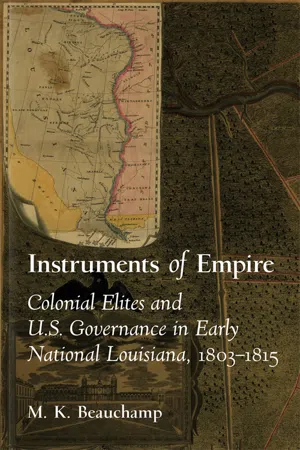
M. K. Beauchamp's Instruments of Empire examines the challenges that resulted from U.S. territorial expansion through the Louisiana Purchase of 1803. With the acquisition of this vast region, the United States gained a colonial European population whose birthplace, language, and religion often differed from those of their U.S. counterparts. This population exhibited multiple ethnic tensions and possessed little experience with republican government. Consequently, administration of the territory proved a trial-and-error endeavor involving incremental cooperation between federal officials and local elites. As Beauchamp demonstrates, this process of gradual accommodation served as an essential nationalizing experience for the people of Louisiana. After the acquisition, federal officials who doubted the loyalty of the local French population and their capacity for self-governance denied the territory of Orleans—easily the region's most populated and economically robust area—a quick path to statehood. Instead, U.S. officials looked to groups including free people of color, Native Americans, and recent immigrants, all of whom found themselves ideally placed to negotiate for greater privileges from the new territorial government. Beauchamp argues that U.S. administrators, despite claims of impartiality and equality before the law, regularly acted as fickle agents of imperial power and frequently co-opted local elites with prominent positions within the parishes. Overall, the methods utilized by the United States in governing Louisiana shared much in common with European colonial practices implemented elsewhere in North America during the early nineteenth century. While historians have previously focused on Washington policy makers in investigating the relationship between the United States and the newly acquired territory, Beauchamp emphasizes the integral role played by territorial elites who wielded enormous power and enabled government to function. His work offers profound insights into the interplay of class, ethnicity, and race, as well as an understanding of colonialism, the nature of republics, democracy, and empire. By placing the territorial period of early national Louisiana in an imperial context, this study reshapes perceptions of American expansion and manifest destiny in the nineteenth century and beyond. Instruments of Empire serves as a rich resource for specialists studying Louisiana and the U.S. South, as well as scholars of slavery and free people of color, nineteenth-century American history, Atlantic World and border studies, U.S. foreign relations, and the history of colonialism and empire.
eBook - ePub
Instruments of Empire
Colonial Elites and U.S. Governance in Early National Louisiana, 1803–1815
- 328 pages
- English
- ePUB (mobile friendly)
- Available on iOS & Android
eBook - ePub
Instruments of Empire
Colonial Elites and U.S. Governance in Early National Louisiana, 1803–1815
About this book
Information
Subtopic
French HistoryIndex
History1
Frontiers and Colonial Loyalties
As a Federalist advocate of expansion, James Workman avidly supported the Louisiana Purchase, despite its occurrence under Thomas Jefferson. Indeed, he wrote a play, Liberty in Louisiana: A Comedy, celebrating the transfer, which went into production in Charleston (and later staged in Philadelphia and New York). Workman had served in the British army, studied law, and worked as a journalist, publishing pieces with the Monthly Review. He immigrated to the United States most likely because his Irish birth barred him from work as a solicitor, and his political opposition to the war with France and advocacy of Irish political rights became increasingly unpopular.1 Workman lived in several cities on the eastern seaboard, became active in Federalist politics, and advocated filibustering expeditions whether mounted from Britain or the United States. For Workman, the purchase advanced the rule of law and civilization, and he wanted to be a part of it. Consequently, after the play closed he moved to New Orleans in 1804 and quickly became a clerk for Governor Claiborne and later secretary of the Legislative Council, where he drafted legislation, including the criminal code for the territory. In 1805 Workman secured an appointment as a judge of Orleans County.
In the final act of Workman’s play, a U.S. general dispatched to oversee the transfer informs the character Don Bertoldo de la Plato, a corrupt Spanish judge who wishes to abscond with his ward, the romantic lead, that “liberty is now in Louisiana!—The government which now rules here will not admit your rank as the testimony of your innocence; nor suffer it to shelter you if you have acted wrong. Our laws confer no privilege which justice may refuse to recognize—the humblest are shielded by their protection.” The general, in concluding the play, declares: “The confederated states of which our commonwealth consists, compose an imperial government, sufficiently united for national defence and those objects for which union and uniformity are requisite; and municipal governments sufficiently numerous powerful and divided to adapt regulations suitable to the circumstance of each state.”2 Workman held no doubt as to the superiority of the American system. Even so, he did not dismiss Spanish jurisprudence so much as the corrupt manner of its application.3 Workman believed in the impartiality of law and the virtues of the U.S. federal system that would bar abuses common under corrupt monarchical regimes. Caricatures of Spanish governance in the New World had become commonplace. The British traveler Francis Bailly observed of Spanish governance in Natchez in 1797: “They depend in all their civil and criminal affairs upon the whim or caprice favour or folly of an upstart Spaniard who is set over them as their governor, and who, through pique or malice, or in a fit of drunkenness or insanity, has it in his power to sport with the lives and property of those persons over whom he is placed for the ostensible purpose of protection.”4 Consequently Bailly found it unsurprising that most inhabitants welcomed the cession of Natchez to the United States under the 1795 Treaty of San Lorenzo. Foreign observers regularly reported the same phenomenon of incompetent and corrupt governance in Spanish Louisiana and assumed that the cession to the United States would be welcomed.
Workman did not just theorize. Over the winter of 1806–7 he found himself in a position to enforce the law impartially. During a period of national emergency brought about by a purported conspiracy by Aaron Burr that aimed to either separate portions of the West from the United States or to conduct a filibustering expedition into New Spain, General James Wilkinson with Claiborne’s tacit approval instituted martial law, made military arrests, and suspended habeas corpus. Workman publicly voiced his opposition to these measures and then moved to counteract abuses. After he ordered the release of three men arrested by Wilkinson in the city, it resulted in his own arrest along with his friend Lewis Kerr. Despite Workman’s beliefs in the impartiality of U.S. law and the virtues of a federal system that barred officeholders from abusing their authority, he became a clear victim of exactly that in the name of public order.
Workman resigned his judgeship and in opposition proved an embarrassing critic of Wilkinson’s violations of civil liberties and Claiborne’s negligence in failing to prevent them. More importantly the behavior of public officials during the incident belied the U.S. rhetoric over its superiorities. Workman addressed Claiborne in 1807, accusing him of cowardice in the face of a military tyranny, and asserting that Wilkinson’s acts “have in great measure blasted the hope which the Louisianians began to entertain of the permanent freedom and prosperity of their country.”5 Due to their opposition to Wilkinson’s measures and alleged support for Burr’s expedition, Workman and Kerr were put on trial for violating U.S. neutrality laws, with the U.S. attorney for the territory, James Brown, leading the prosecution. Kerr’s first trial ended with a hung jury, and when he was tried again the jury returned with a not guilty verdict.6 Though he was acquitted, Workman’s judicial and political career in the territory was finished. He continued to practice law and criticize the administration as an editor of the newspaper La Lanterne Magique for two more years; this too came to an end. In an argument before the bench with Philip Grymes, the district attorney for the district of Orleans, over the batture case in which Workman represented Edward Livingston, who attempted to claim private ownership of a batture (the land between a river and levees) in New Orleans, Workman responded to allegations that he opposed the government a falsehood. Incensed, Grymes threw an ink well at Workman, spraying several surprised observers. The judge, Joshua Lewis, ordered both men to appear the next day, whereupon they were fined and incarcerated for eight hours. The incident resulted in challenges to duels from Workman, which Grymes declined, and acrimonious pamphlets from both men. The handbill war led to Workman’s disbarment when Judge Lewis felt Workman misquoted him as to Grymes’s misconduct. Without a source of income, Workman left New Orleans in 1809 and did not return for eight years. He then reestablished a law practice and began to participate in the social and public life of the city until his death in 1832. Workman’s experience strikingly demonstrates the capability of the U.S. government to operate in a manner contrary to the ideals it espoused. Workman, an Irish Briton and capable ally of the governor until 1807, could be removed in a flagrant violation of the very principles he believed to be at the heart of U.S. administration.
Federal officials justified the extraordinary measures undertaken during the Burr conspiracy in the name of national security and public order. The internal threat represented by Burr coincided with an external threat from Spain that manifested itself on the Sabine. U.S. officials worried that a separatist plot could appeal to the French-speaking populace of Louisiana. The irony was that Creoles remained unmoved by the appeal of separation, and the men targeted by Wilkinson were generally Americans or British immigrants like Workman rather than Creoles. During the Burr conspiracy, which raised the specter of both a potential Spanish conflict and an internal secessionist threat along the American frontier, constitutional safeguards and the men committed to upholding them, such as Workman, would be sacrificed at first in the name of public safety and then later for political expediency.
For all the importance of the last two generations of scholarship that treat frontiers as zones of economic, social, and cultural exchange (which they certainly were), frontiers are about power. Charles S. Maier writes: “The point is that frontier defines authority, and those who govern lose legitimacy if their frontiers become totally permeable.” Federal authority on the frontier created by the Louisiana Purchase mattered a great deal as the United States justified its rule not just to the international community but to the foreign-born populace of Louisiana. In examining frontiers Maier draws a useful distinction between peer competitors and asymmetrical threats: “Call the one function anti-adversarial and the other anti-incursive.”7 Louisiana contained western and eastern frontiers that fit both categories, and the territorial government strove to establish its authority in the face of threats from other nations as well as a series of nonstate actors: Native American tribes, bandits, smugglers, filibusters, and pirates. This chapter will deal with the antiadversarial frontier and the following with the anti-incursive, though it must be kept in mind that in Louisiana the two frontiers until the resolution of the War of 1812 regularly would be linked in the thinking of U.S. officials, all the more so given the foreign nativity of the population and the plasticity of national attachment.
At the onset of the transfer many Americans, both Republicans and Federalists, harbored doubts over the loyalty of the populace of Louisiana, an assessment complicated by external threats. Senator William Plumer of New Hampshire reported that President Jefferson desired to pass a bill to distribute land to encourage immigration into Louisiana, since so much of its population could not be depended upon in the event of a threat.8 The federal union created by the founders and advanced by the Jeffersonian Republicans fundamentally opposed the European concept of a balance of power, but in Louisiana imperial competition played a key role in binding the local population to their new nation.9 With the monarchical empire of Spain in close proximity, the United States could demonstrate its value by offering greater opportunities for advancement than those across the border, while continuing to protect against outside aggression.
Worries over local loyalties in combination with outside threats were nothing new for the young republic, nor for previous imperial occupants of the Mississippi valley. The United States encountered challenges of governance in Louisiana remarkably similar to those earlier encountered by France, Spain, and then France again in dealing with Native Americans, slaves, free persons of color, and the local European population. Spain earlier struggled with the same fears throughout the Mississippi basin when it came to exercising control over non-Spanish populations.10 Nor was the United States unique in the anxieties brought about by the presence of geopolitical competitors that might threaten the nation’s seemingly tenuous control over the region, and these issues recurred elsewhere.11
The United States succeeded in Louisiana for three key reasons. First, geography and the fact that Louisiana lay co...
Table of contents
- Cover
- Title Page
- Copyright Page
- Dedication
- Contents
- Acknowledgments
- Introduction
- 1. Frontiers and Colonial Loyalties
- 2. Natural and Unnatural Frontiers
- 3. Slaves and the Threat of Internal Revolt
- 4. Free People of Color and the Limits of Collaboration
- 5. Imperial Compromises
- 6. Co-option and Collaboration
- Conclusion
- Notes
- Bibliography
- Index
Trusted by 375,005 students
Access to over 1.5 million titles for a fair monthly price.
Study more efficiently using our study tools.
Frequently asked questions
Yes, you can cancel anytime from the Subscription tab in your account settings on the Perlego website. Your subscription will stay active until the end of your current billing period. Learn how to cancel your subscription
No, books cannot be downloaded as external files, such as PDFs, for use outside of Perlego. However, you can download books within the Perlego app for offline reading on mobile or tablet. Learn how to download books offline
Perlego offers two plans: Essential and Complete
- Essential is ideal for learners and professionals who enjoy exploring a wide range of subjects. Access the Essential Library with 800,000+ trusted titles and best-sellers across business, personal growth, and the humanities. Includes unlimited reading time and Standard Read Aloud voice.
- Complete: Perfect for advanced learners and researchers needing full, unrestricted access. Unlock 1.5M+ books across hundreds of subjects, including academic and specialized titles. The Complete Plan also includes advanced features like Premium Read Aloud and Research Assistant.
We are an online textbook subscription service, where you can get access to an entire online library for less than the price of a single book per month. With over 1.5 million books across 990+ topics, we’ve got you covered! Learn about our mission
Look out for the read-aloud symbol on your next book to see if you can listen to it. The read-aloud tool reads text aloud for you, highlighting the text as it is being read. You can pause it, speed it up and slow it down. Learn more about Read Aloud
Yes! You can use the Perlego app on both iOS and Android devices to read anytime, anywhere — even offline. Perfect for commutes or when you’re on the go.
Please note we cannot support devices running on iOS 13 and Android 7 or earlier. Learn more about using the app
Please note we cannot support devices running on iOS 13 and Android 7 or earlier. Learn more about using the app
Yes, you can access Instruments of Empire by Michael K. Beauchamp in PDF and/or ePUB format, as well as other popular books in History & French History. We have over 1.5 million books available in our catalogue for you to explore.