The Roots of Violent Crime in America is criminologist Barry Latzer's comprehensive analysis of crimes of violence—including murder, assault, and rape—in the United States from the 1880s through the 1930s. Combining the theoretical perspectives and methodological rigor of criminology with a synthesis of historical scholarship as well as original research and analysis, Latzer challenges conventional thinking about violent crime of this era.
While scholars have traditionally cast American cities in the late nineteenth and early twentieth centuries as dreadful places, Latzer suggests that despite overcrowding and poverty, U.S. cities enjoyed low rates of violent crime, especially when compared to rural areas. The rural South and the thinly populated West both suffered much higher levels of brutal crime than the metropolises of the East and Midwest. Latzer deemphasizes racism and bigotry as causes of violence during this period, noting that while many social groups confronted significant levels of discrimination and abuse, only some engaged in high levels of violent crime. Cultural predispositions and subcultures of violence, he posits, led some groups to participate more frequently in violent activity than others. He also argues that the prohibition on alcohol in the 1920s did not drive up rates of violent crime. Though the bootlegger wars contributed considerably to the murder rate in some of America's largest municipalities, Prohibition also eliminated saloons, which served as hubs of vice, corruption, and lawlessness.
The Roots of Violent Crime in America stands as a sweeping reevaluation of the causes of crimes of violence in the United States between the Gilded Age and World War II, compelling readers to rethink enduring assumptions on this contentious topic.
eBook - ePub
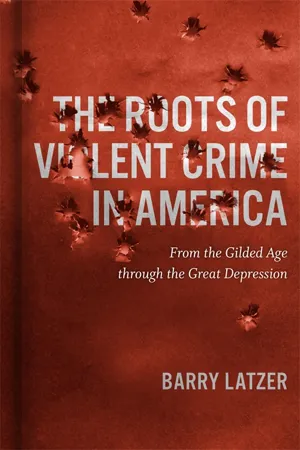
The Roots of Violent Crime in America
From the Gilded Age through the Great Depression
- 424 pages
- English
- ePUB (mobile friendly)
- Available on iOS & Android
eBook - ePub
About this book
Information
Subtopic
North American HistoryIndex
Social SciencesNOTES
PREFACE
1. Federal Bureau of Investigation, Crime in the United States, Uniform Crime Reporting Statistics, https://www.ucrdatatool.gov/Search/Crime/Crime.cfm. According to the FBI, violent crime encompasses four different offenses: criminal homicide (murder and non-negligent manslaughter), robbery, rape and sexual assault, and assault (usually aggravated assault). The violent crime rates in 1960 were 160.9 per 100,000; in 1990, they were 729.6 per 100,000. These rates are based on records of police departments across the United States that report to the FBI crimes known to them (whether or not solved by police).
2. Barry Latzer, The Rise and Fall of Violent Crime in America (New York: Encounter Books, 2016).
3. Roger Lane, Murder in America: A History (Columbus: Ohio State University Press, 1997), 189.
4. Mark Cooney, “The Decline of Elite Homicide,” Criminology 35, no. 3 (1997): 381.
5. H. V. Redfield, Homicide, North and South (Philadelphia: J. B. Lippincott, 1880).
6. A quantitative analysis demonstrated the vitality of the southern white honor culture in the 1990s: Richard E. Nisbett and Dov Cohen, Culture of Honor: The Psychology of Violence in the South (Boulder, CO: Westview, 1996). I found persistently high homicide mortality rates for southern whites in the twenty-first century after adjusting for Hispanic ethnicity and age: Latzer, Rise and Fall, 214, fig. 4.18.
7. For most of American history, until the Great Migration of the twentieth century, the overwhelming majority of blacks resided in the South. In 1910, 89 percent of the black population lived there. This dipped to 85 percent in 1920 and 79 percent in 1930, as blacks migrated north. U.S. Census Bureau, Historical Census Statistics on Population Totals by Race, 1790 to 1990, and by Hispanic Origin, 1970 to 1990, for the United States, Regions, Divisions, and States, by Campbell Gibson and Kay Jung, Working Paper No. 56 (Washington, DC: GPO, 2002), tables 1, 4. By the turn of the twenty-first century, after the Great Migration had ended, 55 percent of blacks lived in the South. U.S. Census Bureau, The Black Population: 2000 (2001), 3, fig. 2, https://www.census.gov/prod/2001pubs/c2kbr01–5.pdf.
8. Elijah Anderson, Code of the Street: Decency, Violence, and the Moral Life of the Inner City (New York: W. W. Norton, 1999), 76.
9. Anderson, Code of the Street, 75.
10. Latzer, Rise and Fall, 216.
CHAPTER ONE
1. David Hackett Fischer, Albion’s Seed: Four British Folkways in America (New York: Oxford University Press, 1989); Grady McWhiney, Cracker Culture: Celtic Ways in the Old South (Tuscaloosa: University of Alabama Press, 1988).
2. John Hope Franklin, The Militant South, 1800–1861 (Cambridge, MA: Harvard University Press, 2002, 1956), 2.
3. Redfield, Homicide.
4. Redfield, Homicide, 87, 88.
5. Redfield, Homicide, 15.
6. Redfield, Homicide, 55.
7. Redfield, Homicide, 188–89.
8. H. C. Brearl...
Table of contents
- COVER
- TITLE PAGE
- COPYRIGHT PAGE
- DEDICATION
- CONTENTS
- PREFACE
- I. A SOUTHERN CULTURE OF VIOLENCE
- II. FEEBLE JUSTICE
- III. DOES URBAN POVERTY CAUSE CRIME?
- IV. IMMIGRANTS AND CRIME
- V. GANGS
- VI. CRIME AND THE ECONOMY
- Conclusion
- Notes
- Bibliography
- Index
Trusted by 375,005 students
Access to over 1.5 million titles for a fair monthly price.
Study more efficiently using our study tools.
Frequently asked questions
Yes, you can cancel anytime from the Subscription tab in your account settings on the Perlego website. Your subscription will stay active until the end of your current billing period. Learn how to cancel your subscription
No, books cannot be downloaded as external files, such as PDFs, for use outside of Perlego. However, you can download books within the Perlego app for offline reading on mobile or tablet. Learn how to download books offline
Perlego offers two plans: Essential and Complete
- Essential is ideal for learners and professionals who enjoy exploring a wide range of subjects. Access the Essential Library with 800,000+ trusted titles and best-sellers across business, personal growth, and the humanities. Includes unlimited reading time and Standard Read Aloud voice.
- Complete: Perfect for advanced learners and researchers needing full, unrestricted access. Unlock 1.5M+ books across hundreds of subjects, including academic and specialized titles. The Complete Plan also includes advanced features like Premium Read Aloud and Research Assistant.
We are an online textbook subscription service, where you can get access to an entire online library for less than the price of a single book per month. With over 1.5 million books across 990+ topics, we’ve got you covered! Learn about our mission
Look out for the read-aloud symbol on your next book to see if you can listen to it. The read-aloud tool reads text aloud for you, highlighting the text as it is being read. You can pause it, speed it up and slow it down. Learn more about Read Aloud
Yes! You can use the Perlego app on both iOS and Android devices to read anytime, anywhere — even offline. Perfect for commutes or when you’re on the go.
Please note we cannot support devices running on iOS 13 and Android 7 or earlier. Learn more about using the app
Please note we cannot support devices running on iOS 13 and Android 7 or earlier. Learn more about using the app
Yes, you can access The Roots of Violent Crime in America by Barry Latzer in PDF and/or ePUB format, as well as other popular books in Social Sciences & North American History. We have over 1.5 million books available in our catalogue for you to explore.