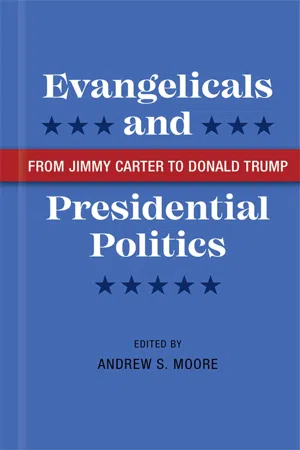
Using as their starting point a 1976 Newsweek cover story on the emerging politicization of evangelical Christians, contributors to Evangelicals and Presidential Politics engage the scholarly literature on evangelicalism from a variety of angles to offer new answers to persisting questions about the movement. The standard historical narrative describes the period between the 1925 Scopes Trial and the early 1970s as a silent one for evangelicals, and when they did re-engage in the political arena, it was over abortion. Randall J. Stephens and Randall Balmer challenge that narrative. Stephens moves the starting point earlier in the twentieth century, and Balmer concludes that race, not abortion, initially motivated activists. In his examination of the relationship between African Americans and evangelicalism, Dan Wells uses the Newsweek story's sidebar on Black activist and born-again Christian Eldridge Cleaver to illuminate the former Black Panther's uneasy association with white evangelicals. Daniel K. Williams, Allison Vander Broek, and J. Brooks Flippen explore the tie between evangelicals and the anti-abortion movement as well as the political ramifications of their anti-abortion stance. The election of 1976 helped to politicize abortion, which both encouraged a realignment of alliances and altered evangelicals' expectations for candidates, developments that continue into the twenty-first century. Also in 1976, Foy Valentine, leader of the Southern Baptist Christian Life Commission, endeavored to distinguish the South's brand of Protestant Christianity from the evangelicalism described by Newsweek. Nevertheless, Southern Baptists quickly became associated with the evangelicalism of the Religious Right and the South's shift to the Republican Party. Jeff Frederick discusses evangelicals' politicization from the 1970s into the twenty-first century, suggesting that southern religiosity has suffered as southern evangelicals surrendered their authenticity and adopted a moral relativism that they criticized in others. R. Ward Holder and Hannah Dick examine political evangelicalism in the wake of Donald Trump's election. Holder lays bare the compromises that many Southern Baptists had to make to justify their support for Trump, who did not share their religious or moral values. Hannah Dick focuses on media coverage of Trump's 2016 campaign and contends that major news outlets misunderstood the relationship between Trump and evangelicals, and between evangelicals and politics in general. The result, she suggests, was that the media severely miscalculated Trump's chances of winning the election.
- 208 pages
- English
- ePUB (mobile friendly)
- Available on iOS & Android
eBook - ePub
About this book
Information
Seeing Red
EVANGELICAL AND FUNDAMENTALIST ANTICOMMUNISM AND POLITICAL ENGAGEMENT
RANDALL J. STEPHENS
In his religious biography of Jimmy Carter, Randall Balmer writes about the politicization of conservative American Christians in the 1970s. “For much of the twentieth century,” he argues, “evangelicals harbored deep skepticism about engaging politics directly.” Their sharpened millennial beliefs, otherworldliness, and skepticism about the gritty business of political engagement, so goes the argument, kept them out of the public arena. Added to this is what Balmer and others have described as a kind of benign disinterest. Televangelist and fundamentalist political broker Jerry Falwell Sr. said as much. His 1965 sermon “Ministers and Marches” proclaimed that “our only purpose on earth is to know Christ and make Him known.”1 There are other versions of this narrative of evangelical hibernation. In her 752-page sprawling narrative on the long history of a religious movement titled The Evangelicals: The Struggle to Shape America, Frances FitzGerald writes that “after the Scopes trial fundamentalists had been relegated to the margins of society.” Certain demagogues among the devout, says Balmer, tried to gather believers together in the common cause of anticommunism. Some evangelicals responded, but, Balmer implies, most of them remained apolitical until the mid-1970s.2
Late in the century, anecdotes from evangelical political leaders themselves seemed to prove this narrative. John Ashcroft—a governor of Missouri and U.S. senator who would go on to serve as George W. Bush’s attorney general—recalled the insularity of his Pentecostal Assemblies of God denomination. In the years after he graduated from Yale University, in 1964, and then received his juris doctor degree at the University of Chicago in 1967, he contemplated a career in politics. Yet the church he called home offered no real examples of how to do that. He recalled only one member of his denomination, J. Roswell Flower, who ran for office. Flower had merely served as a Springfield, Missouri, city councilman. Flower spent some of his time in that position trying to convince fellow Springfielders that the fluoridation of water was part of a larger Communist conspiracy to take control of the population. In 1958, a representative of the Jaycees Fluoridation Committee pushed back, claiming, “It is almost unbelievable that a man in Mr. Flower’s position of responsibility . . . could be so completely misled by half truths and outright false statements made by irresponsible opponents to fluoridation.” In the end, though, Flower’s faction won at the polls. With fears of Communist plots and water poisoning exercising the community, Springfield’s citizens voted down fluoridation by an overwhelming margin of 4,266 to 8,672, or 33 to 67 percent.3 As odd or paranoid as the theory might have seemed, it represented persistent and real fears of Communist subversion in small-town America. Interviewed in 1988, Ashcroft thought about the strange apolitical nature of his denomination, which Flower eventually led as its general secretary. The government, Ashcroft contemplated, was “a worldly thing—in the same way that we shunned formal education for a long time.”4
Evangelicals like Ashcroft in the 1970s were, indeed, paying more attention to national politics and becoming aware of their collective influence. In a 1977 College of William and Mary master’s thesis on evangelical political thought, Darrell Kopp observed the changes taking place. “Evangelicals,” claimed Kopp, “have probably given greater attention to political theory and political affairs in recent years than to any other single area of social concern.” Kopp thought that as the faithful had “begun seriously to consider society’s problems, so has society begun to take evangelicalism more seriously.” National magazines such as Time, Newsweek, and U.S. News and World Report as well as influential newspapers like the New York Times, the Washington Post, and the Boston Globe took stock of the “newly” politicized evangelicals and fundamentalists. U.S. senator Mark Hatfield of Oregon, himself an evangelical, told a UPI reporter in 1976 that “many in the evangelical community were not involved in politics; they were essentially withdrawn from the world.” Referring to Democratic presidential nominee Jimmy Carter, Hatfield went on to claim that “for the first time since William Jennings Bryan,” the American evangelical community “has caught fire because of the fact that a candidate uses (evangelical) nomenclature publicly.”5
Conservative Christians seemed to be thinking about their place in the larger world in other ways too. Christian pop music stars now competed for the hearts and ears of fans with their secular rivals. Evangelicals on the left end of the spectrum called for nuclear disarmament, racial justice, and greater attention to the nation’s social ills. Evangelicals Letha Scanzoni and Nancy Hardesty provided a model for born-again feminism in their influential 1974 book All We’re Meant to Be.6 The larger trend, however, was to the right. Evangelical and fundamentalist conservatives felt that their country was slipping away from them at an alarming rate. They pitched traditional family values and decried what they called secular humanism, the move for gay rights, legalized abortion, and liberal school curriculum, and lamented the banning of prayer and Bible reading in public schools. Just months before Ronald Reagan won his landslide victory over incumbent Jimmy Carter, the New York Times’s Dudley Clendinen maintained that this “new political activism of conservative Christians arises in large part from the growth of television evangelism, whose audiences have become the political wells from which the coalition seeks to draw.”7
But that was only part of the story, Clendinen admitted. Political power brokers and strategists such as Paul M. Weyrich, Richard Viguerie, and a host of others brought together a large grassroots movement. Such changes were stunning to anyone paying attention to local and national politics. Some leaders of the Republican fold bristled at the new coalition of the self-righteous and denounced Falwell and company. There were those who might have wished that fundamentalist activists would have just stayed in their pulpits. In 1981, Barry Goldwater upbraided the Lynchburg, Virginia, TV preacher. “I think that every good Christian ought to kick Falwell right in the ass,” said the Arizona senator and one-time presidential hopeful.8 Falwell’s call for moral purity and righteous politics, especially in his opposition to the appointment of Sandra Day O’Connor to the Supreme Court, was too much for Goldwater to endure. With a sense of irony, the journalist Mike Royko noted in 1984 how much the religious-political revolution had changed the landscape. “There’s little doubt,” he quipped, “the Rev. Jerry Falwell and the ...
Table of contents
- Cover
- Title Page
- Copyright
- Contents
- Acknowledgments
- Introduction
- Seeing Red
- Full Circle
- An Evangelical Black Panther
- Building Bridges and a Broad-Based Movement
- Evangelicals and Abortion
- Dwelling in the Shelter of the Most High
- End of a Life Cycle
- A Question of Emphasis?
- Framing Faith during the 2016 Election
- Contributors
- Index
Trusted by 375,005 students
Access to over 1.5 million titles for a fair monthly price.
Study more efficiently using our study tools.
Frequently asked questions
Yes, you can cancel anytime from the Subscription tab in your account settings on the Perlego website. Your subscription will stay active until the end of your current billing period. Learn how to cancel your subscription
No, books cannot be downloaded as external files, such as PDFs, for use outside of Perlego. However, you can download books within the Perlego app for offline reading on mobile or tablet. Learn how to download books offline
Perlego offers two plans: Essential and Complete
- Essential is ideal for learners and professionals who enjoy exploring a wide range of subjects. Access the Essential Library with 800,000+ trusted titles and best-sellers across business, personal growth, and the humanities. Includes unlimited reading time and Standard Read Aloud voice.
- Complete: Perfect for advanced learners and researchers needing full, unrestricted access. Unlock 1.5M+ books across hundreds of subjects, including academic and specialized titles. The Complete Plan also includes advanced features like Premium Read Aloud and Research Assistant.
We are an online textbook subscription service, where you can get access to an entire online library for less than the price of a single book per month. With over 1.5 million books across 990+ topics, we’ve got you covered! Learn about our mission
Look out for the read-aloud symbol on your next book to see if you can listen to it. The read-aloud tool reads text aloud for you, highlighting the text as it is being read. You can pause it, speed it up and slow it down. Learn more about Read Aloud
Yes! You can use the Perlego app on both iOS and Android devices to read anytime, anywhere — even offline. Perfect for commutes or when you’re on the go.
Please note we cannot support devices running on iOS 13 and Android 7 or earlier. Learn more about using the app
Please note we cannot support devices running on iOS 13 and Android 7 or earlier. Learn more about using the app
Yes, you can access Evangelicals and Presidential Politics by Andrew S. Moore in PDF and/or ePUB format, as well as other popular books in Politics & International Relations & North American History. We have over 1.5 million books available in our catalogue for you to explore.