Louisiana Coushatta Basket Makers brings together oral histories, tribal records, archival materials, and archaeological evidence to explore the fascinating history of the Coushatta Tribe's famed basket weavers. After settling at their present location near the town of Elton, Louisiana, in the 1880s, the Coushatta (Koasati) tribe developed a basket industry that bolstered the local tribal economy and became the basis for generating tourism and political mobilization. The baskets represented a material culture that distinguished the Coushattas as Indigenous people within an ethnically and racially diverse region. Tribal leaders serving as diplomats also used baskets as strategic gifts as they built political and economic allegiances throughout the twentieth century, thereby securing the Coushattas' future.Behind all these efforts were the basket makers themselves. Although a few Coushatta men assisted in the production of baskets, it was mostly women who put in the long hours to gather and process the materials, then skillfully stitch them together to produce treasures of all shapes and sizes. The art of basket making exists within a broader framework of Coushatta traditional teachings and educational practices that have persisted to the present.As they tell the story of Coushatta basket makers, Linda P. Langley and Denise E. Bates
provide a better understanding of the tribe's culture and values. The weavers' own "language of baskets" shapes this narrative, which depicts how the tribe survived repeated hardships as weavers responded on their own terms to market demands. The work of Coushatta basket makers represents the perseverance of traditional knowledge in the form of unique and carefully crafted fine art that continues to garner greater recognition and appreciation with every successive generation.
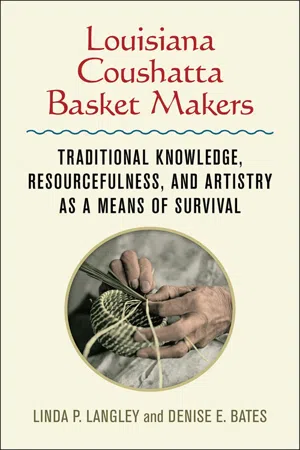
eBook - ePub
Louisiana Coushatta Basket Makers
Traditional Knowledge, Resourcefulness, and Artistry as a Means of Survival
- 216 pages
- English
- ePUB (mobile friendly)
- Available on iOS & Android
eBook - ePub
Louisiana Coushatta Basket Makers
Traditional Knowledge, Resourcefulness, and Artistry as a Means of Survival
About this book
Information
Subtopic
North American HistoryIndex
History1
Naksaamit Stamahilkato
How We Began
I remember real clearly when I was small that people sewed a lot of baskets. . . . they would sell [them] and eat.
—Marion Robinson John
SOUTHWESTERN LOUISIANA IS known for its diverse cultural landscape, but it wasn’t until the 1960s that curious motorists regularly traveled into Jefferson Davis and Allen parishes looking for more information on the Coushatta people. In fact, the Coushattas’ story came to play a prominent role in the tourism efforts of the area. As recently as 2007, the Jefferson Davis Parish Visitor’s Guide featured a commonly used characterization: “The Coushatta Tribe of Louisiana—once known as the ‘Lost Tribe’—is no longer lost but thriving in the Elton community.”1 This theme of a “lost tribe” in search of a permanent home is echoed throughout the twentieth century, and was even adopted by the tribe when it incorporated this language into the Coushattas’ own narrative they shared with the public about themselves. According to a 1978 source, the name “Coushatta” has two meanings:
One is “Lost Tribe,” and originated when a wandering band of tribesmen encountered a group of white men. When asked who they were, the Indians misunderstood the question and replied “Koashatt” meaning they were lost. This narrative was translated by the white men into the word “Kosati” or the present-day spelling “Coushatta.” The second meaning is “white reed-brake” and was originally applied to this group of Indians whose settlement was near patches of swamp cane, which the basket weavers of the tribe utilized in weaving their fine baskets.2
At first glance, the Coushattas’ rationale for embracing the “lost tribe” narrative appeared to compromise their agency as it related to their migration journey. However, this characterization was leveraged strategically, contributing to the mystery of their origin. In addition, by linking the tribal name to natural materials used to make baskets, the Coushatta people were able to emphasize the important place that baskets hold for them as Indigenous people in a region preoccupied with race. This assisted them in distinguishing their unique culture and history—both of which later contributed a great deal to an area they came to call home.3
The documentary record helps to identify the role that baskets played over the course of the Coushattas’ migration history. From the Tennessee River Valley to the tribe’s present settlement, cane baskets proved valuable for trade and as gifts in assisting the Coushatta people in building alliances with their non-Indian neighbors. Over time, however, river cane became increasingly difficult to get, and tribal basket makers were forced to adapt to their new environmental conditions by turning to other materials. But like other cultural practices throughout the tribe’s history, the making of cane baskets was embraced time and time again through different generations, as a tradition that refuses to fully “go to sleep.”4
Naksaamit Onthato Hahchi Okchakko-fa
The Journey to Bayou Blue
Archaeological and historical evidence shows that the Coushatta people were far from “wandering” or “lost” after first encountering Europeans. Instead, they made a series of strategic moves to ensure their survival as a nation. The tribe lived on islands in the Tennessee River in 1540 when the Spanish explorer Hernando de Soto approached them to buy corn. That first encounter did not end well, as the de Soto chroniclers reported stealing the tribe’s corn and taking the chief hostage.5 Decades later, the Coushattas decided to move southward away from the perils of encroaching settlers and competing tribes, as documented by the seventeenth-century Spanish explorer Marcos Delgado.6 In what became Alabama, the Coushattas settled in villages near their Muskogean-speaking cousins, affiliating themselves politically with the Creek Confederacy.7 And, by the second half of the eighteenth century, the tribe increased their political power, culminating with the leadership of Alexander McGillivray, son of a Scottish trader and his Coushatta wife, who wielded previously unparalleled power within the Creek Confederacy.8
Despite the military and political strength of the Creek Confederacy, continued colonial pressures and warfare prompted the Coushattas to resume their efforts to find a permanent home. While journeying through Tennessee, Alabama, Mississippi, Louisiana, Florida, Texas, and then back to Louisiana, the tribe lived in villages along seven major river basins—each with its own unique climate and natural environment. In addition to changes in access to water and arable lands, the Coushattas had to contend with significant limitations in the availability of the natural materials they were accustomed to using for making shelters, clothing, tools for hunting, and baskets. Although there is scarce recorded evidence about the materials Coushatta weavers used to make baskets prior to the eighteenth century, museum collections, ethnographies, and archaeological data indicate that the tribe was proficient in adapting to new environments and used whatever materials were available, such as hardwoods to weave mats and a variety of available grasses to make coiled baskets. While organic basketry materials rarely survive in the archaeological record, a notable exception was found at a Tennessee River site where fragments of split-cane baskets with distinctive Coushatta rims were found. At another site in northern Alabama, fragments of a woven burial mat also were found at a former Coushatta village location.9 In 1756, French explorer Antoine-Simon Le Page du Pratz encountered the Coushattas and concluded that they got their name from the practice of cutting cane that was as sharp as a knife.10 Anthropologist Hiram F. Gregory reaffirmed that the Coushattas likely made frequent use of river cane throughout their migrations by pointing out its abundance from eastern Texas across the Gulf Coastal Plain, making it accessible to the tribe all along its travel route.11 Kniffen, Gregory, and Stokes related how river cane was a significant resource to various tribes across the region:
[T]he great curving natural levees supported the canes, the native grasses Arunkinaria tecta and Arundinaria gigantica. To the aborigines, the canebrakes were almost sacred places. They furnished blowguns, darts, arrow shafts, shields, knives, and spears. Apart from supplying this arsenal, the cane was used in rafts, baskets, bedding, roofing, floor and wall coverings, and as containers for everything from bones of the dead to the plant seeds to be used as food during famines. Duck calls, whistles and flutes, tubes for bubbling medicines, and even beads were of cane. The brakes of river cane, as the Indians and others called it, have been compared to a supermarket that offered something for almost every purpose.12
In fact, river cane was such a prominent material used in Coushatta basket production that, in the early eighteenth century, the French explorers who came into contact with the tribe expressed how impressed they were by the Coushattas’ proficiency at using the material to weave large baskets and mats, both of which were commodities that had become a mainstay in colonial households.13 The Coushattas’ skill in growing and processing corn also was well documented by Europeans and Americans. Although early observers typically did not record details about the use of basketry, information provided by later generations and corroborated by known Coushatta cultural practices tell us that baskets served an important function in the harvesting, storing, and processing of corn.14
Whether overtly or otherwise, Coushatta baskets had a long history as major trade items, helping to sustain the tribal economy throughout the eighteenth and nineteenth centuries as the Coushattas moved between Louisiana and Texas—settling along the Red River and then onto the Calcasieu, Sabine, and Trinity rivers before finally reaching their present location along Bayou Blue in the 1880s.15 Each move was precipitated by a new wave of encroachment from European and American settlers, and the Coushattas credit the wisdom and diplomacy of early leaders for bringing the tribe through numerous perils, including war, forced removals, and assimilation campaigns. For example, Mikko (Chief) Red Shoes is remembered for leading the tribe out of their home in Alabama and into Spanish-controlled Louisiana in 1797, over a decade before the start of the Creek Wars.16 His intelligence and leadership were extolled by Spanish officials, as described by the Opelousas District Commandant Duralde: “The Coushatta Chief is the most distinguished chief among the Alibamons, who as [a] leader . . . has been highly recommended to me.” Red Shoes served as an interpreter for Spanish officials in helping to negotiate a lasting peace between the Caddos and Choctaws in which it was noted that “His intentions are always for the pacification, the most grand concord, amity and union possible with all the nations without exception.” Because of the actions of Chief Red Shoes, Spanish officials recommended that the Coushattas receive assistance to settle in the territory during a time when other tribes were denied admission or even forcibly removed.17
Following the Louisiana Purchase in 1803, the Coushattas moved their villages further westward. This led them into the large, irregularly patrolled neutral strip of territory between the Calcasieu and Sabine rivers, where they remained until the Adams-Onís Treaty of 1819. Although Coushattas must have used baskets daily, they were not enumerated in trade or gift exchanges when a large group of Coushattas moved westward into the piney woods of east Texas to seek sanctuary among the Spanish.18 In Texas, the tribe became key trading partners with many non-Indians in their vicinity, including the pirate Jean Lafitte, who traded with Coushatta people for provisions when docked at Galveston Island.19 Others, such as attorney J. Feagin of Livingston, Texas, recalled Coushatta women bartering moss rugs, reed-cane baskets, and deerskins with his mother. Another observer from that time, known as “Grandma Harrison,” recalled how “no one brought more or better goods to Drew’s Landing on packet days than did the (Coushatta) Indians. The women were adept at basket making, weaving, pottery, and bead work and were quite skilled in cooking, especially meats and vegetables.”20 German traveler Von Wrede was so fascinated by what he witnessed when watching Coushatta women cook in 1841 that he detailed the process of making cornmeal by “stamping corn in a mortar” and “sifting it through a number of sieves . . . until the finest meal was obtained.”21 These “sieves” are sifting baskets for processing corn and are still made by the Coushattas today.
Biographies of noted Texas historical figures provide additional information about the Coushattas in the mid-nineteenth century. For example, a biography of Benjamin Franklin Hardin, a noted Texas surveyor and legislator, discusses how he was interested “in maintaining good relationships with the [Coushatta] Indians.” Hardin was particularly impressed by the Coushattas’ Chief Kalita, whose strong leadership, much in line with Chief Red Shoes decades earlier, commanded the respect of his people and of their “Indian neighbors.” Hardin’s biographer claimed that during his visits with the Coushattas he “bought baskets and fur rugs and bowls for his cabin. He even tried to learn the...
Table of contents
- Cover
- Title Page
- Copyright Page
- Dedication
- Contents
- Illustration
- Acknowledgments
- Introduction
- 1. Naksaamit Stamahilkato How We Began
- 2. Ithani Asaala Taathatilkaak Sfaiyalok, Choiyi Hissi Asaala Achoohilito Transitioning to Pine-Needle Baskets
- 3. Asaala Schoolpak Komawiichito Selling the Baskets Helped Us
- 4. Ittoiyat Ittillokoolit Intoliino Maththit We Had to All Stand Together and Work Together
- Epilogue: Atchakki (Following) by Raynella Thompson Fontenot and Heather Williams
- Appendix 1. Koasati Asaala Achooliiha Louisiana Coushatta Weavers
- Appendix 2. Naksofon Komasaala Hochikkilooli? Where Are Our Baskets Stored?
- Notes
- Bibliography
- Index
Trusted by 375,005 students
Access to over 1.5 million titles for a fair monthly price.
Study more efficiently using our study tools.
Frequently asked questions
Yes, you can cancel anytime from the Subscription tab in your account settings on the Perlego website. Your subscription will stay active until the end of your current billing period. Learn how to cancel your subscription
No, books cannot be downloaded as external files, such as PDFs, for use outside of Perlego. However, you can download books within the Perlego app for offline reading on mobile or tablet. Learn how to download books offline
Perlego offers two plans: Essential and Complete
- Essential is ideal for learners and professionals who enjoy exploring a wide range of subjects. Access the Essential Library with 800,000+ trusted titles and best-sellers across business, personal growth, and the humanities. Includes unlimited reading time and Standard Read Aloud voice.
- Complete: Perfect for advanced learners and researchers needing full, unrestricted access. Unlock 1.5M+ books across hundreds of subjects, including academic and specialized titles. The Complete Plan also includes advanced features like Premium Read Aloud and Research Assistant.
We are an online textbook subscription service, where you can get access to an entire online library for less than the price of a single book per month. With over 1.5 million books across 990+ topics, we’ve got you covered! Learn about our mission
Look out for the read-aloud symbol on your next book to see if you can listen to it. The read-aloud tool reads text aloud for you, highlighting the text as it is being read. You can pause it, speed it up and slow it down. Learn more about Read Aloud
Yes! You can use the Perlego app on both iOS and Android devices to read anytime, anywhere — even offline. Perfect for commutes or when you’re on the go.
Please note we cannot support devices running on iOS 13 and Android 7 or earlier. Learn more about using the app
Please note we cannot support devices running on iOS 13 and Android 7 or earlier. Learn more about using the app
Yes, you can access Louisiana Coushatta Basket Makers by Linda Langley,Denise E. Bates in PDF and/or ePUB format, as well as other popular books in History & North American History. We have over 1.5 million books available in our catalogue for you to explore.