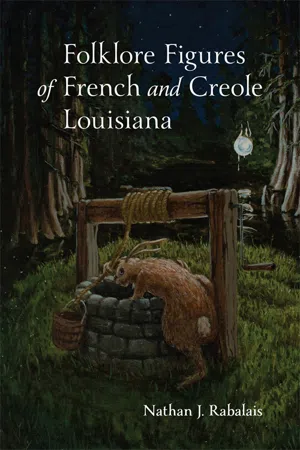
In Folklore Figures of French and Creole Louisiana, Nathan J. Rabalais examines the impact of Louisiana's remarkably diverse cultural and ethnic groups on folklore characters and motifs during the eighteenth and nineteenth centuries. Establishing connections between Louisiana and France, West Africa, Canada, and the Antilles, Rabalais explores how folk characters, motifs, and morals adapted to their new contexts in Louisiana. By viewing the state's folklore in the light of its immigration history, he demonstrates how folktales can serve as indicators of sociocultural adaptation as well as contact among cultural communities. In particular, he examines the ways in which collective traumas experienced by Louisiana's major ethnic groups—slavery, the grand dérangement, linguistic discrimination—resulted in fundamental changes in these folktales in relation to their European and African counterparts.Rabalais points to the development of an altered moral economy in Cajun and Creole folktales. Conventional heroic qualities, such as physical strength, are subverted in Louisiana folklore in favor of wit and cunning. Analyses of Black Creole animal tales like those of Bouki et Lapin and Tortie demonstrate the trickster hero's ability to overcome both literal and symbolic entrapment through cleverness. Some elements of Louisiana's folklore tradition, such as the rougarou and cauchemar, remain an integral presence in the state's cultural landscape, apparent in humor, popular culture, regional branding, and children's books. Through its adaptive use of folklore, French and Creole Louisiana will continue to retell old stories in innovative ways as well as create new stories for future generations.
- 256 pages
- English
- ePUB (mobile friendly)
- Available on iOS & Android
eBook - ePub
Folklore Figures of French and Creole Louisiana
About this book
Information
Index
Social SciencesCHAPTER 1
Lapin and Other Animal Tricksters
Animal tales are perhaps the most prevalent in the folklore repertoires of many cultures. From the fables of La Fontaine to Brer Rabbit, animal tales are probably first to come to mind when the average person thinks of “folktales” today, and it is not difficult to understand their appeal. The most remarkable quality of animal characters is perhaps their “neutrality” and adaptability: they are neither Black nor White; the language they speak in the story is arbitrary; and they can be slyly used to embody (and mock) those in power without explicitly naming them. This slyness is as present in Le Roman de Renart as it is in the slave narratives of the American South. The convenient malleability of animal tales is also paired with a capacity for extraordinary precision and specificity. In other words, a region’s animals (like its flora, languages, and customs) are not found just anywhere. A creature regarded as the creator of the world in one folk tradition might be insignificant or even absent in another tradition.
As humans, we intuitively attribute certain characteristics to specific animals, anthropomorphizing them in a way that reflects our cultural reality. This practice has even permeated our everyday expressions. One can be “sly as a fox” or “meek as a lamb” and so forth. But again, these interpretations come with a high degree of cultural specificity. Whereas an American might be familiar with the phrase “wise as an owl,” a Frenchman would more readily recognize the comparison “curieux comme une chouette” (curious as an owl).
In French- and Creole-speaking Louisiana, animal tales, or contes d’animaux, are the result of a mélange of European, Native American, and African traditions. At the same time, they are undeniably rooted in the unique social reality of Louisiana. For the most part, the cast of characters in the animal tales of Louisiana represents a confluence of French and African traditions.1 In addition to these two major influences, there are many others, including that of the Spanish as evidenced in the rich folklore of the Isleño communities of St. Bernard Parish. A quick look at a sampling of French and Creole folktales of Louisiana will show that while some characters bear remarkable resemblance to the French tradition (the fox, swan, and rabbit), African and Caribbean folklore influences are equally strong, both with regard to the animals (the elephant, hyena, and tiger) and the character traits associated with them. What is not to be understated, however, is how deeply rooted in the reality of Louisiana these tales are. In fact, most of the animals found in this repertoire—turtles, rabbits, frogs, and deer—are easily found in the bayous and prairies of South Louisiana.
From the very earliest written collection of Louisiana Creole folktales in Alcée Fortier’s Louisiana Folk-Tales (1895) to collections of contemporary folklorists such as Barry Ancelet, it is clear that animal tales make up one of the largest categories of folktales in the region. The variety of animals is equally notable. But despite this formidable cast of animal characters, two characters have made their way to the forefront: Bouki and Lapin. This dupe-and-trickster duo can be found in Fortier’s work and throughout the major folklore collections. The two have even been the subject of much more recent works, such as Susan Spillman’s Compère Lapin voyageur (2013) and other children’s books. Who can say why these two characters have gained such popularity? Perhaps it is the plethora of fieldwork that introduced storytellers like Enola Matthews to a wider audience. Perhaps it is the sheer number of Bouki and Lapin stories that seem to be equally appealing to white Cajuns as they are to Creoles of color. Or perhaps it is their accessibility and similarity to the ever-popular Brer Rabbit stories of J. C. Harris’s fictional orator Uncle Remus. Whatever the reason may be, today Bouki and Lapin are emblematic of Louisiana’s folklore and are known well beyond the relatively limited circle of folklorists and storytellers.
Scholars of African American folklore such as Richard Dorson and Lawrence Levine have rightfully warned of the pitfalls of placing too much emphasis on African origins, as this repertoire is primarily an American phenomenon. While it is certainly not my intention here to trace uninterrupted transmissions between American and African folktales or identify definitive analogues or their supposed origins, the historical and cultural connections between Louisiana and West Africa are undeniable. There can be no doubt concerning the strong African influence of the Bouki and Lapin stories in Louisiana. The West African roots of much of the enslaved population of Louisiana and the subsequent Afro-Creole society as well as similarities within the characterization of the folktales confirm this Louisiana–West African connection. One of the most salient and indisputable connections to West Africa is the very name of Bouki, the Wolof word for “hyena.” In addition to Bouki’s analogous casting as the dupe to the clever rabbit in West African and Louisiana Creole tales, the fact that the Wolof word for hyena has persisted in Louisiana is surprising, as very few in Louisiana seem to be aware of the name’s original meaning. And while the two characters often appear together in tales, this is not always the case. Lapin is without a doubt an animal trickster. As a trickster figure, Lapin finds himself in a pantheon of complex characters with examples ranging from Greek mythology to Native American folktales.2 The question becomes, then, what can the representation of the trickster in the folklore of a certain region tell us about that culture?
Regardless of the culture or time period in question, there are a number of overarching traits present in nearly all trickster figures. Tricksters are not simply deceitful; they defy social norms, mock authority figures, disrupt social order, and upset the “normal” order of things. Beyond these common traits, the trickster can display more specific traits (overt or ambiguous sexuality, an affinity for disguise, and so forth). In the case of Lapin or other animal tricksters of Louisiana folklore, there is no single legend or story cycle associated with him, as is the case of African characters such as Anansi, Eshu, Legba, and Ogo-Yurugu.3
The linguistic origin of the Bouki character makes clear the West African origins of the hyena and hare tales; however, the genre’s exact passage into Louisiana’s oral tradition cannot be known for sure. This is because similar tales are found elsewhere in the Caribbean, namely in modern-day Haiti. Furthermore, the traits of Bouki and Lapin are essentially analogous to those of le loup et le renard (the wolf and the fox) in the French tradition. No early written evidence exists of the name Leuk/Lëk (Wolof for “rabbit”) in Louisiana, although it certainly persists in West African folklore today. Curiously, the character has retained its animal identity in Louisiana folklore, as his French appellation of Lapin indicates. Today in Haiti, the tales of Bouki ak Malis (Bouki and Malice) are still well known among children. As is the case in Louisiana, the original meaning of bouki is mostly unknown, even among Haitians who are very familiar with the tales, suggesting that the association with its Wolof origin was lost before the character’s arrival in Louisiana. In Haiti, the animality of the rabbit has also been either lost or morphed in favor of a personification of the hare’s deceitful nature. In place of Lapin or Lëk, Bouki’s counterpart is known simply as “Malice.” It is logical that the Wolof term bouki would have been preserved in Louisiana folktales, as opposed to translating it to English or French, given the absence of hyenas in Louisiana. As an abstract dupe-like character, bouki became a somewhat arbitrary name for a stock folklore figure.4 Unfortunately, without any attestation of the tales in Louisiana before the Saint-Domingue Revolution, it is impossible to say with any certainty whether the character was imported directly from the West African tradition or by way of Saint-Domingue. A third and perhaps more likely explanation would be that the influx of Saint-Domingue refugees into Louisiana reinforced a recent but already present repertoire of Bouki and Lapin tales from the transatlantic slave trade.
The earliest examples of Creole folktales in Louisiana were recorded after the end of the Civil War, as is the case for Black folklore in general in the United States.5 Alcée Fortier, a member of the White Creole upper class of New Orleans, was a linguist and professor of French at Tulane University when he published Louisiana Folk-Tales in 1895. Fortier’s position with the Black Creole community is complicated, to say the least. In fact, it is difficult to determine his exact feelings toward the Creole language as he marvels in a condescending tone at “how the ignorant African slave transformed his master’s language into a speech concise and simple, and at the same time soft and musical,” but he also argues that Louisiana Creole was “not a corruption of French” but rather “a real idiom with a morphology and grammar of its own.”6 To add to the ambivalence of Fortier’s writings, he asserts that some of the tales are “without doubt, of African origin” but also admits that he has made little or no attempt at cataloging or comparing these tales to those found elsewhere in other oral traditions.7
The African influence and didactic nature of the tales in Fortier’s collection are particularly salient in the animal tales. More significant than mere vestiges of African tradition, animal tales remained popular and socially relevant in the New World for a number of reasons, coexisting and often melding with their counterparts of European and Native American origin. Animals in these folktales, while perfectly recognizable as such, are also thoroughly anthropomorphized. In Louisiana Creole folklore, as in most oral traditions, animals typically have assigne...
Table of contents
- Cover
- Title Page
- Copyright Page
- Dedication
- Contents
- Illustrations
- ACKNOWLEDGMENTS
- Introduction: Origins and Evolution of Louisiana’s French and Creole Folklore Tradition
- 1. Lapin and Other Animal Tricksters
- 2. The Master Thief, a Human Trickster
- 3. The Many Faces of Jean le Sot
- 4. Un Sacré Conte: Anticlerical Humor in Louisiana Folklore
- 5. Bayou Belles: The Fairy Tales of French and Creole Louisiana
- 6. Mystery, Magic, and Curses
- Epilogue: Contemporary Uses of Folklore Figures
- NOTES
- BIBLIOGRAPHY
- INDEX
Trusted by 375,005 students
Access to over 1.5 million titles for a fair monthly price.
Study more efficiently using our study tools.
Frequently asked questions
Yes, you can cancel anytime from the Subscription tab in your account settings on the Perlego website. Your subscription will stay active until the end of your current billing period. Learn how to cancel your subscription
No, books cannot be downloaded as external files, such as PDFs, for use outside of Perlego. However, you can download books within the Perlego app for offline reading on mobile or tablet. Learn how to download books offline
Perlego offers two plans: Essential and Complete
- Essential is ideal for learners and professionals who enjoy exploring a wide range of subjects. Access the Essential Library with 800,000+ trusted titles and best-sellers across business, personal growth, and the humanities. Includes unlimited reading time and Standard Read Aloud voice.
- Complete: Perfect for advanced learners and researchers needing full, unrestricted access. Unlock 1.5M+ books across hundreds of subjects, including academic and specialized titles. The Complete Plan also includes advanced features like Premium Read Aloud and Research Assistant.
We are an online textbook subscription service, where you can get access to an entire online library for less than the price of a single book per month. With over 1.5 million books across 990+ topics, we’ve got you covered! Learn about our mission
Look out for the read-aloud symbol on your next book to see if you can listen to it. The read-aloud tool reads text aloud for you, highlighting the text as it is being read. You can pause it, speed it up and slow it down. Learn more about Read Aloud
Yes! You can use the Perlego app on both iOS and Android devices to read anytime, anywhere — even offline. Perfect for commutes or when you’re on the go.
Please note we cannot support devices running on iOS 13 and Android 7 or earlier. Learn more about using the app
Please note we cannot support devices running on iOS 13 and Android 7 or earlier. Learn more about using the app
Yes, you can access Folklore Figures of French and Creole Louisiana by Nathan Rabalais in PDF and/or ePUB format, as well as other popular books in Social Sciences & Folklore & Mythic Literary Criticism. We have over 1.5 million books available in our catalogue for you to explore.