Every summer for the past thirty years, the Sewanee Writers' Conference has gathered a community of writers for two weeks of workshops, readings, talks, and meetings focused on the craft and art of writing. This book is a selection of craft talks delivered during the conference over the last several years. Some essays focus on one or two authors, some focus on texts, while others cast their regard more broadly. All are written in response to questions generated by the process of writing, as masters of the craft candidly report challenges they confront and the means by which they work to resolve such issues. The eighteen essays encompass poetry, fiction, and playwriting, investigating questions of language, character, design, and meaning, with nuanced readings of particular authors and works alongside more wide-ranging reflections on craft.
Designed for audiences of writers and readers across multiple levels and backgrounds, the essays collected in As We Were Saying offer original, insightful arguments about the craft of writing and the power of literature.
eBook - ePub
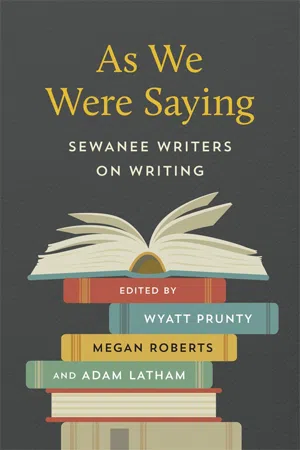
As We Were Saying
Sewanee Writers on Writing
- 288 pages
- English
- ePUB (mobile friendly)
- Available on iOS & Android
eBook - ePub
As We Were Saying
Sewanee Writers on Writing
About this book
Information
Subtopic
Literary EssaysIndex
LiteratureINDEX
Aarne-Thompson Classification System, 202
About Fiction (Morris), 204
Abrams, M. H., 65–68
abstractions, 191–92, 214
adjectives, 201
adultery, 184–85
advice, 54, 66, 113, 118–19, 128–29, 171, 199, 204, 208–10, 214, 231
Aeneid (Virgil), 59
aesthetics of ambivalence, 84–97
Albers, Josef, 104
alchemy, 55, 79–80, 83, 211
allegory, 164
All the King’s Men (Warren), 50–52
alterations affecting a poem, 193–203
“Always” (Strand), 99
ambivalence, 88–97
American literature, 159–60
American poetry, 154–55
The American Scene (James), 92–93
“American Scenes (1904–1905)” (Justice), 91–93, 96
anagrams, 111–12
“Animals in Heaven,” 11–24
animation, 32, 35, 43
“A&P” (Updike), 228–29
architecture and narrative: and the Bunny Lane House, 38–40; and childhood memories, 25–27; form and function, 29–32; and Herrera’s Signs Preceding the End of the World, 35–38; and libraries, 32–35; and shaping stories, 27–30, 35–38; and Tokarczuk’s House of Day, House of Night, 40–44
Arduini, Franca, 63
“Aren’t You Happy for Me?” (Bausch), 208
Aristotle, 16, 23, 57–58, 63
Ars Poetica (Horace), 58
artifice, 88, 108
The Art of Fiction (Gardner), 47
“An Arundel Tomb” (Larkin), 241–42
The Atlantic (magazine), 117
“Aubade” (Larkin), 69, 237, 241–42, 245
Auden, W. H., 90
Audubon: A Vision (Warren), 160–69
Audubon, John James, 155, 161–69
Austen, Jane, 116
authenticity, 68
autobiographical poets, 98
“Automat” (Hopper), 107
backstory, 36, 47
Baldwin, James, 116, 117, 119–22, 124
The Ballad of the Sad Café (McCullers), 172
Barnstone, Willis, 217
Barthes, Roland, 195
“The Bath” (Carver), 116
Bausch, Richard, 208
“The Beautiful Changes” (Wilbur), 240–41, 244
beginning of a story: in as few words as possible, 228–29; and magic, 16–20; and opening pages of novels, 127–36; and the process of writing, 211–12; and revision, 123–24. See also opening paragraphs
Bell, Madison Smartt, 27
Bellow, Saul, 209
Beloved (Morrison), 55
Bennington College, 179–81
Bernard Shaw (Holr...
Table of contents
- Cover
- Title Page
- Copyright Page
- Dedication
- Contents
- Introduction
- Story
- Narrative Architecture and the Inhabitation of Story
- The Character of Our Character: Reality, Actuality, and Technique in Fiction and Nonfiction
- “Is There a Plot in This Poem?”
- What Makes a Play a Play?
- Seven Types of Ambivalence: On Donald Justice
- S Is for Something: Mark Strand and Artistic Identity
- The Train Stops Here: The Optimism of Revision
- The Starting Line
- Unspeakable: Speech on Stage
- Birds of America: Or, Tell Me a Story about Farming, Haunted Houses, and Poetry in Motion
- Haunted
- Why Literature Can Save Us
- Inside “Out, Out—”
- Technique Makes Imagination Matter More
- Metaphor: The Fundament of Imaginative Writing
- The Directing Sentence
- Rationed Compassion: Philip Larkin and Richard Wilbur
- Contributors
- Index
Trusted by 375,005 students
Access to over 1.5 million titles for a fair monthly price.
Study more efficiently using our study tools.
Frequently asked questions
Yes, you can cancel anytime from the Subscription tab in your account settings on the Perlego website. Your subscription will stay active until the end of your current billing period. Learn how to cancel your subscription
No, books cannot be downloaded as external files, such as PDFs, for use outside of Perlego. However, you can download books within the Perlego app for offline reading on mobile or tablet. Learn how to download books offline
Perlego offers two plans: Essential and Complete
- Essential is ideal for learners and professionals who enjoy exploring a wide range of subjects. Access the Essential Library with 800,000+ trusted titles and best-sellers across business, personal growth, and the humanities. Includes unlimited reading time and Standard Read Aloud voice.
- Complete: Perfect for advanced learners and researchers needing full, unrestricted access. Unlock 1.5M+ books across hundreds of subjects, including academic and specialized titles. The Complete Plan also includes advanced features like Premium Read Aloud and Research Assistant.
We are an online textbook subscription service, where you can get access to an entire online library for less than the price of a single book per month. With over 1.5 million books across 990+ topics, we’ve got you covered! Learn about our mission
Look out for the read-aloud symbol on your next book to see if you can listen to it. The read-aloud tool reads text aloud for you, highlighting the text as it is being read. You can pause it, speed it up and slow it down. Learn more about Read Aloud
Yes! You can use the Perlego app on both iOS and Android devices to read anytime, anywhere — even offline. Perfect for commutes or when you’re on the go.
Please note we cannot support devices running on iOS 13 and Android 7 or earlier. Learn more about using the app
Please note we cannot support devices running on iOS 13 and Android 7 or earlier. Learn more about using the app
Yes, you can access As We Were Saying by Wyatt Prunty, Megan Roberts, Adam Latham, Wyatt Prunty,Megan Roberts,Adam Latham in PDF and/or ePUB format, as well as other popular books in Literature & Literary Essays. We have over 1.5 million books available in our catalogue for you to explore.