An ethnographic study of how doctoral-level research in the social sciences and humanities is produced in Egypt
Much scholarship has been devoted to debates around how global inequalities of knowledge production arise from asymmetric power relations and disparities in access to material resources, as well as values and practices that prioritize certain academic disciplines and research outputs over others. The central role played by universities in producing both knowledge and researchers is similarly acknowledged, with the doctorate increasingly recognized as a crucial phase in establishing both.
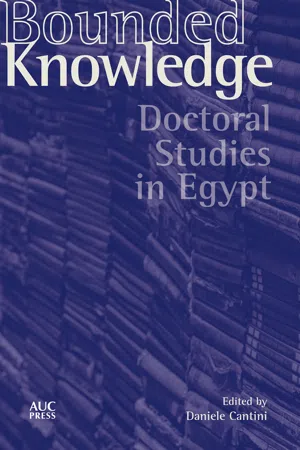
Bounded Knowledge: Doctoral Studies in Egypt explores these debates from a uniquely Egyptian perspective. It provides a fresh, historical analysis of how doctoral studies evolved in Egypt and an ethnographic inquiry into the actual conditions of knowledge production in the country's public universities, with focus on the humanities and social sciences. Although it is commonplace to speak of international collaborations in knowledge production, institutional settings and material conditions are so uneven as to make the fiction of equality impossible to sustain. The chapters in this book, by social scientists within and outside Egypt, look closely at how such academic hierarchies are reinforced in the context of the internationalization of research. They also look at the ways in which notions of socially responsible research, common the world over, are translated in the particularly Egyptian context: how research topics are discussed, how doctoral studies are organized, and ultimately, how society thinks about research.
Contributors
Mona Abaza, The American University in Cairo, Egypt
Daniele Cantini, Martin-Luther-University of Halle/Wittenberg, Germany
Nefissa Dessouqi, Cairo University, Egypt
Hala Kamal, Cairo University, Egypt
Jonathan Kriener, Ruhr-University Bochum, Germany
Ola Kubbara, Cairo University, Egypt
Ahmed Mansour, University of Alexandria, Egypt
David Mills, University of Oxford, England
- English
- ePUB (mobile friendly)
- Available on iOS & Android
eBook - ePub
About this book
Information
1
A Brief Sketch of the Political History of Doctoral Studies in Egypt
While the history of doctoral education in Egypt still needs to be written, opportunities for doctoral studies have existed for over a century. The studies devoted to postgraduate studies in different disciplines tend to be lists of MA and PhD theses, rather than discussions of their content, even less of the context within which they are produced. For example, the Markaz al-Tanzim wa-al-Mikrufilm has a list of over five thousand theses, mostly at the MA level, produced at Egyptian universities between 1922 and 1974. Individual disciplines also kept their own tallies, with dissertations (again, at both MA and PhD levels) in historiography being listed in the journal of the Egyptian Historical Studies from the beginning of graduate studies at Cairo University to the mid-1970s (Abbas 1995: 25). For sociology, Ahmed Zayd edited two volumes with title, author, supervisor, and abstract of all MA and PhD theses published in sociology at Egyptian universities, and reports a similar and earlier publication of Mohammed Higazi in this sense (Zayd 1995: 69). In a similar vein, Ahmed Badawi lists MA and PhD dissertations in sociology up to the mid-2000s, offering some reflections on the problems of doing sociology in Egypt, however condensed in a few pages (Badawi 2009: 319–25).1 In this chapter, I present a sketch of the political history of the doctorate in Egypt, with the aim of providing the necessary background information for the nonspecialist reader in a concise way, detailing the main historical developments, trying to do some justice to their complex and nonlinear character.
The Egyptian University was the first, private (ahliya), albeit with some sponsorship from the khedivial court, attempt at creating a national university in the country. In this first phase, between 1908, the year of its foundation, and 1925, the year in which the Decree of 11 March established it as a state university, six PhD theses were defended, the first of which was by Taha Hussein on May 5, 1914, on Abu al-’Ala al-Ma’arri (Waardenburg 1966: 223–25).2 Interestingly for a discussion on the availability of data, another later source states that in the same period, nine theses were defended, seven successfully (Al-Jumay’i 1983: 49–51).3 Parallel to this pioneering moment, in which the doctorate was far from being structured (Al-Jumay’i 1983: 49–51)—as it wasn’t in most of Europe—the government started the practice of sending students abroad, most notably to France and England. According to Reid, the training of professors abroad was seen as so important that the first mission4 left in September 1908, before the university began classes, and was almost a national celebration. The first eleven students were divided between arts and the sciences, got a monthly allowance for living expenses, and were not to marry; returning with their doctorates, they were to teach for ten years or pay back their scholarships (Reid 1990: 63). This practice, which continues until today under different conditions, has created from the very beginning a cleavage among those who received their education abroad and those who were locally trained, as I will abundantly discuss later.5 It became immediately apparent that this practice would present substantial problems, not only from the point of view of formal recognition of previous studies but more importantly on the very meaning of research, on the limits of its acceptability. Among the first students sent abroad, the case of Mansour Fahmy, the first Egyptian holding a PhD in sociology from Sorbonne, stands out both as exceptional for the degree of resistance his thesis, defended in 1913 on “the condition of the woman in the tradition and evolution of Islamism” provoked and exemplary for the difficult condition of in-betweenness of scholars well-versed in more than one tradition, and for the public role of the intellectual (Roussillon 2002). His thesis adopted some of the harsher criticisms levelled by orientalists on Islam and particularly on the condition of women—as one can easily see, recurrent themes in the scholarship on the region (see also Chapter 5)—and was met with outrage in Cairo, causing the (temporary, as it happened) cancellation of the professorial position for which he had originally been sent abroad.6
It is only with the inception of the state university in 1925, what is nowadays the Cairo University, that university studies were established according to the tripartite division, between diploma, master, and doctorate. At the beginning, PhDs were awarded in three of the four faculties (literature, science and law, but not in medicine), but this was soon to change, with 847 PhDs being awarded in all faculties, including the newly created ones, between 1925/26 and 1958/59 (42 to women).7 Despite this steady growth in numbers, the public doctoral defense could still generate sustained public interest, heated polemics, and even political implications. Examples include the description of the doctorate in philosophy awarded to Abd al-Rahman Badawi on existential time by the Faculty of Arts at Cairo University in 1944 (Di Capua 2012), or the refusal of awarding an honorary title to a political personality sponsored by the king (Waardenburg 1966: 92), followed by the announced resignation of the dean of the Faculty of Adab as well as of the president of the university on March 9, 1932.8 Some of the first locally trained PhD holders became scholars in their own right, establishing disciplinary schools that in some cases lasted decades, and that constituted one of the greatest achievements of the “founding fathers” for the development of the discipline in local universities (Abbas 1995). The historian Ahmed Izzat Abd el-Karim is an apt example in this regard; having obtained his doctorate in 1941 with a thesis on education in modern Egypt, he became professor and later rector of Ain Shams University, where he established in 1955 a seminar for Higher Studies in Modern History that was still active in the 2000s and where generations of scholars discussed their works (Gorman 2003: 30–31).
After the 1952 revolution
Both the education and the higher education sector expanded greatly after the 1952 revolution, which greatly increased the number of students and institutes, as well as the budget allocated to education; according to some, the expansion of the higher education sector must be regarded as the “prime educational achievement of the 1952 revolution” (Abdalla 1985: 105). The transformation undergone by Egyptian universities after 1952 was not without troubles, however. The university was regarded by the army officers as a stronghold of conservatism and antirevolutionary thought (Najjar 1976); in 1954 more than sixty professors lost their positions in what became known as the Nasserite purges (Reid 1990), and the revolutionary powers exerted considerable effort in transforming the academia toward their goal of building a new society (Awad 1963). Some commentators lamented the end of the university; in particular, Luis Awad wrote that a university without scientific research, reading, thinking, and discussion is no more than a workshop to train laborers; others labelled the university as nothing more than a factory where degrees and aspirations for social mobility gave education a utilitarian character; in a similar vein, Waardenburg wrote that this was no longer a university (both quoted in Abdalla 1985: 114). However, universities were never completely under governmental control, not even at the height of Nasser’s power; as Gorman (2003: 77) notes, the university has been enmeshed in national policies, without becoming a simple extension of any government, but rather sharing nationalist concerns and perspectives, and being actively part of the national fabric of politics.
Beyond dispute is that, since the early years of Nasserite rule, governmental interventions in university affairs, something not unknown in the previous phase of course, reached an entire new level, particularly after the purges. From 1961 on, Nasser intensified the pressure on universities to conform to the socialist design of the revolutionary society; at this time a crisis of the university and of the intellectuals, who were accused of failing to accord to the new social reality, was proclaimed (Najjar 1976). As Malcom Kerr noted, during this phase intellectuals were
publicly encouraged to blame themselves . . . journalists and university teachers may debate at great length in the press about the failings of their own class, provided that the conclusion drawn is not that the army has monopolized power and deprived intellectuals to the right of self-expression, but that the intellectuals had ignominiously abdicated responsibility . . . breast-beating has thus become a fixed posture of the intellectual in the public press as he self-consciously discusses the “crisis” of the university. (quoted in Abdalla 1985: 139)
When professors proved too resistant to introduce change, funding was channeled through research centers instituted ad hoc, to pursue specific research interests, such as in the case of the Institute for Sudanese Studies, later labelled Institute for African Studies hosted at Cairo University, and at times even explicitly political goals, such as in the Higher Institute of Socialist Studies, led by Ibrahim Saad Eddin (Gorman 2003).9 During this phase the system was geared toward the needs of the state and of the government, with Nasserism being instrumental in creating enduring ideas about appropriate knowledge and lines of inquiry, as well as a certain blurriness in knowing the limits of acceptable research (Reid 1990); in some disciplines, one could see this period as heralding a nationalization of research, particularly in sociology (Roussillon 2002). The National Charter of 1962, the ideological guide for the socialist revolution, proclaimed that science for its own sake, a characteristic of Egyptian university before 1952, was an ideal making it detached from the reality of a revolutionary society and inadequate to its new needs, a luxury Egypt could no longer afford under such circumstances; it must be in the service of society (Najjar 1976: 66). This framing of the mission of the university as a rupture with what was existing before (hence the ‘crisis’) had obvious practical consequences for the freedom of doing research; despite professors writing in the press (in 1968, when the revolutionary élan had lost some momentum) that “the freedom of scientific research is not an abstract concept or a slogan to raise in the air, it is a pressing necessity dictated by the pressing need for the country’s development” (quoted in Abdalla 1985: 144), incidents involving professors trying to conduct research without permission from the CAPMS (Central Agency for Public Mobilization and Statistics) were the norm.10
The newly created Ministry of Higher Education was to make sure that the transformation of higher education was inevitable, not only in terms of the content of the curriculum, but also in terms of who was to be educated and for what (quoted in Abdalla 1985: 144); higher education planning was to be linked to the planning of the state, to supply government departments with required technicians and experts, and to create a new citizenry in line with the official ideology. At about the same time in which education was recognized as an essential human necessity and a right of every citizen, an idea of the university as a crucial transforming force in the effort of reaching a socialist citizenry and of knowledge and research as being instrumental in this effort was also established.11
The need to train the next generation of professors, particularly after the independence that gradually put an end to the inflow of foreign professors (Reid 1990), became all the more urgent. Scholarships to study abroad, however desired to improve the quality of professors back home, were not enough to cover these needs (Ismail 1974: 236), also given their mixed effects, particularly because many did not come back (Reid 1990),12 and thus a greater emphasis was placed on training doctoral candidates at universities in the country. At the same time, Egypt had a great influence on the educational systems of the region, and particularly during Nasser’s era many professors were seconded, at Egyptian expenses, to different Arab countries, officially to assist them in not only developing their educational systems but also to spread the socialist creed; at times this came at the expenses of the internal educational system (for a recent analysis, see Tsourapas 2016). In particular, the dual need of maintaining both the training and the research functions of the university fell behind the importance of creating a new citizenry, as well as scientists useful for the development of the state (most notably engineers and medical doctors) as well as teachers for the mass schooling of the population (Reid 1990, Waardenburg 1966).
Despite the political climate, in this period economic prospects for professors were relatively good, and the number of doctoral students kept increasing; in the academic year 1969/70 there were 1,200 PhD students at Cairo University, and 402 doctorates were awarded in 1972 alone (Akrawi 1979: 53, Ismail 1974: 226). Bilingualism in research and teaching became well established, with English or French for science and technology studies and Arabic for the social sciences and humanities; this had long-standing consequences, for example, for citation practices (Hanafi and Arvanitis 2016: 241–47).13 Many universities were opened in this phase, normally first as regional branches of the older universities that later acquired an independent status; they were able to absorb the growing numbers of PhD holders who entered the academic ranks.
The most enduring legacy of this period, though, is the formal structuring of PhD programs, which became key to any employment of university ...
Table of contents
- Cover
- Half Title
- Title Page
- Copyright Page
- Contents
- List of Contributors
- Acknowledgments
- Doctoral Studies in Egypt: An Introduction
- 1. A Brief Sketch of the Political History of Doctoral Studies in Egypt
- 2. Doctorate Studies at the Sociology Department, Cairo University: A Case Study
- 3. Internationalization of Higher Education: Faculty of Economics and Political Science, Cairo University
- 4. Heritage-related Knowledge Production: A Study into Postgraduate Dissertations at Alexandria University (1985–2016)
- 5. Knowledge Production on Women’s Issues in Egypt: A Reading into the Experiences of a Sample of Female Researchers
- 6. Joining the ‘World-class’ University Club? History, Geopolitics, and Doctoral Education in the Arab World
- 7. Social Sciences at Cairo University before and after February 2011: Changing Perceptions of Academic Freedom
- 8. “Scholactivism”: Feminist Translation as Knowledge Production for Social Change
- Afterword
- Index
Trusted by 375,005 students
Access to over 1.5 million titles for a fair monthly price.
Study more efficiently using our study tools.
Frequently asked questions
Yes, you can cancel anytime from the Subscription tab in your account settings on the Perlego website. Your subscription will stay active until the end of your current billing period. Learn how to cancel your subscription
No, books cannot be downloaded as external files, such as PDFs, for use outside of Perlego. However, you can download books within the Perlego app for offline reading on mobile or tablet. Learn how to download books offline
Perlego offers two plans: Essential and Complete
- Essential is ideal for learners and professionals who enjoy exploring a wide range of subjects. Access the Essential Library with 800,000+ trusted titles and best-sellers across business, personal growth, and the humanities. Includes unlimited reading time and Standard Read Aloud voice.
- Complete: Perfect for advanced learners and researchers needing full, unrestricted access. Unlock 1.5M+ books across hundreds of subjects, including academic and specialized titles. The Complete Plan also includes advanced features like Premium Read Aloud and Research Assistant.
We are an online textbook subscription service, where you can get access to an entire online library for less than the price of a single book per month. With over 1.5 million books across 990+ topics, we’ve got you covered! Learn about our mission
Look out for the read-aloud symbol on your next book to see if you can listen to it. The read-aloud tool reads text aloud for you, highlighting the text as it is being read. You can pause it, speed it up and slow it down. Learn more about Read Aloud
Yes! You can use the Perlego app on both iOS and Android devices to read anytime, anywhere — even offline. Perfect for commutes or when you’re on the go.
Please note we cannot support devices running on iOS 13 and Android 7 or earlier. Learn more about using the app
Please note we cannot support devices running on iOS 13 and Android 7 or earlier. Learn more about using the app
Yes, you can access Bounded Knowledge by Daniele Cantini in PDF and/or ePUB format, as well as other popular books in Social Sciences & Higher Education. We have over 1.5 million books available in our catalogue for you to explore.