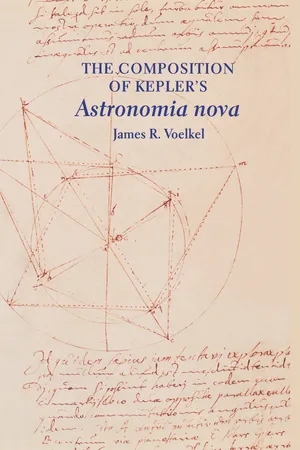
This is one of the most important studies in decades on Johannes Kepler, among the towering figures in the history of astronomy. Drawing extensively on Kepler's correspondence and manuscripts, James Voelkel reveals that the strikingly unusual style of Kepler's magnum opus, Astronomia nova (1609), has been traditionally misinterpreted. Kepler laid forth the first two of his three laws of planetary motion in this work. Instead of a straightforward presentation of his results, however, he led readers on a wild goose chase, recounting the many errors and false starts he had experienced. This had long been deemed a ''confessional'' mirror of the daunting technical obstacles Kepler faced. As Voelkel amply demonstrates, it is not.
Voelkel argues that Kepler's style can be understood only in the context of the circumstances in which the book was written. Starting with Kepler's earliest writings, he traces the development of the astronomer's ideas of how the planets were moved by a force from the sun and how this could be expressed mathematically. And he shows how Kepler's once broader research program was diverted to a detailed examination of the motion of Mars. Above all, Voelkel shows that Kepler was well aware of the harsh reception his work would receive--both from Tycho Brahe's heirs and from contemporary astronomers; and how this led him to an avowedly rhetorical pseudo-historical presentation of his results. In treating Kepler at last as a figure in time and not as independent of it, this work will be welcomed by historians of science, astronomers, and historians.
- 332 pages
- English
- PDF
- Available on iOS & Android
eBook - PDF
The Composition of Kepler's Astronomia nova
About this book
Information
Table of contents
- Cover Page
- Half-title Page
- Title Page
- Copyright Page
- Dedication Page
- Contents
- List of Illustrations
- Acknowledgments
- Preface
- Introduction
- Part 1: The Mysterium Cosmographicum
- Part 2: The Astronomia Nova
- Conclusion
- Notes
- Bibliography
- Index
- Index of Correspondence
Trusted by 375,005 students
Access to over 1.5 million titles for a fair monthly price.
Study more efficiently using our study tools.
Frequently asked questions
Yes, you can cancel anytime from the Subscription tab in your account settings on the Perlego website. Your subscription will stay active until the end of your current billing period. Learn how to cancel your subscription
No, books cannot be downloaded as external files, such as PDFs, for use outside of Perlego. However, you can download books within the Perlego app for offline reading on mobile or tablet. Learn how to download books offline
Perlego offers two plans: Essential and Complete
- Essential is ideal for learners and professionals who enjoy exploring a wide range of subjects. Access the Essential Library with 800,000+ trusted titles and best-sellers across business, personal growth, and the humanities. Includes unlimited reading time and Standard Read Aloud voice.
- Complete: Perfect for advanced learners and researchers needing full, unrestricted access. Unlock 1.5M+ books across hundreds of subjects, including academic and specialized titles. The Complete Plan also includes advanced features like Premium Read Aloud and Research Assistant.
We are an online textbook subscription service, where you can get access to an entire online library for less than the price of a single book per month. With over 1.5 million books across 990+ topics, we’ve got you covered! Learn about our mission
Look out for the read-aloud symbol on your next book to see if you can listen to it. The read-aloud tool reads text aloud for you, highlighting the text as it is being read. You can pause it, speed it up and slow it down. Learn more about Read Aloud
Yes! You can use the Perlego app on both iOS and Android devices to read anytime, anywhere — even offline. Perfect for commutes or when you’re on the go.
Please note we cannot support devices running on iOS 13 and Android 7 or earlier. Learn more about using the app
Please note we cannot support devices running on iOS 13 and Android 7 or earlier. Learn more about using the app
Yes, you can access The Composition of Kepler's Astronomia nova by James R. Voelkel in PDF and/or ePUB format, as well as other popular books in History & Science History. We have over 1.5 million books available in our catalogue for you to explore.