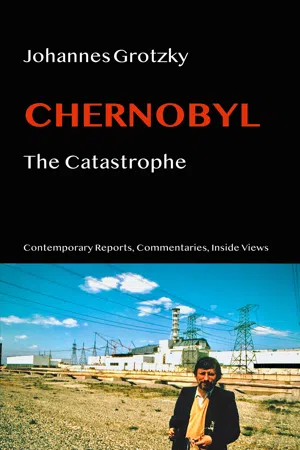
Everything that was published years after the Chernobyl catastrophe could refer to a great deal of substantial material and facts in retrospect. But during the catastrophe, the reporting was partly characterized by ignorance, a lack of facts and the undermining of information, by speculations, fears and rumors. And that is exactly what this book is about: day by day reports as things were happening, the struggle for information, the development of glasnost in the Soviet media and a look back from today´s perspective. Overall, this book is a small contribution to the realistic handling of journalism in crises at a time when there was neither the internet, nor mobile phones, nor e-mails or satellite television. And even free telephone connections were not allowed for Western correspondents in the Soviet Union.
- 184 pages
- English
- ePUB (mobile friendly)
- Available on iOS & Android
eBook - ePub
About this book
Information
THE YEAR 1986
April 29, 1986
IN THE PRESS – NOT A WORD
The reports from the disaster area are sparse. Some correspondents have been able to telephone with the Ukrainian capital Kiev, which is about 80 miles south of Chernobyl.
According to this information, there is no exceptional situation in Kiev. The city seems to be quiet. It is said that there is no evidence of evacuation measures. Foreign embassies in Moscow have also received similar information.
On the outskirts of Kiev, the staff of a German company is working, which has contacted the Moscow Foreign Ministry via the German embassy in order to obtain possible rules of conduct in the event of a disaster. A reaction from the Foreign Ministry in Moscow is not yet available.
The Soviet press does not report the accident today with a single line.
The short, only four-line message of the Soviet agency TASS has not yet been reprinted anywhere. Also, the Soviet radio news – as far as one can tell – has not yet dealt with the disaster.
Only one year ago the Soviet Union signed an agreement with the International Atomic Energy Agency in Vienna. Since then, Soviet nuclear power plants may be inspected by commissions from other countries. For the first time, following this agreement, an international commission of experts travelled to Moscow to inspect two nuclear power plants near the Soviet capital. The Soviet Union had already entered into an obligation to report disturbances at facilities – whether civil or military – when it joined the International Atomic Energy Agency.
The Soviet media's reluctance to respond to disasters in their own country is typical. In most cases, only events such as earthquakes or major environmental pollution are reported that are already identifiable by international measurements. On the other hand, there are usually no reports about air or train accidents within the Soviet Union.
In the case of real natural disasters, however, reports in recent years have increasingly come from the crisis region within the Soviet Union. However, accidents in Western countries – anything from a hotel fire to a train collision – are usually reported in the Soviet news.
April 30, 1986
THE SILENCE CONTINUES
The news of deaths and injuries, of radioactive contamination and evacuation of the population is not top news in the Soviet Union.
The evening television program praised the new fashion line with lyrical breadth. A new diesel-powered truck model also took precedence, not to mention a new electricity link between the socialist brother countries and the usual reports of successful field work.
Only then did the speaker's face darken to announce the new version from the Council of Ministers about the accident. The world has not become wiser as a result.
When and to what extent what happened remains a secret: the cause of the accident, the amount of radioactivity leaked, the number of injured and evacuees. Accuracy in this case is not a matter of Soviet information.
But the concession that there have been two deaths already has a shock effect on Soviet citizens, regardless of whether there may have been several more deaths. The very term "dead" in a disaster in one's own country is unusual and therefore frightening enough.
Two young Muscovites, in their early twenties, commented on the fact that the radioactive cloud had also spread over other countries and that the Soviet Union admitted the disaster only with delay and under international pressure:
"Typically, what happens in our country is always the last thing we learn ourselves."
So far, Soviet citizens have not learned anything about the contacts of Soviet diplomats and scientists with experts from abroad. Whether requests for help have really been made and foreign specialists will have access to the scene of the accident cannot be confirmed from Moscow.
How differently did the Soviet media behave during the accident at the American nuclear power plant at Three Mile Island near Harrisburg, PA.33 From the very beginning, there were reports and comments in detail. The conclusion: Catastrophes in capitalist foreign countries are always good to show what a dying branch the class enemy is sitting on.
33 Three Mile Island is known for having been the site of the most significant accident in US commercial nuclear energy, on March 28, 1979, when 2 suffered a partial meltdown.
April 30, 1986
DECEPTION
Almost three years ago a South Korean jumbo jet had been shot down by Soviet fighter planes. Moscow insisted for a week on this version:
An unknown aircraft had penetrated Soviet airspace and then disappeared towards the Sea of Japan.
When the shooting was finally admitted, a Kremlin spokesman rebuked protesting Western journalists in a press conference:
"Please don't accuse official authorities in Moscow of having lied before. If you do so," the argument goes, "you don't understand our political language properly."
Indeed, the Kremlin's news policy did not lie at the time. But they did not tell the truth either. And this is precisely where the dilemma of Soviet information policy lies.
If an airplane disappears, then we cannot rule out the possibility that it has been shot down. Or, in relation to the current case: If – as we are told in fine linguistic detail - two people died during the accident at the Chernobyl nuclear power plant, then further radiation victims are not unthinkable.
Dealing with Soviet information teaches us to play with a logic that is different by Western standards.
In the event of disasters in the Soviet Union, one must always look for things that have not been mentioned or denied.
The public statements by party and government, supposed to have such a calming and non-binding effect on the outside, trigger only rumors, dismay and additional false information.
Whoever relies on the Russian babushka from the countryside, who crosses herself three times and has seen dozens of dead in a traffic accident, where in reality only a donkey cart collided with a bike – in view of such information deficits – is just as badly advised as by some news presentation from Pravda.
In a disaster like Chernobyl, however, all ironic remarks must be banned. It is not only a sign of recklessness, but also of an unusual cynicism that the world’s public is put off with the thin claim that there have been some outflows of radioactive substances; and further on, the either meaningless or revealing claim that the radioactive situation has stabilized.
If, with a measurably increased radioactivity in the air in several countries hundreds of miles away from the scene of the accident, the perpetrator does not have the courage to tell the truth, he loses his credibility.
Gorbachev's slogan glasnost – openness – still is ringing in people’s ears: All things in public life – the party leader has promised and demanded – must be treated with relentless openness. His offers on disarmament measures and their international controls will now be determined on this one point: If the Soviet Union does not have the courage to accept this self-proclaimed openness in the event of a civil disaster, how will it proceed in the military arena?
The standard that is now being applied cannot be strict enough. Chernobyl is not somewhere in Eastern Siberia, far away from other national borders. Chernobyl is no longer an internal affair of the Soviet Union. Nobody in Moscow should really want to talk his way out of the often-attempted slogan of non-interference. Chernobyl lies – to put it in a nutshell – in the middle of Europe and is no further from Vienna than the French capital Paris.
The Soviet Union has always had to accept criticism of its information policy. In contrast, it has often relied on its well-coordinated propaganda machine and did not rule out further misleading information.
With media-effective appearances by an agile party leader, with open press conferences and self-criticism, a start was made that gave many hope for improvement.
These hopes are destroyed with such wrong decisions, which already now prevent the clearing-up of Chernobyl for days.
May 2, 1986
FIRST REACTIONS
A 40-year-old Muscovite only learned in conversation with foreigners that leaking radioactivity from Chernobyl had crossed the borders of the Soviet Union. Her reaction:
"My God, – and I thought it was just a local disaster!"
Many Soviet citizens are skeptical about their own media. But the absent news about Chernobyl did not cause panic or major rumors. On the contrary:
A limited accident, in which even the dead and wounded are admitted, is considered credible. The time and cause of catastrophes are usually kept secret by the state press for a long time anyway. Even the cautious information policy in the case of Chernobyl did not arouse excessive mistrust.
In addition, the Soviet public is not aware of any critical debate about nuclear energy. If there is any harmful use of nuclear power at all, so the propaganda tenor goes, then this is done by greedy monopolies in capitalist countries. An essay on deficiencies in nuclear power plants, as it had just been published in a Soviet magazine warning about Chernobyl before the accident, is one of the major exceptions.
The significance of a radioactive accident in a nuclear power plant is therefore less spectacular for most Soviet citizens than one of the frequent earthquakes in the Central Asian republics.
An exception, however, are those who listen to western radio stations: Informed via BBC London, the VoA (Voice of America) or DW (Deutsche Welle), such listeners occasionally turn to foreigners in Moscow for further information.
In this way, despite the May holidays, the first rumors seem to be spreading. A ward doctor in a Moscow infectious disease clinic urgently advised on request to wash or peel all fruit. "Preferably," said another man in Moscow, "one should inquire now at the markets whether goods from Ukraine are being sold."
At the end of last week, schoolchildren in Moscow had allegedly been asked to take great care in dealing with fruit because of the risk of rat poisoning. "But so far", according to medical experts, "there is no special information concerning health issues."
Now, even products from Poland can hardly be sold on Western markets because of the feared contamination. The reaction by a resigned Soviet citizen was: "Then, probably we will end up buying these things from Poland."
May 5, 1986
CRITICISM OF THE WEST
On Soviet television, the Moscow engineer F. A. Shvets described his reaction to Western depictions of the Chernobyl nuclear power plant accident as a "feeling of bitterness". He compared the accident with the Challenger disaster34, which caused mourning among the Soviet population; while the West in face of Chernobyl shows no sympathy, but judges on the principle of "the worse the better". Where the engineer got his detailed knowledge of Western media from, however, remained unclear.
The only witnesses of a so called exaggerated fear campaign in the West were British tourists; they had complained in the main Soviet television news program that they were being persuaded to return home from the Soviet Union because of horror reports in Britain of a nuclear catastrophe.
British guest scientists, who were recalled from Kiev, were outraged, speaking to Soviet journalists, that they had been forced to have their clothes checked for radioactivity before departure and to exchange them for sport suits. When the flight director of the British plane then banned the Soviet camera team from entering the plane and even interrupted the interviews, the otherwise rather monotonous TV news program Vremya had its scandal.
"Even these foreigners," interpreted the retiree A. G. Kaplyug the following day on television the statements of the British scientists, "understand as well as we do that the Western attitude to Chernobyl is pure provocation". The controlled popular anger in the media, however, is countered by the astonishing indifference of many Soviet citizens. They are often skeptical about their own media. But the sparse news flow of the first week has caused neither panic nor major rumors. On the contrary.
Such a limited industrial accident is all the more credible among Soviet citizens, because even officially dead and wounded were reported. Moreover, the reassuring affirmations that a state commission with experts had been set up freed many Soviet citizens – accustomed to authority – from ...
Table of contents
- About the author
- Table of Contents
- WHY THIS BOOK?
- CHRONOLOGY OF THE DISASTER
- BURDENS FOR THE FUTURE
- HOW IT ALL BEGAN
- THE YEAR 1986
- THE YEAR 1987
- THE YEAR 1988
- THE YEAR 1989
- 30 YEARS LATER – LOOKING BACK
- POSTSCRIPT
- Copyright
Trusted by 375,005 students
Access to over 1.5 million titles for a fair monthly price.
Study more efficiently using our study tools.
Frequently asked questions
Yes, you can cancel anytime from the Subscription tab in your account settings on the Perlego website. Your subscription will stay active until the end of your current billing period. Learn how to cancel your subscription
No, books cannot be downloaded as external files, such as PDFs, for use outside of Perlego. However, you can download books within the Perlego app for offline reading on mobile or tablet. Learn how to download books offline
Perlego offers two plans: Essential and Complete
- Essential is ideal for learners and professionals who enjoy exploring a wide range of subjects. Access the Essential Library with 800,000+ trusted titles and best-sellers across business, personal growth, and the humanities. Includes unlimited reading time and Standard Read Aloud voice.
- Complete: Perfect for advanced learners and researchers needing full, unrestricted access. Unlock 1.5M+ books across hundreds of subjects, including academic and specialized titles. The Complete Plan also includes advanced features like Premium Read Aloud and Research Assistant.
We are an online textbook subscription service, where you can get access to an entire online library for less than the price of a single book per month. With over 1.5 million books across 990+ topics, we’ve got you covered! Learn about our mission
Look out for the read-aloud symbol on your next book to see if you can listen to it. The read-aloud tool reads text aloud for you, highlighting the text as it is being read. You can pause it, speed it up and slow it down. Learn more about Read Aloud
Yes! You can use the Perlego app on both iOS and Android devices to read anytime, anywhere — even offline. Perfect for commutes or when you’re on the go.
Please note we cannot support devices running on iOS 13 and Android 7 or earlier. Learn more about using the app
Please note we cannot support devices running on iOS 13 and Android 7 or earlier. Learn more about using the app
Yes, you can access Chernobyl by Johannes Grotzky in PDF and/or ePUB format, as well as other popular books in Politics & International Relations & Politics. We have over 1.5 million books available in our catalogue for you to explore.