In 1835 a renegade group of Tasmanians wishing to expand their landholdings disembarked in what was to become Melbourne. This colonising expedition was funded by a group of investors including the Jewish emancipist Joseph Solomon. Thus, in Melbourne, as in the settlement of the continent itself, Jews were at the foundation of colonisation. Unlike many other settlers, these Jews predominantly came from urban backgrounds. Although principally from London, some of them had experienced other forms of Jewish urbanism—in central and eastern Europe, the Ottoman Empire and the Caribbean—and applied their experience to the formation of a new emancipated conceptualisation of urban Judaism.In Victoria, as in the other new Australian colonies, there were no civil or political restrictions on the Jewish community. With the establishment of Melbourne, Jewish settlers were required to create new communal frameworks and the religious bodies of an active Jewish life. The community's structure and the institutions they founded were a pragmatic response to the necessities of communal formation and the realities of maintaining Judaism within this colonial outpost.As with other Jewish communities in the large centres of the world, they responded to the freedoms of an emancipated society, while the political and social environment of a new city such as Melbourne provided a unique set of opportunities. Unlike in other cities where Jewish property ownership was restricted, here Jews could live and work where they chose, becoming, from the first land sales, investors in property. Subsequently as the city expanded, as developers and builders they influenced the formation of the urban fabric, while their intellectual and economic connections brought new political and intellectual ideas and networks to the colonial experience.
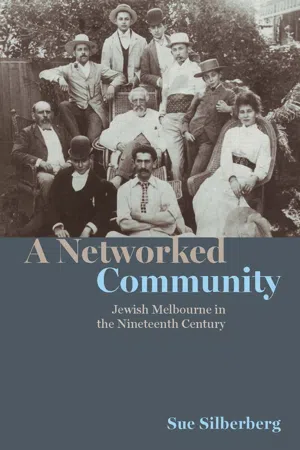
- 256 pages
- English
- ePUB (mobile friendly)
- Available on iOS & Android
eBook - ePub
About this book
Trusted by 375,005 students
Access to over 1.5 million titles for a fair monthly price.
Study more efficiently using our study tools.
Information
Chapter 1
Jewish Space and Place
To celebrate the Duke of Edinburgh’s visit to Victoria in 1867, a grand (male only) levée was held in the Exhibition Building, ‘such a one as has never been seen in the colony before. All who desired to honour the Prince as we have honoured none who have yet stood on Victorian shores, passed before him yesterday’.1 Given equal entrée with the major dignitaries including senior parliamentarians, judges and the heads of the diverse Christian churches was ‘the Head of the Hebrew Congregation’.2 The formalities of the event included the presentation by religious and cultural organisations of forty-three addresses to the Prince, including those of the Melbourne and East Melbourne Hebrew Congregations, both of which expressed their loyalty and attachment to the Sovereign. The Argus published less than half of these, but significantly reported those of the two synagogues in third and fourth place in their list, behind the Anglicans and Presbyterians and before the Wesleyans and Congregational Churches (there was no listing of any Catholic address).
Included in the ‘general presentations’ at the levée were sixty or seventy members of the Melbourne Jewish community, including the rabbinical leaders of both Melbourne synagogues, five men who were or would become members of the Victorian Parliament and a cross-section of the Jewish community, from the sons of convicts to members of some of the wealthiest Jewish families in Britain. Two weeks later in Ballarat, Prussian-born Emanuel Steinfeld hosted the Prince in his capacity as mayor of East Ballarat. In return the Prince presented a silver claret jug to Steinfeld, commissioned from the Victorian goldsmith William Edwards and marked ‘by appointment to His Royal Highness’. Those attending these events had been born in England, Scotland, Germany, Poland, Russia, the United States, Jamaica and Gibraltar. Ashkenazi and Sephardi, they represented the social and cultural diversity of the local Jewish community. Social acceptance, both as Jews and as members of a ‘respectable class’, was markedly different from that which many of these individuals would have expected in their place of birth, but significantly reflects the sense of place that this small community had forged in Melbourne.
The mid nineteenth century saw the culmination of the assertion of rights and emancipatory processes concurrently taking place in many parts of the Jewish world. Those settling in Melbourne brought with them their knowledge of this struggle and their encounters or otherwise in emancipated societies. Jews in Melbourne did not suffer from formal exclusion or restriction and the community endured limited anti-Semitism. These conditions coalesced to create opportunities in a new colony, providing for engaged forms of intellectual, political and physical space.
No place has a fixed identity. Invasions, migration (both forced and voluntary), changes to national boundaries and other geopolitical upheavals influence and create identity and these are reinforced through evolving traditions, cultures and language. A consequence of the complex history of Jewish migration has been the formation of local identities shaped by the internal and external connections maintained across time and place.3 Migration creates a reciprocal process. For minority communities, adaptation to their new home results in varying levels of assimilation and acculturation; while for the host society, national identity is subtly changed by the presence of resettled and minority communities.4
Jewish self-consciousness has centred on ‘exile’, both as a physical and a geopolitical identity. Exile created a diaspora, a spatial reality identified with a lack of space, a loss of space and a loss of control over space.5 This was an exile in which Jews were politically and socially inferior, lacking sovereignty over land, disconnected in time and place. ‘My heart is in the East [Jerusalem], my body in the extreme West [Spain].’ Thus Judah Halevi described a ‘space of the heart, a space of the body, and in between them a void’.6
This is not just a sociopolitical existence, but also a religious one. From a Christian perspective the Jewish lack of a homeland was closely connected to concepts of Christian redemption and the relationship to the divine.7 A Jewish diaspora has existed for millennia and Jews have been characterised by their high degree of mobility and as a globalised community, reflecting the experience and settlement patterns encountered and adapted through this journey. This has also led to the loss of space, both through destruction and abandonment and from an intellectual perspective, compounded by a focus on ‘anti-spatial’ issues: religion, history and language.8
Current thinking challenges this perception, considering the peripatetic nature of the community as a more complex experience. This can be seen as a duality in the understanding of space, that of the physical location and that of spaces of reference, combining to create a Jewish spatial experience. Jews have traditionally not been constrained to the nation in which they resided; rather they responded (or were forced to respond) to the legal frameworks, expulsions, changes in economic conditions and at times riots and massacres that were encountered, hoping to find new opportunities in other areas.9 This experience was transnational and multi-rooted, uninterested in the borders between political entities and identifying space through emotional, familial, cultural or economic constructs.10 Thus, as Jews considered history outside the Christian linear progression towards Grace, so too was their connection to a particular location understood from a fundamentally different perspective.
Anglo and Australian Jewish history is that of communities epitomised by global and local connections. While their Jewish identity and communal affiliation have not followed a single format of observance or social and political interactions, these have been framed by emancipation, historical experience and determined by particular concepts of space and identification with place.
Intellectual Space, Religious Space
The land of Israel and Jerusalem in particular are the historical and metaphysical centre of Judaism. This is a perception of space that has fundamentally shaped Jewish practice and Jewish thinking, and provided an opportunity for a collective memory of shared ‘thought and remembrance formed and maintained there through the ages’.11 Space was of fundamental importance to ancient Jewish life, represented in the symbolism of the structure and layout of the Temple in Jerusalem and its hierarchy of religious significance.12 This spatial imperative was transferred through the rabbinic interpretations of the Talmud into abstract and symbolic representations in religious practice and religious ritual. Space becomes a physical expression of religious practices, reflected in the built form in permanent structures such as synagogues, in theoretical forms such as the eruv or in the more ephemeral, in the Sukkah, built and demolished annually for the festival of Sukkot.
Whereas traditional notions of space focus on a specific location, ritual and religious spaces create a symbolic place of belonging. Synagogues are both emblematic and physical spaces, defined by their liturgical function, providing meaning and memory for the participant: ‘religion is expressed in symbolic forms that unfold and cohere in space. This condition alone guarantees its continued existence.’13 Synagogues and synagogue architecture have been public manifestations of Jewish identity. Prior to emancipation, synagogues were characteristically small places for Jews to gather, providing space for study and worship, to meet socially and to conduct community business. These tended to be discrete from the outside, but could contain lavish interiors. Post-emancipation, throughout Europe, Britain and the New World, synagogues reflected a confident public style. Presented as monuments to emancipation, a public articulation of the new ‘spirit of Judaism’, these buildings were designed to present the Jewish community as an integrated presence in the nation.
Places of remembrance also have a duality in Jewish thinking. Traditionally these have been considered places of destruction, while the core of Judaism itself forms a site of memory, delivered through the liturgical calendar and the Talmud, delivering ‘the Mobius strip of the collective and the individual, the sacred and the profane’.14 Places of remembrance and destruction are particularly poignant for Jewish communities, reinforcing the image of placelessness and the metaphor of the Wandering Jew. Places of memory exist as the real places are lost.15 These are often spaces of postwar experience, death camps, Holocaust memorials and extinct ghettos.
Remembered space can pertain to Jewish themes that are superimposed and defined by non-Jewish agents, creating a nostalgic ‘constructed cultural space’ and a homogenous community identity.16 Lost Jewish space can also become a major tourist attractor, as has happened in Prague, where the once thriving Jewish community has been reduced from a pre-war population of 96,000 to 1600, but where the Jewish quarter of Prague is now marketed as a major cultural attraction with synagogue tours, vi...
Table of contents
- Cover
- Title
- Copyright
- Contents
- Introduction
- Chapter 1 Jewish Space and Place
- Chapter 2 Jewish Identity in a New Land
- Chapter 3 Family Identity
- Chapter 4 Migration and Connection
- Chapter 5 Building a City
- Chapter 6 In Public Life
- Glossary
- Bibliography
- Index
Frequently asked questions
Yes, you can cancel anytime from the Subscription tab in your account settings on the Perlego website. Your subscription will stay active until the end of your current billing period. Learn how to cancel your subscription
No, books cannot be downloaded as external files, such as PDFs, for use outside of Perlego. However, you can download books within the Perlego app for offline reading on mobile or tablet. Learn how to download books offline
Perlego offers two plans: Essential and Complete
- Essential is ideal for learners and professionals who enjoy exploring a wide range of subjects. Access the Essential Library with 800,000+ trusted titles and best-sellers across business, personal growth, and the humanities. Includes unlimited reading time and Standard Read Aloud voice.
- Complete: Perfect for advanced learners and researchers needing full, unrestricted access. Unlock 1.5M+ books across hundreds of subjects, including academic and specialized titles. The Complete Plan also includes advanced features like Premium Read Aloud and Research Assistant.
We are an online textbook subscription service, where you can get access to an entire online library for less than the price of a single book per month. With over 1.5 million books across 990+ topics, we’ve got you covered! Learn about our mission
Look out for the read-aloud symbol on your next book to see if you can listen to it. The read-aloud tool reads text aloud for you, highlighting the text as it is being read. You can pause it, speed it up and slow it down. Learn more about Read Aloud
Yes! You can use the Perlego app on both iOS and Android devices to read anytime, anywhere — even offline. Perfect for commutes or when you’re on the go.
Please note we cannot support devices running on iOS 13 and Android 7 or earlier. Learn more about using the app
Please note we cannot support devices running on iOS 13 and Android 7 or earlier. Learn more about using the app
Yes, you can access A Networked Community by Sue Silberberg in PDF and/or ePUB format, as well as other popular books in History & Australian & Oceanian History. We have over 1.5 million books available in our catalogue for you to explore.