The aggressive exploitation of labor on both sides of the US-Mexico border has become a prominent feature of capitalism in North America. Kids in cages, violent ICE raids, and anti-immigrant racist rhetoric characterize our political reality and are everyday shaping how people intersect at the US-Mexico border. As activist-scholar Justin Akers Chacón carefully demonstrates, however, this vicious model of capitalist transnationalization has also created its own grave-diggers.
Contemporary North American capitalism relies heavily on an inter-connected working class which extends across the border. Cross-border production and supply chains, logistics networks, and retail and service firms have aligned and fused a growing number of workers into one common class, whether they live in the US or Mexico. While money moves without restriction, the movement of displaced migrant workers across borders is restricted and punished. Transborder people face walls, armed agents, detention camps, and a growing regime of repressive laws that criminalize them. Despite the growth and violence of the police state dedicated to the repression of transborder populations—the migra-state—migrant workers have been at the forefront of class struggle in the United States.
This timely book persuasively argues that labor and migrant solidarity movements are already showing how and why, in order to fight for justice and re-build the international union movement, we must open the border.
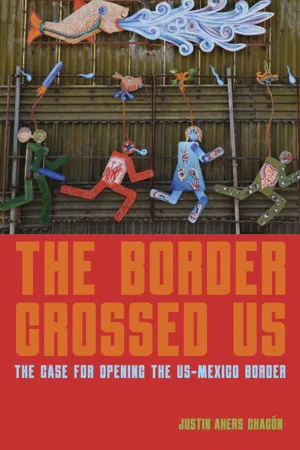
eBook - ePub
The Border Crossed Us
The Case for Opening the US-Mexico Border
- 150 pages
- English
- ePUB (mobile friendly)
- Available on iOS & Android
eBook - ePub
The Border Crossed Us
The Case for Opening the US-Mexico Border
About this book
Information
Topic
Ciencias socialesPART I
Opening Borders in Response
to Capitalist Crisis
to Capitalist Crisis
A major effort of US policy toward Latin America should be to point up the merits of and assist these countries to develop a reliance on private enterprise and the process of private investment decision-making.
— Congressional Report on Inter-American Economic
Relationships of the Joint Economic Committee
of the Congress of the United States, 1962
Relationships of the Joint Economic Committee
of the Congress of the United States, 1962
ONE
The Colonial Origins of Free Trade
The construction of the capitalist economy of the United States occurred through colonialist methods. These include the pilfering and exploitation of Indigenous lands and violent removal of the people, racialized slavery and regimented labor migration, and the repopulation of stolen lands through exclusive citizenship policies and settler colonialism.
Indigenous nations were denied inclusion and forcibly displaced, eliminated, or concentrated into territorial prison camps. Their brutal and systematic dispossession from the land over the course of nearly two hundred and fifty years opened the path to privatization, commoditization, and, ultimately, capitalism. The consolidating ruling classes were sure to disqualify them from citizenship and any form of basic right or legal recognition, and with that, they precluded any means to resist the process of genocidal displacement through the colonizer’s legislative or judicial systems.1 The long process of physical elimination and forced removal and relocation has since passed to one of systematic under-development through the reservation system and cultural genocide through aggressive assimilation and historical erasure from the national imagination.2
Enslaved Africans were denied access to citizenship—and humanity— so that the value of their labor could be savagely extracted. For more than one hundred and fifty years, enslaved labor was multiplied throughout an expanding agricultural sector and factored into the supply chains of capitalist industrialization.3 Along with the stolen land of the original inhabitants, their stolen labor brought together the key elements of what Karl Marx described as the original accumulation of wealth that lay the basis for the rise of US capitalism. As he explained in Capital,
The discovery of gold and silver in America, the extirpation, enslavement and entombment in mines of the aboriginal population, the beginning of the conquest and looting of the East Indies, the turning of Africa into a warren for the commercial hunting of black-skins, signalized the rosy dawn of the era of capitalist production. These idyllic proceedings are the chief moments of [original] accumulation. On their heels treads the commercial war of the European nations, with the globe for a theatre.4
The march of capitalism included the conquest and colonization of the northern territories of Mexico in 1848, after an invasion and occupation by US slaveholding settlers beginning in 1835.5 Colonial expansion continued into the Caribbean and Asia, with the occupation and forcible acquisition of Puerto Rico, Cuba, Philippines, Hawai’i, Samoa, Guam, and Wake Island between 1890 and 1903.6
By the end of the nineteenth century, following a period of rapid industrialization, unprecedented capital accumulation and concentration, and the legal foundation of the rights of capital to perpetually expand through incorporation and national mobility, a qualitatively different character emerged within the capitalist class. This marked the arrival of monopoly capitalism—the process that eclipsed competitive capitalism through the aggregation and consolidation of large capital and firms that came to dominate and control national and colonial markets. Monopoly capitalism also coincides with the growing preponderance of capital and its impact on political structures, through which various representative agents of the rising class learned to exercise greater influence over the state and military and utilize them as instruments for further advances internationally.
Expansion was initially driven by the need for capitalist producers to export their excess agricultural and manufactured goods. Eventually, the scale of accumulated surplus capital outgrew the potentiality for profit from within national boundaries. This compelled them to look beyond their own borders to export their capital investments in order to find new and ever more sources of profit.7
The rise of the United States as a regional and then international power through the buildup and deployment of unrivaled military capacity, capital export, and market dominance facilitated the unprecedented transfer of wealth from a growing list of formerly colonized nations into the US and the hands of private, state-connected banks and other incipient multinational firms. This process positioned sections of monopoly capital to acquire such unprecedented infusions of wealth through the nodes of military imperialism that a further transfiguration in class organization was catalyzed in the articulation of finance capitalism.
Finance capitalism refers to the orientation of a distinct class of super-wealthy investors (now explicitly international in outlook), who sought to open markets on a global scale to freely move and invest their amassed stores of capital. Alongside military imperialism, “free trade” emerged as the mantra of finance capitalism—the fundamental notion that the rights of capital supersede all others. It is against this historical backdrop that concurrently expanding capitalist nations began to come into direct competition and conflict over whose capital gets to enjoy the fullest extent of free trade.
Military invasion, interventionism, and occupation paved the way for the imposition of free-trade policy and the subsequent freedom of movement across borders to freely engage in different economic activities to extract surplus value from the labor processes of conquered or subjugated nations. In this trajectory, capital mobility necessarily creates conflict among international rivals, domestic capitalists in the receiving nations, and the working classes whose labor and natural resources it seeks to exploit. Within the imperialist system, the dominant capitalist classes sought to open foreign markets only to then dominate them for themselves. As Rudolph Hilferding described in 1910,
It is the largest banks and the largest branches of industry which succeed in obtaining for themselves the best conditions for the valorization of their capital in foreign markets, and acquire the rich extra profits in which lesser capitals cannot even dream of participating.
The policy of finance capital has three objectives: (1) to establish the largest possible economic territory; (2) to close this territory to foreign competition by a wall of protective tariffs; and consequently (3) to reserve it as an area of exploitation [for itself].8
In the early twentieth century, Vladimir Lenin observed and described the emergence of imperialism as a stage of capitalism transcending traditional colonialism as a means for capital accumulation on an international scale. The emergence of finance capital and the advent of modern capitalist imperialism marked an evolutionary step in the operational behavior of the capitalist state. The dominant capitalist classes reduced the ranks of their competitors and formed into financial oligarchies, monopolized national markets, forced open markets on a regional level through military intervention and disproportionate economic leverage, and then set out to project this model of control and dominance internationally. By the second decade of the twentieth century, rival and competing centers of world capitalism had gone to war to contest and redivide control over conquered global markets.
The Making of Free Markets
By seeking out new markets for capital export, these dominant capitalist classes ran up against a closed colonial system in which subject nations were already seized by rival capitalist powers to facilitate their own capital export. Gaining access to new markets already enclosed within the existing division of colonies and spheres of influence, specifically to invest in the exploitation of labor, land, and natural resources, necessitated a military buildup. Conflict, war, revolutions, and counterrevolutions became characteristic of the process of redividing the globe and reordering the hierarchy of international capitalism.
The conception, pursuit, and sanctification of US-directed free-trade began under the moniker of the “Open-Door Policy,” by forcing open national economies (as existing colonies, semicolonies, or independent nations) so that US capital could be exported, invested, and expanded.
Despite its original colonialist trajectory, by the turn of the twentieth century the US capitalist class had changed course. It opted for an aggressive form of imperialism, leveraging military power to open foreign national markets to facilitate capital export. Instead of increasing direct colonial holdings, the US Marines were sent in to forcibly impose “free-market” arrangements at gunpoint. Oppositional governments, social and political movements, and any other form of barrier were toppled; compliant regimes were installed and subsequently backed by US political and military power.
In the first three decades of the twentieth century, for example, US military forces invaded Puerto Rico, Cuba, Honduras, Nicaragua, Guatemala, Costa Rica, Mexico, Colombia, Panama, Haiti, and the Dominican Republic. Beyond Latin America, forces were also deployed to Russia, China, and Turkey. The threat of war was used against its imperialist rivals to compel them to share the spoils by giving its capitalists access to the markets within their own spheres of influence.9
Marine Corps major general Smedley Butler, the highest ranked and most decorated marine of his time, participated in the invasions to open Latin American economies. He later lamented his role and criticized the use of the military as an instrument to advance the interests of capitalists. In a speech he gave in 1933, he described his service in the following terms:
I spent thirty-three years and four months in active military service as a member of this country’s most agile military force, the Marine Corps. I served in all commissioned ranks from Second Lieutenant to Major-General. And during that period, I spent most of my time being a high-class muscle-man for Big Business, for Wall Street and for the Bankers. In short, I was a racketeer, a gangster for capitalism.10
Successive US governments built the empire and supplanted European states and rival capitalist classes across Latin America and into Asia. This model of imperial free-trade policy became based on the US maintaining its economic primacy through imposed free-trade regimes backed by disproportionate and asymmetric military might. This imperial model enabled the US state to reorder the global economy by the end of World War II and work to gradually undermine existing systems of national development outside its control. The exploitation of labor was central to the process of capitalist expansion.
Imperialism and Reserve Armies of Labor
The exploitation of captive and enslaved labor was a primary factor in original capitalist accumulation and the building of the economy. Further expansion necessitated subsequent infusion of new groups of workers from beyond existing national boundaries, so the state enticed migration. Building on the colonial framework, racial and ethnic exclusions were built into the first definition of citizenship in the Naturalization Act of 1790. The state prohibited colonized and enslaved Indigenous and African peoples from accessing citizenship, initiating a system of state labor regulation that determined citizenship rights within the constructs of racialized capitalism and colonialism.
Building on the construction of disempowered systems of slave and captive labor, English colonial and then United States immigration policy was invented and implemented within this framework. As a result, immigration policy was crafted at each phase of capitalist development based on legal frameworks that excluded, subdivided, and hierarchized migrant workers along racial and national lines. This was reflective of original colonial policy, excluding basic rights and citizenship to African and Indigenous peoples, and its integral effect in creating permanent patterns of segregation and social marginalization. Immigration has policy formed within this mold and has further progressed in tandem with cycles of capitalist development.
Furthermore, evolving immigration policies have been developed in conjunction with the specific episodes and characteristics of global colonial and imperial expansion that have fueled waves of displacement and out-migration into the present. The colonization of Puerto Rico and the Philippines and the opening of China (US Open-Door Policy), for example, further added racialized subjects to this colonial framework. This colonial immigration model has been fine-tuned to undergird all of the phases of capitalist expansion, providing a lever for capitalists to increase the exploitation of a stratified workforce. Racism and xenophobia are therefore normalized as an ideological means to undermine class unity and to socially legitimize and reproduce class divisions. Within labor markets, bosses and contractors quickly learned that they could pay migrant workers of color less, make them work harder, and fire or replace them more easily. This became a widely employed method for increasing the rate of capital accumulation throughout US history.11 Workers from the colonies, from Puerto Rico to the Philippines, began to move into the US through the circuits of capitalism and within the framework of regulated colonial citizenship.12 This was followed by further elaboration and formalization with succeeding waves of labor immigration from other parts of the world.
The practice continued throughout the imperialist phase of expansion, where the state systematized racially and nationally regulated labor importation projects in dialectical rhythm with economic growth and the internationalization of capital export. As imperialist expansion facilitated the transfer of wealth from colonized and semicolonized countries back to the rich nations, so too did economically displaced people move in the directions of these economic links and capital and profit flows. For instance, Mexicans were already incorporated into the US as racially restricted laborers after colonial occupation in 1848, but a much larger population of migrants began to cross the border in the first three decades of the twentieth century. Between 1900 and 1930, over one and half milli...
Table of contents
- Cover
- Copyright
- Contents
- Introduction: The Bordering of Capitalism
- Part I: Opening Borders in Response to Capitalist Crisis
- Part II: The Transnational Working Class
- Part III: Immigrant Workers: Unionization vs. Criminalization
- Part IV: Opening the Border through Class Struggle and Solidarity
- Acknowledgments
- Notes
- Index
- Back Cover
Trusted by 375,005 students
Access to over 1.5 million titles for a fair monthly price.
Study more efficiently using our study tools.
Frequently asked questions
Yes, you can cancel anytime from the Subscription tab in your account settings on the Perlego website. Your subscription will stay active until the end of your current billing period. Learn how to cancel your subscription
No, books cannot be downloaded as external files, such as PDFs, for use outside of Perlego. However, you can download books within the Perlego app for offline reading on mobile or tablet. Learn how to download books offline
Perlego offers two plans: Essential and Complete
- Essential is ideal for learners and professionals who enjoy exploring a wide range of subjects. Access the Essential Library with 800,000+ trusted titles and best-sellers across business, personal growth, and the humanities. Includes unlimited reading time and Standard Read Aloud voice.
- Complete: Perfect for advanced learners and researchers needing full, unrestricted access. Unlock 1.5M+ books across hundreds of subjects, including academic and specialized titles. The Complete Plan also includes advanced features like Premium Read Aloud and Research Assistant.
We are an online textbook subscription service, where you can get access to an entire online library for less than the price of a single book per month. With over 1.5 million books across 990+ topics, we’ve got you covered! Learn about our mission
Look out for the read-aloud symbol on your next book to see if you can listen to it. The read-aloud tool reads text aloud for you, highlighting the text as it is being read. You can pause it, speed it up and slow it down. Learn more about Read Aloud
Yes! You can use the Perlego app on both iOS and Android devices to read anytime, anywhere — even offline. Perfect for commutes or when you’re on the go.
Please note we cannot support devices running on iOS 13 and Android 7 or earlier. Learn more about using the app
Please note we cannot support devices running on iOS 13 and Android 7 or earlier. Learn more about using the app
Yes, you can access The Border Crossed Us by Justin Akers Chacón,Justin Akers-Chacón in PDF and/or ePUB format, as well as other popular books in Ciencias sociales & Relaciones laborales e industriales. We have over 1.5 million books available in our catalogue for you to explore.